
Review of Atul Gawande’s Being Mortal
The current medicine concentrates on extending the quality of life rather than focusing on the ways to evade the death prognosis. Atul Gawande’s “Being Mortal” critiques this approach through advocacy for an alternative approach that puts dignity, autonomy, and ensures quality of life, most importantly to the aging and the terminally ill patients (Stolarek, 2016). This paper delves into reviewing Gawande’s central arguments, outlines the areas that need further exploration, and sheds light on the implications for the health stakeholders and palliative care.
Author’s Center of Argument
To begin with, the author’s point of view is that medicine should cease from prolonging life and focus on improving the quality of life at all stages of life and illness. Gawande supports his point through findings from personal case studies, existing evidence from historical sources, and past personal experiences that demonstrate instances where medical interventions compromise the dignity and well-being of patients (Stolarek, 2016). He gives a personal experience where his father’s general health condition deteriorates in response to aggressive treatment (Stolarek, 2016). This instance portrays how modern medicine looks down on patients’ values and wishes. Gawande thinks patients should be involved in discussions revolving around their goals, often leading to more effective and humane care. By shifting the focus to palliative principles, Gawande’s (2014) book forms the background for reconsidering how patients, families, and providers navigate the terminal stages of life.
Topics Requiring Further Exploration
Despite the explorative ideas of the author, several other vital topics would be further explored. These include the cultural differences revolving around the views on end-of-life care, leaving out the full impact. In addition, the role of different disciplines such as the pharmaceuticals, mental health specialists, technological experts, and caregivers in geriatric care would be further explored (Stolarek, 2016). The shallow exploration of these two aspects yields a gap that needs to be bridged to increase the practicability and diversity of this book across numerous communities. This would have significantly improved its capability to critique modern medicine. Incorporating these sects in the book would give a holistic perception of palliative care to policymakers to help them develop more equitable and inclusive models of care.
Implications on Patients and Families
When it comes to dying, Gawande’s book encourages dying patients and their families to embrace mortality by fostering honest discussions and seeking care that aligns with personal values (Stolarek, 2016). The questions formed in these suggestions guide families and patients to make a value-based decision. These help transform passive patients into active agents of their treatment. Mental health and psychological satisfaction are attained when the care offered aligns with personal priorities rather than medical convention. Such conversations promote clarity and emotional preparedness, allowing both patients and families to focus on meaningful experiences rather than medical anxieties. When families understand a loved one’s vision of a “good day,” they become advocates for care that provides dignity and emotional closure. This can alleviate guilt, reduce conflict, and strengthen relationships during the final stages of life. That way, the therapeutic relationships are built on compassion.
Implications for Health Professionals
On the other hand, healthcare professionals are urged to improve their communication skills, improve empathy, and ethical discernment when attending to patients. Gawande advises that clinicians should listen more than they talk, allow patients to express themselves, and offer informed guidance through complex decisions. Clinicians are often conditioned to intervene and “save” rather than accept natural decline (Stolarek, 2016). This mindset can alienate patients and lead to decisions that conflict with their values. Healthcare systems also need to incentivize time spent on conversations, not just procedures, to realign care with patient goals. Transforming medical culture in this way can restore trust, improve end-of-life experiences, and reduce unnecessary interventions, benefiting both patient outcomes and provider well-being.
Implications for Institutions
An institutional geriatric model that prioritizes purpose, informed autonomy, and connection with patients is what Gawande has been advocating for. He brings on board the ideas like the Greenhouse Project and Eden Alternative, which faces out the ancient home nursing models and encourage small-scale environments that mimic a home. Such environments enable the patients to feel at home, preventing them from culture shock, enabling them to perform their daily routines, mingle and establish therapeutic and social relationships, and most importantly, make informed choices about their care (Stolarek, 2016). Such ideas nullify the notion that safety and autonomy are mutually exclusive. These ideas promote mental health by eliminating depression and improving patient satisfaction, hence achieving psychological well-being, which is an important aspect of human health. It is evident that if Gawande’s ideas are embraced and embedded in palliative and geriatric care, then positive transformation to empathetic, collaborative, and inclusive care is easily achievable. Summatively, this acts as a clarion call to the stakeholders to facilitate the implementation of these discoveries to upgrade the quality of care for the elderly. The implementation should be strategic and sustainable in preparation for a healthy aging population globally, in line with the Sustainable Development Goals.
Conclusion
“Being Mortal” by Atul Gawande is a sane idea that gives a clear guide on achieving improved quality of palliative care and decency during the last stages of life. His personal experiences, social and professional interventions, Gawade rationalizes his proposal for a bridge of the deficit in models of care that concentrates on extending life rather than improving its quality by ensuring dignity, purpose, and psychological satisfaction. From my point of view, the book superficially delved into cultural, industrial, and technological influences, as well as other systems. However, it was able to drive a transformative message into our minds. Implications cut across all the stakeholders at the individual, institutional, societal, and administrative levels. Holistic, not merely biological, model of palliative care improves the quality of life, and brings one to terms with death as a stage of human life instead of an outcome of failed treatment.
Reference
Gawande, A. (2014). Being mortal: Medicine and what matters in the end. Doubleday Canada.
Stolarek, I. (2016). Dr Atul Gawande on being mortal: Does it matter? Australasian Journal on Ageing, 35(1), 62–62. https://doi.org/10.1111/ajag.12309
ORDER A PLAGIARISM-FREE PAPER HERE
We’ll write everything from scratch
Question 
Review of Atul Gawande’s Being Mortal
review of Being Mortal by Atul Gawande.
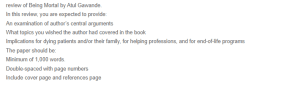
In this review, you are expected to provide:
Review of Atul Gawande’s Being Mortal
An examination of author’s central arguments
What topics you wished the author had covered in the book
Implications for dying patients and/or their family, for helping professions, and for end-of-life programs
The paper should be:
Minimum of 1,000 words.
Double-spaced with page numbers
Include cover page and references page