
Responses – Alterations in Cellular Processes
Responding to Ashton Engebretsen
Hello Ashton,
Great post! Your detailed exploration of anaphylactic shock in the context of the case study is both comprehensive and insightful, particularly your focus on the genetic mutation of alpha-tryptasemia and its role in predisposing individuals to severe allergic reactions. This connection adds a critical genetic dimension to the understanding of anaphylaxis, emphasizing the importance of personalized patient care.
To further enrich the discussion, I would suggest considering the emerging role of epigenetic factors in modulating the severity of allergic responses. Recent research indicates that environmental exposures can influence gene expression related to immune system hyperreactivity (Mijač et al., 2024). Could this interplay help explain variability in anaphylaxis severity among patients with similar genetic backgrounds?
Additionally, while you mentioned serum tryptase as a useful biomarker, exploring advances in point-of-care testing might provide quicker diagnostic support in emergency settings. How might rapid diagnostic tools transform APRN protocols for managing acute allergic reactions?
Your discussion lays a solid foundation, and integrating these dynamic biological and technological perspectives could further optimize patient outcomes. What are your thoughts on incorporating epigenetic screening or rapid biomarker assays into clinical practice for allergy management?
References
Mijač, S., Banić, I., Genc, A.-M., Lipej, M., & Turkalj, M. (2024). The Effects of Environmental Exposure on Epigenetic Modifications in Allergic Diseases. Medicina, 60(1), 110. https://doi.org/10.3390/medicina60010110
Responding to Chloe Gorgonio
Hello Chloe,
Great post! Your detailed explanation of anaphylaxis and the role of IgE in the hypersensitivity reaction effectively connects cellular processes with the patient’s symptoms. I especially appreciate your inclusion of genetic variations like IL4, IL13, and KIT, which are often overlooked in general discussions about anaphylaxis. One additional layer to consider is how epigenetic mechanisms may also contribute to increased susceptibility. For instance, environmental exposures—such as pollutants or dietary allergens during early life—can alter gene expression related to immune responses, even in the absence of direct mutations. This might explain why some patients react severely upon first known exposure.
Additionally, although you mentioned the role of mast cells in releasing histamine and other mediators, it could be helpful to emphasize the speed at which these mediators act, contributing to the life-threatening nature of the condition. The rapid drop in vascular tone and airway narrowing makes early epinephrine administration essential, as outlined by the CDC (2025).
Do you think routine screening for tryptase or allergen-specific IgE in high-risk populations might help with earlier identification and prevention of severe outcomes?
Reference
CDC. (2025). Part 3 – management of anaphylaxis. BC Centre for Disease Control. http://www.bccdc.ca/resourcegallery/Documents/Guidelines%20and%20Forms/Guidelines%20and%20Manuals/Epid/CD%20Manual/Chapter%202%20%20Imms/Part_3_Anaphylaxis.pdf
Responding to Nicole Hall
Hello Nicole,
Great post! You offered a thorough and well-supported discussion of anaphylaxis and the interplay with asthma. I particularly appreciate how you emphasized the increased sensitivity to allergens in asthmatic patients and the role of histamines in driving clinical symptoms. One additional angle to consider is the delayed or biphasic nature of anaphylactic reactions, which can occur in some patients several hours after the initial symptoms resolve. This has significant implications for APRNs when deciding observation periods and patient education on when to seek follow-up care.
Another important consideration is the genetic predisposition not just for asthma but also for allergic responses in general. While over 120 genes are associated with asthma (Rogers, 2023), some of these may also influence immunoglobulin E (IgE) production and mast cell activation, suggesting a genetic susceptibility to severe allergic responses like anaphylaxis.
How do you think the APRN can best tailor education for patients with asthma who are at higher risk of anaphylaxis? Should patients with asthma be routinely prescribed epinephrine auto-injectors even in the absence of known allergies?
Reference
Rogers, J. (2023). McCance & Huether’s Pathophysiology: The biologic basis for disease in adults and children (9th ed.). Elsevier.
ORDER A PLAGIARISM-FREE PAPER HERE
We’ll write everything from scratch
Question 
Responses – Alterations in Cellular Processes
At its core, pathology is the study of disease. Diseases occur for many reasons. But some, such as cystic fibrosis and Parkinson’s Disease, occur because of alterations that prevent cells from functioning normally.
Responses – Alterations in Cellular Processes
Understanding of signals and symptoms of alterations in cellular processes is a critical step in diagnosis and treatment of many diseases. For the Advanced Practice Registered Nurse (APRN), this understanding can also help educate patients and guide them through their treatment plans.
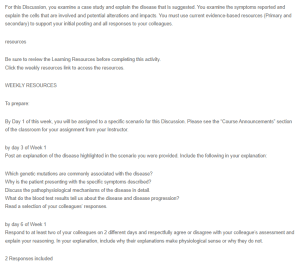
For this Discussion, you examine a case study and explain the disease that is suggested. You examine the symptoms reported and explain the cells that are involved and potential alterations and impacts. You must use current evidence-based resources (Primary and secondary) to support your initial posting and all responses to your colleagues.
resources
Be sure to review the Learning Resources before completing this activity.
Click the weekly resources link to access the resources.
WEEKLY RESOURCES
To prepare:
By Day 1 of this week, you will be assigned to a specific scenario for this Discussion. Please see the “Course Announcements” section of the classroom for your assignment from your Instructor.
by day 3 of Week 1
Post an explanation of the disease highlighted in the scenario you were provided. Include the following in your explanation:
Which genetic mutations are commonly associated with the disease?
Why is the patient presenting with the specific symptoms described?
Discuss the pathophysiological mechanisms of the disease in detail.
What do the blood test results tell us about the disease and disease progression?
Read a selection of your colleagues’ responses.
by day 6 of Week 1
Respond to at least two of your colleagues on 2 different days and respectfully agree or disagree with your colleague’s assessment and explain your reasoning. In your explanation, include why their explanations make physiological sense or why they do not.
2 Responses included