
Response on Mental Health
Wendy,
Thank you for sharing your post on mental health. Psychiatric mental health is a specialty; along with the essential RN functions, MHNPs also make assessments of the patient, diagnose and treat them or their families with psychiatric disorders or those potentially developing such conditions. These NPs possess patient credibility through their work specialty in pediatric mental health, forensics, geriatrics, or substance abuse. The NPs practice in different settings, including addiction facilities, psychiatric facilities, private clinics, hospitals, public health agencies, prisons, and nursing homes (Delaney et al., 2018). One of the biggest challenges MHNPs face is working with older patients, as these patients have beliefs and attitudes about mental health issues. Many senior patients grew up at times when problems in mental health went unrecognized, treated, or even discussed. Geriatric patients are uncomfortable talking about and taking medication for their mental health. Providing education and acceptance becomes a significant part of the treatment. An ideal mental healthcare delivery system includes parity and access to mental health services considering the strengths and needs of the group, family, individual, and community. Such a system also embeds quality, evidence-based, safe, interprofessional practice and cultural competence in the 21st century, consumer-focused, essential dimensions of mental health care and professional practice (Chaves, Dwyer & Ramelet, 2018). This vision can be translated into everyday practice by collaborating with healthcare specialists, including speech, recreational, physical, and occupational therapists, social workers, and psychiatrists. The NP must depend on direct input from nursing assistants and RNs in formulating and evaluating patient treatment plans. An NP should, thus, be a part of a team that delivers coordinated and comprehensive care with respect, dignity, and compassion for the patients.
References
Chavez, K. S., Dwyer, A. A., & Ramelet, A. S. (2018). International practice settings, interventions and outcomes of nurse practitioners in geriatric care: A scoping review. International journal of nursing studies, 78, 61-75.
Delaney, K. R., Naegle, M. A., Valentine, N. M., Antai-Otong, D., Groh, C. J., & Brennaman, L. (2018). The effective use of psychiatric mental health nurses in integrated care: policy implications for increasing quality and access to care. The journal of behavioral health services & research, 45(2), 300-309.
ORDER A PLAGIARISM-FREE PAPER HERE
We’ll write everything from scratch
Question 
RESPOND TO THIS TOPIC
– A minimum of 150 words per post, not including references
Citations: At least one high-level scholarly reference in APA per post from within the last five years
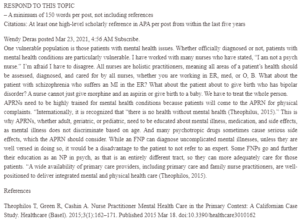
Response on Mental Health
Wendy Deras posted Mar 23, 2021, 4:56 AM Subscribe.
One vulnerable population is those patients with mental health issues. Whether officially diagnosed or not, patients with mental health conditions are particularly vulnerable. I have worked with many nurses who have stated, “I am not a psych nurse.” I’m afraid I have to disagree. All nurses are holistic practitioners, meaning all areas of a patient’s health should be assessed, diagnosed, and cared for by all nurses, whether you are working in ER, med, or O, B. What about the patient with schizophrenia who suffers an MI in the ER? What about the patient about to give birth who has bipolar disorder? A nurse cannot just give morphine and an aspirin or give birth to a baby. We have to treat the whole person.
APRNs need to be highly trained for mental health conditions because patients will come to the APRN for physical complaints. “Internationally, it is recognized that “there is no health without mental health (Theophilus, 2015).” This is why APRNs, whether adult, geriatric, or pediatric, need to be educated about mental illness, medication, and side effects, as mental illness does not discriminate based on age. And many psychotropic drugs sometimes cause serious side effects, which the APRN should consider. While an FNP can diagnose uncomplicated mental illnesses, unless they are well versed in doing so, it would be a disadvantage to the patient to not refer to an expert. Some FNPs go and further their education as an NP in psych, as that is an entirely different tract, so they can more adequately care for those patients. “A wide availability of primary care providers, including primary care and family nurse practitioners, are well-positioned to deliver integrated mental and physical health care (Theophilos, 2015).
References
Theophilos T, Green R, Cashin A. Nurse Practitioner Mental Health Care in the Primary Context: A Californian Case Study. Healthcare (Basel). 2015;3(1):162–171. Published 2015 Mar 18. doi:10.3390/healthcare3010162