
Reasons Why People Choose Not to Eat Healthy
Perceived Barriers
A significant challenge to eating healthy is the perception of cost, accessibility, and time. These barriers are among the most significant causes of non-healthy behaviors according to the Health Belief Model (HBM) (Alyafei, 2024). For example, people who think eating healthy is too expensive or takes too much effort will often resort to cheaper, processed foods. Such scenarios reflect postmodern economic factors, making it imperative to find solutions to these barriers and foster healthier, more inclusive sociocultural environments.
Potential solutions to the above-mentioned barriers include reducing the price of affordable healthy meals, making community gardens more accessible and available, and aiding in the hands-on training of basic cooking skills. Community gardens address the issue of affordable fresh food in low-income neighborhoods. Furthermore, these classes will help individuals develop basic cooking skills to easily prepare healthy meals. Subramaniam et al. (2022) suggest the importance of structural changes in the elimination of barriers, advocating that these sorts of changes are fundamental in creating a sustainably healthy environment. With the dismantling of barriers, people from diverse backgrounds will be able to adopt healthy eating habits.
Overall, overcoming perceived barriers requires there to be a formulation of localized policies, community work, and education. Such steps not only provide solutions to the barriers but also lead to changes in perceptions and actions, improving health outcomes in the long run.
Low Perceived Severity and Susceptibility
Another major barrier to eating healthily is the low perceived severity and susceptibility to risks related to diet. Most people do not perceive unhealthy eating as having the potential to bring severe consequences and therefore do not feel as if their eating habits will negatively impact their health in the future. These attitudes are described by the HBM model as “perceived severity” and “perceived susceptibility” (Alyafei, 2024). In this case, people underestimate the likelihood of developing chronic diseases such as diabetes and heart disease, and thus have little motivation to maintain a healthy diet.
Subsequently, changing attitudes toward health could be accomplished by using health promotion strategies focused on the consequences of poor eating behaviors, which could result in a change of behavior. These campaigns can include relatable facts and even messages directly tailored to specific patients so as to raise their perception of severity and susceptibility. Przybyłowicz & Danielewicz (2022) note that higher perceptions of health risks, when combined with methods of positively changing one’s diet, can lead to a positive change in dietary habits. Warnings regarding the development of dangerous diseases, such as obesity due to unhealthy eating, are one way to get patients to rethink their choices.
Reference
Alyafei, A. (2024, May 19). The health belief model of behavior change. StatPearls [Internet]. https://www.ncbi.nlm.nih.gov/books/NBK606120/
Subramaniam, M., Devi, F., AshaRani, P. V., Zhang, Y., Wang, P., Jeyagurunathan, A., Roystonn, K., Vaingankar, J. A., & Chong, S. A. (2022). Barriers and facilitators for adopting a healthy lifestyle in a multi-ethnic population: A qualitative study. PloS one, 17(11), e0277106. https://doi.org/10.1371/journal.pone.0277106
Przybyłowicz, K. E., & Danielewicz, A. (2022). Eating Habits and Disease Risk Factors. Nutrients, 14(15), 3143. https://doi.org/10.3390/nu14153143
REACTION
Hello,
Thank you for your post. Both of your reasons underscore essential psychological and practical factors that affect diet choices. The first reason talks about the perceived barriers quite well, especially the cost, accessibility, and time limitations, while also offering solutions such as cooking classes and policy amendments to ease access. On the other hand, your second reason examines low perceived susceptibility in conjunction with the absence of cues to action, effectively connecting motivational factors with health risks that may not materialize for decades. Both of the reasons corroborate each other in that addressing barriers and enhancing motivation, whether through education, media, or personal testimony, will most likely lead to positive behavioral change in the context of dietary practices.
ORDER A PLAGIARISM-FREE PAPER HERE
We’ll write everything from scratch
Question 
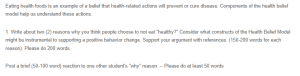
Eating health foods is an example of a belief that health-related actions will prevent or cure disease. Components of the health belief model help us understand these actions.
Reasons Why People Choose Not to Eat Healthy
1. Write about two (2) reasons why you think people choose to not eat “healthy?” Consider what constructs of the Health Belief Model might be instrumental to supporting a positive behavior change. Support your argument with references. (150-200 words for each reason). Please do 200 words
Post a brief (50-100 word) reaction to one other student’s “why” reason. — Please do at least 50 words