
Qualitative Research Design Selection: Exploring the Lived Experiences of Students with Disabilities Regarding School Disciplinary Practices
Area of Research Interest
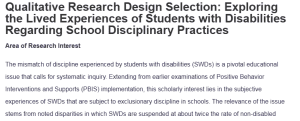
The mismatch of discipline experienced by students with disabilities (SWDs) is a pivotal educational issue that calls for systematic inquiry. Extending from earlier examinations of Positive Behavior Interventions and Supports (PBIS) implementation, this scholarly interest lies in the subjective experiences of SWDs that are subject to exclusionary discipline in schools. The relevance of the issue stems from noted disparities in which SWDs are suspended at about twice the rate of non-disabled peers (Losen & Martinez, 2020): Qualitative Research Design Selection: Exploring the Lived Experiences of Students with Disabilities Regarding School Disciplinary Practices.
This research interest bears directly on educational practice by engaging with essential questions of equity and inclusion. As a practitioner, knowledge of the phenomenological dimensions of the way SWD perceive, internalize, and act towards disciplinary interactions is crucial to informing the development of more responsive educational practices. Qualitative investigation of the subject allows for the investigation of subtle experiences that quantitative analysis is not well equipped to access, especially the emotional, social, and academic dimensions of the effect of discipline practices from the students’ points of view.
Selected Research Design: Phenomenology
Phenomenology is the most suitable research design for studying the lived experiences of SWDs in relation to disciplinary practices. According to van Manen (2014), the design endeavors to uncover the very essence of human experiences about a phenomenon. The phenomenological method is most aligned with the research interest because it is interested in learning how people make sense of their experiences as opposed to simply recording the observable actions or the end products.
The nature of phenomenological research makes it very appropriate for this inquiry. To be precise, it brackets researcher assumptions first and thus enables students’ genuine voices to be heard without preformed frameworks (Moustakas, 1994). Secondly, phenomenology uses in-depth interviews and reflective journaling as the main means of gathering data, which enables a rich investigation of students’ subject realities. Thirdly, the focus of the design on finding the constant structure of the experiences aids in comprehending universal themes amidst the varying experiences of students with respect for differences.
Critique of Alternative Design: Case Study
Despite the case study design seeming appropriate for this area of interest, critical analysis shows limitations for the planned investigation. Case studies, as defined by Yin (2018), are particularly good at yielding rich contextual descriptions of bounded systems. The emphasis of this design, though, to thoroughly examine particular cases or contexts might limit the capacity for capturing the intrinsic nature of the disciplinary experience phenomenon across a number of students.
Additionally, the case study design will also use multiple sources of data such as documents, observations, and artifacts (Stake, 1995). While strengthening validity, triangulation can, at the same time, blur the emphasis given to the lived experiences of students by adding extraneous viewpoints that might dominate participant voices. The bounded character of case studies also precludes the transferability of results when contrasted with the wider application of phenomenological findings toward the nature of experiences.
Implications for Educational Practice and Theory
The phenomenological inquiry of SWDs’ experiences of discipline holds much promise for both educational theory and practice. Theoretically, such a study can expand knowledge about the intersection of school climate and discipline with disability, with the potential to advise the refinement of inclusive education policy and frameworks. The evidence can upset the current behavioral intervention protocols by making student voices the priority over adult-driven outcomes.
In practical terms, conclusions drawn from the analysis of students’ lived experiences can be used to inform more responsive discipline practices that recognize the distinctive problems of SWDs. Educators and school administrators can use phenomenological observations to craft support mechanisms that extend past behavioral expressions to experiential factors that lead to disciplinary interactions. Furthermore, giving students a voice through phenomenological research helps advance the movement for policy changes toward more equitable discipline practices.
References
Losen, D. J., & Martinez, P. (2020). Lost opportunities: How disparate school discipline continues to drive differences in the opportunity to learn. Center for Civil Rights Remedies. https://escholarship.org/content/qt7hm2456z/qt7hm2456z.pdf
Moustakas, C. (1994). Phenomenological research methods. SAGE Publications.
Stake, R. E. (1995). The art of case study research. SAGE Publications.
van Manen, M. (2014). Phenomenology of practice: Meaning-giving methods in phenomenological research and writing. Left Coast Press.
Yin, R. K. (2018). Case study research and applications: Design and methods (6th ed.). SAGE Publications.
ORDER A PLAGIARISM-FREE PAPER HERE
We’ll write everything from scratch
Question 
In the Lesson 2 assignment, you will outline a potential educational research topic of interest. This may be the topic that you began exploring throughout your previous courses, or it may be something completely different. You may even have already started to think of an actual research problem and research purpose that fall within your topic area. The point of this assignment is to explore qualitative research designs and link your topic (and research problem, if possible) to a potential research design and explain the applicability and relevance of doing so.
You will accomplish several tasks with this assignment, and your paper should be structured to include four parts:
Qualitative Research Design Selection: Exploring the Lived Experiences of Students with Disabilities Regarding School Disciplinary Practices
- Give some thought to an area of interest to you, based on your personal professional experience and the current research literature. Explain why you are interested in this topic and/or research problem, how it relates to your field of practice or career, and how this topic and/or research problem can be explored by way of qualitative design. You may include excerpts from the problem statement you wrote in EDR8300 (ATTACHED IF NEEDED), but the focus of this exercise is not to restate or refine your problem statement. Rather, you will want to provide enough information about your topic to give the reader an understanding of the intended research project. (1/2 page ).
- Select a design that is aligned with the topic and/or research interest as described above. Explain why this design was selected as appropriate for the topic/research interest and describe in detail how the characteristics of this research design make it appropriate for your intended study. (1/2 page)
- Critique another research design that you considered and state your argument as to why this other design may not be suitable for your research interest. (1/2 page)
- Provide a closing argument that explains how a potential study, based on the research design you have selected, may inform educational practice and/or theory. (1/2 page)
Length: at least two pages
References: Include a minimum of 5 scholarly sources, including at least one seminal author on your chosen design
- The client’s field of practice or career is Education
- Textbook: Completing Your Qualitative Dissertation by Linda Dale Bloomberg
- Read Chapter 3, Choosing a Qualitative Research Design.
- The second half of this chapter includes a description of the most current qualitative designs (also referred to as traditions or genres), with a focus on associated philosophical underpinnings, strengths, and limitations. Also, review the companion website associated with this book for additional related materials.
- Read Chapter 3, Choosing a Qualitative Research Design.
- Case Study Method
- Bloomberg, L. D. (2018). Case Study Method. In B. Frey (Ed.), The SAGE Encyclopedia of Educational Research, Measurement, and Evaluation (pp. 237-239). SAGE.
- In this encyclopedia segment, the author outlines and explains the key characteristics of the case study as a prominent and commonly used qualitative research design.
- Bloomberg, L. D. (2018). Case Study Method. In B. Frey (Ed.), The SAGE Encyclopedia of Educational Research, Measurement, and Evaluation (pp. 237-239). SAGE.
- Considerations for Conducting Case Study Research
- Bedford, L. (2019). Considerations for conducting case study research [Webinar]. National University/Center for Teaching and Learning.
- In this webinar, case study design is discussed.
- Bedford, L. (2019). Considerations for conducting case study research [Webinar]. National University/Center for Teaching and Learning.
- Qualitative research designs: Exploring the “Big Five” (Part 1)
- Bloomberg, L. (2023). Qualitative research designs: Exploring the “Big Five” (Part 1). National University/Center for Teaching and Learning.
- This presentation compares the characteristics of case study and phenomenology.
- Bloomberg, L. (2023). Qualitative research designs: Exploring the “Big Five” (Part 1). National University/Center for Teaching and Learning.
- Essentials of Descriptive-Interpretive Qualitative Research
- Featuring Drs. Robert Elliott and Ladislav Timulak – American Psychological Association.
- Watch from 4:30-13:00. This video discusses the concept of generic descriptive-interpretive qualitative research, why to use it, and its disadvantages.
- Featuring Drs. Robert Elliott and Ladislav Timulak – American Psychological Association.
- Generic qualitative research: An often overlooked and misunderstood qualitative approach
- Generic qualitative research: An often overlooked and misunderstood qualitative approach. National University GSSC
- Writing a White Paper
- National University Writing Resources. Writing a White Paper.
- What is a white paper?
- White paper: Purpose and audience. What is a white paper?
- https://owl.purdue.edu/owl/
subject_specific_writing/ professional_technical_ writing/white_papers/index. html - Purdue Online Writing Lab. (n.d.). White paper: Purpose and audience. What is a white paper? Purdue University.