
Psychoanalytic Approaches and Developmental Theories
Cognitive behaviorial therapy (CBT) is a goal-coping psychotherapy, whose adherents place a strong emphasis on the mutuality among thoughts, feelings and behaviors. CBT was developed by Aaron Beck in the 1960s and has grown to be one of the most studied and practiced therapeutic interventions within the sphere of psychiatry. The effective and positive nature of the intervention within the parameters of psychiatric mental health nurse practitioners (PMHNPs) is that CBT has proven to be effective in treating various degrees of mental conditions in a wide range of populations. By having patients realize and change their ineffective lines of thinking, CBT has improved a more profound control over their emotions, a more life-course-like manner of living, and a more long-term problem-solving capacity, and has hence evolved into a major part of mental care.
Key Concepts of Cognitive Behavioral Therapy
CBT is based on the premise that pathological emotion and behavior are distinguished by the existence of a tremendous level of origins in distorted or, rather, maladaptive thinking. The CBT tenet is a cognitive model that presupposes the interconnectedness of cognition, emotion, and behavior under the condition that the transformative change in one efficiently leads to a positive outcome in other components (Nakao et al., 2021). Awareness of automatic thoughts, challenging cognitive distortions, and putting into place balanced and evidence-based thinking are some of the main skills of CBT. Behavior schemes also support cognitive change, which brings in healthy problem-solving and coping, such as exposure, activity scheduling, and experiments. CBT is a collaborative, goal-oriented and time-limited course that is founded on an active therapeutic relationship; both the therapist and patient have a shared stake in the result. The systematized character of CBT enables the patient to learn skills that are self-regulated by the patient to offer them self-efficacy and resiliency in the long term.
Indications for Cognitive Behavioral Therapy
The indication of CBT is broad in the scope of psychiatric disorders or psychosocial disturbances. There is robust evidence of its use in the treatment of anxiety conditions such as generalized anxiety disorder, panic disorder, obsessive-compulsive disorder, and depressive disorders (Chand et al., 2023). It can also be used in the management of post-traumatic stress disorder (PTSD), substance abuse disorders, eating disorders, and personality disorders. In addition to psychiatric disorders, CBT is useful in the treatment of chronic pain, insomnia, and stress conditions related to medication. CBT is typically an adjunctive treatment in more severe diseases of the mind, like bipolar and schizophrenia, to promote insight, compliance, and functional modification. Developmentally leveled and cognitively matched CBT interventions can also be used with geriatric and pediatric populations. CBT is a first-line psychotherapy in many clinical practice guidelines, because it is flexible and structured with ample evidence.
Structure of Cognitive Behavioral Therapy Sessions
CBT follows a highly structured session format with the objective of maximizing therapeutic efficiency and augmenting visible progress. Agenda setting at the beginning of each session is common, where both the therapist and patient identify and agree on the priorities of the session (Curtiss et al., 2021). The session begins with a brief summary of the previous session and homework assignments, reinforcing skill consolidation. Its core is psychoeducation, guided discovery, cognitive restructuring, and goal-oriented behavioral interventions. Socratic questioning by therapists helps patients to critically evaluate their beliefs and try out alternative perspectives. Homework, a mandatory component, encourages the application of skills to everyday life between sessions, which increases treatment generalization. The end of sessions includes a retrospective of the key points, a joint organization of homework, and obtaining feedback to comply with the needs of patients. The policy framework encourages commonality with the independence to provide personalized interventions.
Clinical Significance and Efficacy of CBT
CBT is clinically relevant as it has resilient empirical support, flexibility, and the ability to empower patients through the teaching of skills. Meta-analytic studies prove its effectiveness in relieving symptoms of a wide range of mental disorders with equal or even higher effect sizes than pharmacotherapy in some conditions, including mild to moderate depression and anxiety (Yu et al., 2020). CBT’s emphasis on relapse prevention and self-management also equips patients with tools to sustain improvements after therapy has terminated. CBT is useful in the reduction of distress caused by persistent psychotic symptoms, enhances coping and the promotion of functional gains in severe mental illness such as schizophrenia. It is also economical because its hypothesis and time-boundness are comparatively shorter processes compared to other psychotherapies. In the case of PMHNPs, the transformation of evidence-based psychotherapy using the CBT approach into the practice satisfies the Psychiatric-Mental Health Nursing Scope and Standards of Practice because it allows them to offer evidence-based psychotherapy that does not interfere with pharmaceutical treatment and the overall approach toward the patient.
Conclusion
One of the most evidence-supported and successful psychotherapeutic interventions that a psychiatric-mental health nurse practitioner can familiarize themselves with is cognitive behavior therapy. According to the cognitive model, CBT helps patients to recognize and revise negative thought and behavior patterns by means of didactic, collaborative, and skill-building interventions. Its medical applications to a wide range of psychiatric and medical conditions, its convenience of delivery to wide segments of the population, and its high level of empirical support make it a worthwhile addition to the therapeutic tool box of a PMHNP. Besides, CBT enables PMHNPs to provide quality and patient-centered psychotherapy, which can be used in combination with pharmacological treatment, enhancing clinical outcomes and long-term mental resilience.
References
Chand, S. P., Kuckel, D. P., & Huecker, M. R. (2023, May 23). Cognitive behavior therapy. PubMed. https://pubmed.ncbi.nlm.nih.gov/29261869/
Curtiss, J. E., Levine, D. S., Ander, I., & Baker, A. W. (2021). Cognitive-behavioral treatments for anxiety and stress-related disorders. Focus: The Journal of Lifelong Learning in Psychiatry, 19(2), 184–189. https://doi.org/10.1176/appi.focus.20200045
Nakao, M., Shirotsuki, K., & Sugaya, N. (2021). Cognitive–behavioral therapy for management of mental health and stress-related disorders: Recent advances in techniques and technologies. BioPsychoSocial Medicine, 15(1). https://doi.org/10.1186/s13030-021-00219-w
Yu, H., Ma, Y., Lei, R., & Xu, D. (2020). A meta-analysis of clinical efficacy and quality of life of cognitive-behavioral therapy in acute coronary syndrome patients with anxiety and depression. Annals of Palliative Medicine, 9(4), 1886–1895. https://doi.org/10.21037/apm-20-974
ORDER A PLAGIARISM-FREE PAPER HERE
We’ll write everything from scratch
Question 
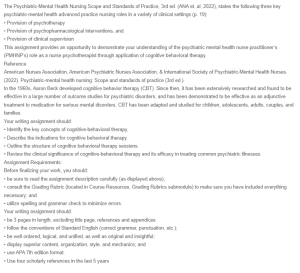
The Psychiatric-Mental Health Nursing Scope and Standards of Practice, 3rd ed. (ANA et. al, 2022), states the following three key psychiatric-mental health advanced practice nursing roles in a variety of clinical settings (p. 19):
Psychoanalytic Approaches and Developmental Theories
• Provision of psychotherapy
• Provision of psychopharmacological interventions, and
• Provision of clinical supervision
This assignment provides an opportunity to demonstrate your understanding of the psychiatric mental health nurse practitioner’s (PMHNP’s) role as a nurse psychotherapist through application of cognitive behavioral therapy.
Reference
American Nurses Association, American Psychiatric Nurses Association, & International Society of Psychiatric-Mental Health Nurses. (2022). Psychiatric-mental health nursing: Scope and standards of practice (3rd ed.).
In the 1960s, Aaron Beck developed cognitive behavior therapy (CBT). Since then, it has been extensively researched and found to be effective in a large number of outcome studies for psychiatric disorders, and has been demonstrated to be effective as an adjunctive treatment to medication for serious mental disorders. CBT has been adapted and studied for children, adolescents, adults, couples, and families.
Your writing assignment should:
• Identify the key concepts of cognitive-behavioral therapy.
• Describe the indications for cognitive behavioral therapy.
• Outline the structure of cognitive behavioral therapy sessions.
• Review the clinical significance of cognitive-behavioral therapy and its efficacy in treating common psychiatric illnesses.
Assignment Requirements:
Before finalizing your work, you should:
• be sure to read the assignment description carefully (as displayed above);
• consult the Grading Rubric (located in Course Resources, Grading Rubrics submodule) to make sure you have included everything necessary; and
• utilize spelling and grammar check to minimize errors.
Your writing assignment should:
• be 3 pages in length, excluding title page, references and appendices
• follow the conventions of Standard English (correct grammar, punctuation, etc.);
• be well ordered, logical, and unified, as well as original and insightful;
• display superior content, organization, style, and mechanics; and
• use APA 7th edition format.
• Use four scholarly references in the last 5 years