
Psychiatric Patient Evaluation
Instructions |
Use the following case template to complete Week 2 Assignment 1. Assign DSM-5-TR diagnoses and ICD-10 codes to the services documented in the case scenario. You will add your narrative answers to the assignment questions to the bottom of this template and submit them together as one document. | |||||||||||||||||||||||||||||||||||||||||
Identifying Information |
Identification was verified by stating their name and date of birth.
Time spent for evaluation: 1103am-1151am |
|||||||||||||||||||||||||||||||||||||||||
Chief Complaint |
“My primary doctor thinks I need more help than she can give me now.” | |||||||||||||||||||||||||||||||||||||||||
HPI |
42 young female was evaluated for psychiatric evaluation and referred by her primary care provider for worsening depression and panic symptoms. She is currently prescribed escitalopram 5mg po daily for depression, alprazolam 1mg po daily for anxiety.
Today, the client reported symptoms of worsening in past month for depression with anergia, anhedonia, motivation, reports anxiety, frequent worry, reports feeling restlessness, palpitations “feels like everything is closing in on me, can’t focus, hard time breathing,” no reported obsessive/compulsive behaviors. Client reported feelings like want to sleep and never wake up. There is no evidence of psychosis or delusional thinking. Client denied past episodes of hypomania, hyperactivity, erratic/excessive spending, involvement in dangerous activities, self-inflated ego, grandiosity, or promiscuity. Client reports increased irritability and easily frustrated. Has low frustration tolerance, sleeping 10-12 hrs/24hrs, appetite decreased. She has somatic concerns with GI upset and headaches. Client denied any current binging/purging behaviors, denied withholding food from self or engaging in anorexic behaviors. No self-mutilation behaviors. |
|||||||||||||||||||||||||||||||||||||||||
Diagnostic Screening Results |
Screen of symptoms in the past week: Severity Measure for Panic Disorder = Total Score 38 |
|||||||||||||||||||||||||||||||||||||||||
Past Psychiatric and Substance Use Treatment |
· Entered mental health system when she was age 29 after a family suicide.
· Previous Psychiatric Hospitalizations: · Previous Detox/Residential treatments: · Previous psychotropic medication trials: sertraline (became suicidal), trazodone (worsened nightmares), bupropion (became suicidal) · Previous mental health diagnosis per client/medical record: |
|||||||||||||||||||||||||||||||||||||||||
Substance Use History |
Have you used/abused any of the following (include frequency/amt/last use):
Any history of substance related: · Blackouts: – · Tremors: – · DUI: – · D/T’s: – · Seizures: – Longest sobriety |
|||||||||||||||||||||||||||||||||||||||||
Psychosocial History |
Client was raised by single mother. She is married; has 2 children.
Employed at local day care as administrative assistant. Education: High School Diploma Denied current legal issues. |
|||||||||||||||||||||||||||||||||||||||||
Suicide / Homicide Risk Assessment |
Suicide Inquiry: Denies active suicidal ideations, intentions, or plans. | |||||||||||||||||||||||||||||||||||||||||
Mental Status Examination |
She is a 42 yo Hispanic female who looks her stated age. She is cooperative with examiner. She is disheveled, dressed appropriately. There is psychomotor restlessness. Her mood is anxious and mildly irritable. She denies any auditory or visual hallucinations. There is no evidence of any delusional thinking. She denies any current suicidal or homicidal ideation. |
|||||||||||||||||||||||||||||||||||||||||
Clinical Impression |
The client is a 42 yo Hispanic female who presents with a history of treatment for depression and panic symptoms.
Moods are anxious and irritable. She has reported symptoms related to her depression and panic. no evident mania/hypomania, no psychosis, denied current cravings for drugs/alcohol, exhibits no withdrawal symptoms, has somatic concerns of GI upset and headaches. At the time of disposition, the client adamantly denies SI/HI ideations, plans, or intent and has the ability to determine right from wrong and can anticipate the potential consequences of behaviors and actions. |
|||||||||||||||||||||||||||||||||||||||||
Diagnostic Impression |
Major Depressive Disorder, Recurrent Episode, Moderate ICD-10 Code: F33.1Panic Disorder ICD-10 Code: F41.0 |
|||||||||||||||||||||||||||||||||||||||||
Treatment Plan |
1) Medication:
· Increase escitalopram 10mg po daily · Continue with alprazolam 2) Order labs 3) Patient has emergency numbers: Emergency Services 911, the national Crisis Line 800-273-TALK, the MHC Crisis Clinic. Patient was instructed to go to nearest ER or call 911 if they become actively suicidal and/or homicidal. 4) Time allowed for questions and answers provided. Provided supportive listening. 5) RTC in 30 days 6) Follow up with PCP for GI upset and headaches |
|||||||||||||||||||||||||||||||||||||||||
Narrative Answers
Reimbursement Billing CodeIn this case, the ideal billing code for the psychiatric evaluation is 90792, which indicates a psychiatric diagnostic evaluation with services. The code is applied when the physician provides a complete evaluation with medical services like reviewing systems, prescribing or modifying medication, and ordering tests. In this instance, the practitioner adjusted the patient’s escitalopram dosage and reordered alprazolam, which indicated transparently that medical services were rendered in addition to the psychiatric evaluation. The visit also lasted 48 minutes (1103 to 1151), within the average time spent on an initial assessment. Additionally, the record contained many elements that validate the application of this code, including a complete psychiatric history, history of medications, current symptoms, MSE, suicide risk assessment, and treatment plan. According to the Centers for Medicare & Medicaid Services (2024), 90792 is warranted over other CPT codes such as 90791, which does not cover medical services, or 99204/99205, which are typically used in wider evaluation settings outside psychiatric services. Pertinent Information Required in Documentation to Support the Chosen DSM-5-TR Diagnoses, ICD-10 Coding, and Billing CodeSome required information must be documented to substantiate DSM-5-TR diagnoses, ICD-10 codes, and billing under code 90792. The client’s chief complaint must first be noted in the client’s own words to establish the medical necessity for the visit. The history of the present illness (HPI) must consist of the onset, duration, severity, and functional effect of the symptoms allegedly experienced. In addition, a mental status exam (MSE) must evaluate appearance, behavior, speech, mood, affect, cognition, insight, and judgment (Voss & Das, 2024). The complexity of medical decision-making must be documented, including symptom severity measurement, comorbidities under consideration, and medication changes justified. Psychiatric history, brief, previous treatment, and medication response are relevant, as is the history of substance use and psychosocial stressors. The treatment protocol should be well-defined, with information on medication change, follow-up, and patient instruction. This organized documentation reinforces the clinical work done and both the billing level and the diagnosis codes. Missing Pertinent Documentation and Other Information That Would Be Helpful to Narrow the Coding and Billing OptionsAlthough the case study provides some background data, it does not include many elements of documentation required for coding and billing. It does not include a review of systems (ROS), which would help address medical comorbidities for the sake of treatment. There are no documented vital signs or allergies, which are routine in psychiatric-medical evaluations. It is without a detailed family psychiatric history and complete medical history, which restricts understanding of genetic or chronic health effects on the client’s presentation. The practitioner gave no other standardized screening instruments besides panic severity measures, such as PHQ-9 or GAD-7, which would enhance diagnostic confidence (Pranckeviciene et al., 2022). No discussion of cultural issues, religious beliefs, or patient treatment expectations was conducted, although these are likely to influence participation and care expectations. Legal status, informed consent indication, and coordination of care arrangements (such as whether PCP was contacted) are not found in the record. Lastly, there is no record of laboratory testing or balancing medication risks and benefits as would be anticipated with prescribing or altering psychotropics. These factors would augment care and offer greater reimbursement and coding rationale. Dilemmas Related to Overbilling, Upcoding, and Fraudulent Practices and Strategies for Promoting Legal and Ethical Coding and Billing PracticesOvercharging, upcoding, and deceptive documentation are significant legal and ethical issues in psychiatric practice. Upcoding charging a more complex service than was rendered—can lead to overpayment and subject the provider to audit, penalty, and loss of licensure. Similarly, billing for services or evaluations not rendered, even unintentionally, constitutes fraud according to federal law. Such practices erode trust and undermine the integrity of care. A successful method for encouraging ethical billing is periodic peer or supervisory audits that enable providers to gain constructive feedback and rectify coding conventions early (Burks et al., 2022). Another method is the utilization of standardized templates and EHR checklists that remind providers to document each of the elements necessary for particular CPT codes. This eliminates the possibility of omissions and bills only for the documented service corresponding to the billed code. Regular compliance training, coding updates, and payer demands must also be incorporated into clinical practice. Improving Documentation to Support Coding and Billing for Maximum ReimbursementBetter documentation involves utilizing structured, evidence-based templates to meet CPT code requirements and completeness. The templates must cue the provider to document the chief complaint, history of present illness, MSE, psychiatric and medical history, risk assessments, substance use, functional status, and medication decision-making. Quantitative screening instruments like the PHQ-9 or the GAD-7 enhance diagnosis and allow quantifiable results over time. Recording time, complexity of medical decision-making, and coordination with other providers also justify the application of higher-level codes like 90792. Informed consent conversations and the risks versus benefits of treatments provided also need to be well-documented by providers (Shah et al., 2024). Finally, reporting a detailed treatment plan with clear follow-up instructions and patient safety precautions demonstrates quality care and deserves complete reimbursement. Such documentation care maximizes billing efficiency and improves patient outcomes and physician accountability. |
References
Burks, K., Shields, J., Evans, J., Plumley, J., Gerlach, J., & Flesher, S. (2022). A systematic review of outpatient billing practices. SAGE Open Medicine, 10(10), 1–10. https://doi.org/10.1177/20503121221099021
Centers for Medicare & Medicaid Services. (2024, January 1). Billing and coding: Psychiatric Diagnostic Evaluation and Psychotherapy Services (A57520). CMS. https://www.cms.gov/medicare-coverage-database/view/article.aspx?articleid=57520&ver=33&
Pranckeviciene, A., Saudargiene, A., Gecaite-Stonciene, J., Liaugaudaite, V., Griskova-Bulanova, I., Simkute, D., Naginiene, R., Dainauskas, L. L., Ceidaite, G., & Burkauskas, J. (2022). Validation of the patient health questionnaire-9 and the generalized anxiety disorder-7 in the Lithuanian student sample. PLOS ONE, 17(1). https://doi.org/10.1371/journal.pone.0263027
Shah, P., Thornton, I., Turrin, D., & Hipskind, J. E. (2024). Informed consent. National Library of Medicine; StatPearls Publishing. https://www.ncbi.nlm.nih.gov/books/NBK430827/
Voss, R. M., & Das, J. M. (2024). Mental status examination. National Library of Medicine; StatPearls Publishing. https://www.ncbi.nlm.nih.gov/books/NBK546682/
ORDER A PLAGIARISM-FREE PAPER HERE
We’ll write everything from scratch
Question 
Psychiatric Patient Evaluation
This is for my PMHNP course. Please follow rubirc and let me know if you have any questions
Insurance coding and billing is complex, but it boils down to how to accurately apply a code, or CPT (current procedural terminology), to the service that you provided. The payer then reimburses the service at a certain rate. As a provider, you will have to understand what codes to use and what documentation is necessary to support coding.
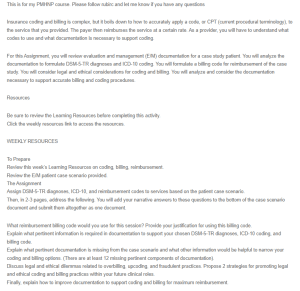
Psychiatric Patient Evaluation
For this Assignment, you will review evaluation and management (E/M) documentation for a case study patient. You will analyze the documentation to formulate DSM-5-TR diagnoses and ICD-10 coding. You will formulate a billing code for reimbursement of the case study. You will consider legal and ethical considerations for coding and billing. You will analyze and consider the documentation necessary to support accurate billing and coding procedures.
Resources
Be sure to review the Learning Resources before completing this activity.
Click the weekly resources link to access the resources.
WEEKLY RESOURCES
To Prepare
Review this week’s Learning Resources on coding, billing, reimbursement.
Review the E/M patient case scenario provided.
The Assignment
Assign DSM-5-TR diagnoses, ICD-10, and reimbursement codes to services based on the patient case scenario.
Then, in 2-3 pages, address the following. You will add your narrative answers to these questions to the bottom of the case scenario document and submit them altogether as one document.
What reimbursement billing code would you use for this session? Provide your justification for using this billing code.
Explain what pertinent information is required in documentation to support your chosen DSM-5-TR diagnoses, ICD-10 coding, and billing code.
Explain what pertinent documentation is missing from the case scenario and what other information would be helpful to narrow your coding and billing options. (There are at least 12 missing pertinent components of documentation).
Discuss legal and ethical dilemmas related to overbilling, upcoding, and fraudulent practices. Propose 2 strategies for promoting legal and ethical coding and billing practices within your future clinical roles.
Finally, explain how to improve documentation to support coding and billing for maximum reimbursement.