
Psychiatric Comprehensive Assessment
Date of Assessment: April 16, 2025
Client Initials: M.L. Age: 67 Sex: Female Race: Caucasian
CC: “For the past several months, I have not been able to sleep well, and I have been so anxious.”
HPI: M.L. is a 67-year-old retired female elementary school teacher with the clinical features of anxiety disorder, insomnia, and anorexia for the last six months. She states her main concerns are her adult children’s safety and their financial concerns, even though there is no major stressful event in their lives. She complains of several symptoms that have worsened after her husband retired from his job, and which she blamed on close proximity due to retirement. Some of the other symptoms she appears to have include fatigue, restlessness, and muscle tension, and consequently, she cannot carry out most activities. She does not show any suicidal thoughts or hallucinations but tiredness that has overwhelmed her psychologically.
Stressors: Factors such as the retirement of her husband that lead to a change in lifestyle, financial implications because of their new income-generating capacity, and lack of friends with whom she can socialize since they have moved to other places.
Strengths: Respectful attitude towards children, understanding her psychological state, observance of healthcare appointments, fluency in speaking, compliance with the interview and able to reason properly.
Challenges: Predominant anxiety, sleep disturbances, social phobia regarding group therapy, slight resistance to taking medications, and restricted mobility due to enduring joint pain.
Psychiatric History: The patient was diagnosed with generalized anxiety disorder, GAD, at the age of 52 but kept it under control through psychotherapy and avoiding any serious life changes. She has a past history of taking sertraline, which she stopped taking due to side effects on her stomach. No history of psychosis, mania, or personality disorder.
Hospitalizations- There are no psychiatric hospitalizations stated.
Outpatient treatments- She underwent six months of cognitive behavioral therapy in the year 2010.
Prior suicide attempts- There are none reported.
Previous Psychiatric Medication Used
| Name of Medication | Dosage | How Long Used | Reason Discontinued |
| Sertraline | 50 mg daily | 3 months | Due to nausea and lack of appetite. |
Medication Adherence: She is adherent to current medications but expresses concern about side effects and prefers non-pharmacologic methods if possible.
Any problems or side effects with current medications? ___Y ____N _ N/A Yes – complains of mild drowsiness with current use of lorazepam.
Medical History: Diagnosed with osteoarthritis and hypertension. Takes lisinopril for blood pressure. No history of diabetes or cardiac disease.
Allergies: No known drug or food allergies.
Family Psychiatric/Medical History:
Paternal: Father had an alcohol use disorder and died from a myocardial infarction at age 68.
Maternal: The mother had anxiety and was treated with benzodiazepines in later life.
Siblings: One sister with a history of depression, treated with SSRIs successfully.
Substance Abuse History:
Nicotine- Never smoked.
Illicit drugs- Denies use.
Other drugs- None.
Alcohol- Drinks wine occasionally, approximately once per week, 4 oz per serving. No signs of dependence.
Legal History: No history of legal issues or arrests.
Social History: Married, lives with a spouse in a suburban home. Retired and formerly worked as an educator for over 30 years. Maintains infrequent contact with a few friends. Has two adult children and four grandchildren. Participates in church activities occasionally but avoids crowded social gatherings due to anxiety. Financially stable but cautious with spending due to fixed income.
Vital Measurements:
Temp: 98.1°F Pulse: 78 bpm Resp: 16 bpm BP: 132/84 mmHg Weight: 154 lbs Height: 5’4”
Waist Circumference: 35 inches
Review of Systems:
Eyes, Ears, nose, mouth, throat- No reported abnormalities.
Cardiovascular- Controlled hypertension, no chest pain or palpitations.
Respiratory- No complaints.
Gastrointestinal- Intermittent constipation related to dietary habits.
Genitourinary- Unremarkable.
Musculoskeletal- Reports chronic knee and hip joint pain due to osteoarthritis.
Integumentary- No lesions or rashes.
Neurological- No dizziness, seizures, or motor deficits.
Allergic/Immunologic- No known issues.
Endocrine- No thyroid or hormonal concerns.
Hematologic/Lymphatic- No bruising, bleeding, or anemia reported.
Psychiatric- Anxiety, sleep disturbance, somatic symptoms, and emotional dysregulation.
Mental Status Exam:
Appearance: Well-groomed, appropriate attire.
Attitude: Cooperative, engaging, maintains eye contact.
Orientation: Alert and oriented to time, place, person, and situation.
Motor activity: Normal; no agitation or retardation.
Speech: Fluent, coherent, normal rate and tone.
Mood: “Worried and overwhelmed.”
Affect: Congruent with mood, mildly anxious.
Thought content: No delusions or obsessions.
Thought process: Logical and goal-directed.
Perception/sensorium: No hallucinations or perceptual disturbances.
Memory: Intact short- and long-term memory.
Insight: Good – acknowledges symptoms and their impact.
Judgment: Sound, capable of making appropriate decisions.
SI/HI: Denies suicidal or homicidal ideation.
Diagnostic Formulation
Diagnosis
Generalized Anxiety Disorder (F41.1)
M.L. meets the diagnostic criteria for generalized anxiety disorder as defined in the DSM-5-TR. She experiences excessive, uncontrollable worry occurring more days than not for over six months, accompanied by fatigue, restlessness, muscle tension, and difficulty sleeping. These symptoms are persistent, not limited to any specific situation, and cause significant impairment in her daily functioning (Munir & Takov, 2022). There is no indication that these symptoms are due to substance use, medical illness, or another mental disorder supporting a primary diagnosis of GAD.
Differential Diagnoses
Major Depressive Disorder, Recurrent, Moderate (F33.1)
MDD shares overlapping symptoms with GAD, such as fatigue, poor concentration, and sleep difficulties. However, M.L. does not endorse key features of depression such as persistent sadness, anhedonia, hopelessness, or suicidal ideation (Bains & Abdijadid, 2023). Her emotional state is primarily characterized by worry and anxiety, not depressive affect. Therefore, while MDD is a differential consideration, the symptom pattern does not meet the full criteria for this disorder.
Adjustment Disorder with Anxiety (F43.22)
Adjustment Disorder with Anxiety involves an excessive response to a specific identifiable stressor, usually developing within three months of the event (Geer, 2023). Although M.L. experienced stress following her husband’s retirement, her anxiety is chronic, lasting longer than six months, and is not solely related to a specific situational trigger. The severity and duration of her symptoms suggest GAD is a more accurate diagnosis.
Panic Disorder (F41.0)
Panic Disorder involves unexpected, recurrent panic attacks accompanied by concern about future attacks (Cackovic et al., 2023). While both panic disorder and GAD involve anxiety, M.L. does not report acute episodes of intense fear, palpitations, or sensations of losing control, characteristic of panic attacks. Her anxiety is more constant and generalized, lacking the episodic nature of panic disorder, thus supporting GAD over this diagnosis.
Plan of Care:
- Pharmacologic Treatment: Initiate escitalopram 10 mg daily, an SSRI with a favorable side effect profile and efficacy in late-life GAD. Taper lorazepam gradually to minimize dependence risk.
- Non-Pharmacologic Treatment: Resume CBT with emphasis on cognitive restructuring and worry exposure. Weekly sessions for 12 weeks.
- Referrals: Referral to a geriatric therapist specializing in anxiety disorders.
- Education: Psychoeducation on anxiety management, sleep hygiene, and lifestyle strategies to reduce worry.
- Follow-Up: Re-evaluation in four weeks for symptom response and side effect monitoring.
- Laboratory Testing: Basic metabolic panel and thyroid panel to rule out metabolic or endocrine contributions to symptoms.
Plan of Care Rationale:
Initiating escitalopram 10 mg daily is clinically appropriate as SSRIs are the first-line pharmacologic treatment for generalized anxiety disorder (GAD), especially in older adults. Escitalopram is well-tolerated, has fewer anticholinergic effects, and demonstrates high efficacy in late-life anxiety, as noted by (Landy et al., 2023). Tapering lorazepam is necessary due to the risk of dependence, cognitive impairment, and falls in the geriatric population (Ghiasi et al., 2024). Gradual discontinuation minimizes withdrawal symptoms and promotes long-term safety. Non-pharmacologic treatment with cognitive behavioral therapy (CBT) is equally critical, as it targets cognitive distortions and maladaptive worry behaviors as indicated by Chand et al. (2023). Weekly CBT over 12 weeks has shown durable benefits in GAD symptom reduction and relapse prevention. Referral to a geriatric therapist provides age-appropriate, professional care, treating the distinctive psychological concerns of older individuals. Psychoeducation reinforces M.L.’s knowledge of her condition, facilitates self-management capacity, and improves adherence to medication and therapy. The inclusion of education on changes in sleep hygiene and lifestyle also maximizes coping skills. Four-week follow-up enables timely evaluation of treatment efficacy and tracking of side effects. Finally, ordering a basic metabolic panel and thyroid panel serves to eliminate metabolic or endocrine etiologies that may masquerade or worsen the symptoms of anxiety for the sake of diagnostic precision.
References
Bains, N., & Abdijadid, S. (2023, April 10). Major depressive disorder. StatPearls – NCBI Bookshelf. https://www.ncbi.nlm.nih.gov/books/NBK559078/
Cackovic, C., Nazir, S., & Marwaha, R. (2023, August 6). Panic disorder. StatPearls – NCBI Bookshelf. https://www.ncbi.nlm.nih.gov/books/NBK430973/
Geer, K. (2023). Adjustment disorder. Primary Care: Clinics in Office Practice, 50(1), 83–88. https://doi.org/10.1016/j.pop.2022.10.006
Ghiasi, N., Bhansali, R. K., & Marwaha, R. (2024, May 25). Lorazepam. StatPearls – NCBI Bookshelf. https://www.ncbi.nlm.nih.gov/books/NBK532890/
Landy, K., Rosani, A., & Estevez, R. (2023, November 10). Escitalopram. StatPearls – NCBI Bookshelf. https://www.ncbi.nlm.nih.gov/books/NBK557734/
Munir, S., & Takov, V. (2022, October 17). Generalized anxiety disorder. StatPearls – NCBI Bookshelf. https://www.ncbi.nlm.nih.gov/books/NBK441870/
Chand, S. P., Kuckel, D. P., & Huecker, M. R. (2023, May 23). Cognitive behavior therapy. PubMed. https://pubmed.ncbi.nlm.nih.gov/29261869/
ORDER A PLAGIARISM-FREE PAPER HERE
We’ll write everything from scratch
Question 
Psychiatric Comprehensive Assessment
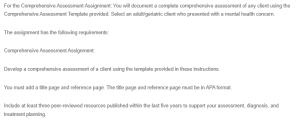
For the Comprehensive Assessment Assignment: You will document a complete comprehensive assessment of any client using the Comprehensive Assessment Template provided. Select an adult/geriatric client who presented with a mental health concern.
Psychiatric Comprehensive Assessment
The assignment has the following requirements:
Comprehensive Assessment Assignment:
Develop a comprehensive assessment of a client using the template provided in these instructions.
You must add a title page and reference page. The title page and reference page must be in APA format.
Include at least three peer-reviewed resources published within the last five years to support your assessment, diagnosis, and treatment planning.