
PSY 520 SPSS Assignment 4
Question 1
One sample research situation that would require a chi-square analysis is a study that investigates whether a level of schooling is linked with a person voting in elections. The study would have two nominal variables: voting habit and level of schooling. The level of schooling variable could have categories of graduate/professional degree, bachelor’s degree, some college/associate’s degree, and high school diploma or less: PSY 520 SPSS Assignment 4.
The voting habit variable could have categories of those who voted in the last election, and those who did not vote in the last election. The researcher would sample from a population, recording each individual’s level of schooling as well as whether that individual voted in the last election. To determine whether a correlation between level of schooling and voting habit is significant, a chi-square test would be utilized.
This is upheld by a study by Burden (2009), which confirmed that voting participation is highly correlated with level of educational attainment as one of the most consistent outcomes in political participation research. The academic source affirms that a chi-square analysis is highly suitable in analyzing whether the voting pattern is a function of educational level. The frequency observed in those with different educational attainment who voted as well as those that did not vote can be compared with the expected frequency in the case of no association in the null hypothesis.
The chi-square can be used in determining whether variables are related at a statistical level. The above analysis can be enlightening in analyzing political participation as a function of level of educational attainment as well as inform strategies towards improving voting participation in constituencies that are not highly educated.
Question 2
Part a
Part b
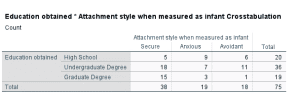
Based on the results of the infant attachment style versus level of educational attainment, secure attachment style can be observed as having a direct correlation with high educational level in adulthood. In those with a graduate level, a staggering 79% (15 out of 19) also had a secure attachment style as babies. Compared with 16% (3 out of 19) with a graduate level who had an anxious attachment style as babies, 5% (1 out of 19) had an avoidant attachment style as babies. The trend is that those with secure attachment early in life are more likely to have high educational attainment.
Furthermore, as educational level decreased, secure attachment rate also decreased. In those with a bachelor’s level, 50% (18 out of 36) had been securely attached as infants, while in those with a high school level alone, 25% (5 out of 20) had been securely attached. The rate of participants with anxious and avoidant attachment styles increased as educational level decreased. These findings support the notion that a secure attachment style in infancy is most strongly related to achieving higher levels of education later in life, compared to anxious or avoidant attachment styles.
Question 3
Part a
Part b
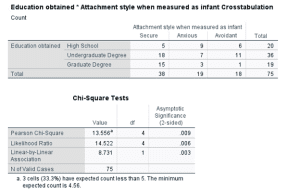
A chi-squared test of independence was carried out in order to examine whether infant attachment style is linked with level of educational attainment in adulthood. The two variables were significantly related, ꭓ2(4, N = 75) = 13.556, p = .009. The implication is that infant attachment style and level of educational attainment are not independent variables. That is, a correlation is seen between attachment style developed as an infant and level of educational attainment achieved.
The crosstabulation also provides some hints about the nature of that correlation. Individuals with a secure attachment as babies were more likely to have high educational attainment, with 79% with a graduate level having experienced a secure attachment. Similarly, those with anxious or avoidant attachment styles were unlikely to have high educational attainment and overrepresented those with a high school level. The implication is that early attachment experiences play some role towards educational attainment in later life, with secure attachment as a probable protective variable that leads towards academic success and attainment.
Question 4
Part a
Part b
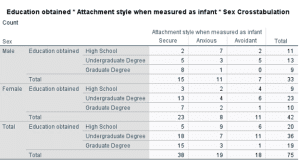
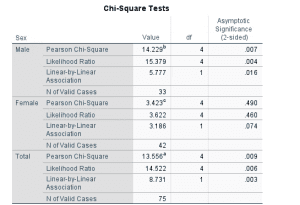
From the results of the gender-based chi-square tests that were calculated, infant attachment style is associated with educational attainment obtained in females but not in males. The female sample had a significant result on the chi-square test (ꭓ2(4, N = 42) = 33.0, p < .001), which implies that infant attachment style is associated with educational attainment in adulthood. The females’ likelihood ratio (15.379) also supports that attachment style is associated with educational attainment. The male sample did not have a significant result on the chi-square test (ꭓ2 (4, N = 33) = 14.229, p = .007), which implies that infant attachment is not associated with educational attainment in males.
Results from the crosstabulation shed light on these outcomes. In females, those with secure attachment as babies had a higher level of educational attainment than females with anxious or avoidant attachment. To give you a sense, 7 out of 10 females with graduate level educational attainment had been securely attached as babies.
In males, educational attainment across attachment styles is more distributed with no discernible pattern. The implication is that while early attachment is probably a prime contributor in predicting educational attainment in females, perhaps some other variables play a more important role in predicting educational attainment in males.
References
Burden, B. C. (2009). The dynamic effects of education on voter turnout. Electoral Studies, 28(4), 540–549. https://doi.org/10.1016/j.electstud.2009.05.027
ORDER A PLAGIARISM-FREE PAPER HERE
We’ll write everything from scratch
Question 
Before You Begin the Assignment
- Read Chapter 15 in your Beginning Behavior Research: A Conceptual Primer textbook and Chapter 18 in your Discovering Statistics Using IBM SPSS Statistics
- Review the video tutorial for an overview of chi-square analyses in SPSS.
- Access and open the Attachment SPSS data set.
To Submit Your Assignment
- The best way to paste your output into the Assignment document is to do the following:
- Select Copy when copying from the SPSS output.
- To paste in Word, your document must be open within the VDI. Use a shared drive (such as OneDrive) or access your learning environment within the virtual desktop to download this document.
- Select Paste and then resize the image to fit the screen in Word.
An Overview of the Data Set
This data set represents hypothetical data from a study that examined the relationship between infant-attachment style as measured in infancy and education as measured in adulthood. That is, the same participants had their attachment style measured as young children, and then researchers measured the participants’ level of education obtained many years later.
Here is some more information about the variables in this hypothetical data set:
- Number: The participant’s ID number
- Sex: The participant’s sex, with 1 = male and 2 = female
- Infant_Attachment: The participant’s infant-attachment style, with 1 = secure, 2 = anxious, and 3 = avoidant
- Education: The participant’s level of education obtained, with 1 = high school, 2 = undergraduate, and 3 = graduate
PSY 520 SPSS Assignment 4
Questions
1) Briefly describe a research situation that would require a chi-square analysis. Be sure to explain each variable and the possible values of each variable.
[Insert your answer.]
2a) Generate a cross table of Infant_Attachment and Education.
[Paste your output.]
2b) From these results, which group-attachment style seems most related to obtaining high levels of education?
[Insert your answer.]
3a) Conduct a chi-square test to see if Infant_Attachment and Education are independent of one another.
[Paste your output.]
3b) Document the results of this test in APA style. Be sure to explicitly state whether the two variables are independent. Refer to How to Report a Chi-Square Test Result (APA) for guidance.
[Insert your answer.]
4a) Run the chi-square again, but this time, add sex as a layer.
[Paste your output.]
4b) Based on these results, does the relationship between Infant_Attachment and Education hold for both males and females? How do you know?
[Insert your answer.]
Readings: