
Proposed Study: Enhancing Depression Treatment Through Digital Cognitive Behavioral Therapy
Description of the Disorder
Major depressive disorder (MDD) is a prevalent mental health condition characterized by persistent low mood, diminished interest or pleasure in activities, fatigue, changes in sleep and appetite, and cognitive impairments. Proudman et al. (2021) describe that MDD is experienced by roughly 17.3 million adults in the US annually, and its lifetime prevalence is close to 20%. The disorder is more commonly diagnosed in women compared to men and typically arises in adolescence or young adulthood. Gender disparities can point towards hormonal, social, as well as cognitive vulnerabilities, whereas age trends can indicate a developmental vulnerability to stress and identity formation throughout adolescence.
Risk for Developing the Disorder
Three prominent risk factors are implicated in the development of MDD. Social isolation, particularly following the COVID-19 pandemic, has been a strong precipitant. Proudman et al. (2021) observe that decreased social interaction and extended loneliness, particularly in young adults, have propelled the increasing load of depression. Socioeconomic disadvantage is a risk factor for MDD. Those who come from lower socioeconomic backgrounds are exposed to chronic stressors like financial insecurity and decreased access to healthcare, which in turn are reliably linked to increased depression rates (Proudman et al., 2021). Third, having comorbid medical or psychiatric illnesses, like anxiety disorders or chronic pain, vastly elevates the risk of developing depression. These conditions contribute to physiological and psychological distress and complicate disease management, thus increasing the risk for MDD (Karrouri et al., 2021). Each of these variables—isolation, low socioeconomic status, and comorbidity—is strongly evidence-based and has an independent contribution to the causation of depression.
Common Treatments for the Disorder
Interventions for MDD are both psychological and pharmacological. Most prescribed medications are antidepressant drugs in the form of SSRIs, which have proven efficacy in alleviating symptoms of depression. Their efficacy, however, is not equal, and side effects are frequent (Karrouri et al., 2021). Of the psychological interventions, CBT is most well-supported for its potential to enable patients to recognize and reformulate negative thought processes. CBT is particularly useful for relapse prevention and can be administered in individual, group, or computerized formats, which makes it more accessible for those patients with fewer resources or mobility (Nakao et al., 2021).
Identifying Gaps in Treatment Research
Despite the efficacy of CBT, accessibility and adherence remain critical challenges. Karrouri et al. (2021) mentioned that although iCBT is promising, most trials have small, homogeneous samples and no longitudinal follow-up to determine long-term outcomes. This constrains our knowledge about its long-term effectiveness, especially in racially, socioeconomically, and digitally literacy-level diverse populations (Karlsson-Good et al., 2023). These are significant areas to address to promote equitable and effective mental health care delivery via digital technologies.
Proposed Study: Research Design and Implications
To build on this research, we propose a study that investigates the long-term efficacy of culturally adapted internet-based CBT in reducing depressive symptoms among low-income, racially diverse young adults (Christ et al., 2020).
Research Question: Does a culturally tailored iCBT program lead to greater reductions in depressive symptoms over six months compared to a standard iCBT program?
Hypothesis: Participants receiving the culturally adapted iCBT intervention will report significantly greater decreases in depressive symptoms (dependent variable) than those receiving standard iCBT (independent variable).
The study sample will include 200 participants aged 18–25 from low-income backgrounds, with equal representation across racial and ethnic groups. Recruitment will occur through university counseling centers, community clinics, and social media advertisements.
An experimental, longitudinal design will be used. Participants will be randomly assigned to one of two iCBT conditions: standard or culturally adapted. Measures will include pre-treatment, post-treatment, and 6-month follow-up assessments using the Patient Health Questionnaire-9 (PHQ-9) and satisfaction surveys. The research will offer important information on the benefits of customizing digital therapies for different cultures. The findings may be used to improve mental health care and help bridge the gap experienced by underprivileged people.
References
Christ, C., Schouten, M. J., Blankers, M., van Schaik, D. J., Beekman, A. T., Wisman, M. A., Stikkelbroek, Y. A., & Dekker, J. J. (2020). Internet and computer-based cognitive behavioral therapy for anxiety and depression in adolescents and young adults: Systematic review and meta-analysis. Journal of Medical Internet Research, 22(9), e17831. https://doi.org/10.2196/17831
Karlsson-Good, M., Kaldo, V., Lundberg, L., Kraepelien, M., Anthony, S. A., & Holländare, F. (2023). Increasing the accessibility to internet-based cognitive behavioural therapy for depression: A single-blind randomized controlled trial of condensed versus full-text versions. Internet Interventions, 34, 100678. https://doi.org/10.1016/j.invent.2023.100678
Karrouri, R., Hammani, Z., Benjelloun, R., & Otheman, Y. (2021). Major depressive disorder: Validated treatments and future challenges. World Journal of Clinical Cases, 9(31), 9350–9367. https://doi.org/10.12998/wjcc.v9.i31.9350
Nakao, M., Shirotsuki, K., & Sugaya, N. (2021). Cognitive–behavioral therapy for management of mental health and stress-related disorders: Recent advances in techniques and technologies. BioPsychoSocial Medicine, 15(1). https://doi.org/10.1186/s13030-021-00219-w
Proudman, D., Greenberg, P., & Nellesen, D. (2021). The growing burden of major Depressive Disorders (MDD): implications for researchers and policy makers. PharmacoEconomics, 39(6), 619–625. https://doi.org/10.1007/s40273-021-01040-7
ORDER A PLAGIARISM-FREE PAPER HERE
We’ll write everything from scratch
Question 
Proposed Study: Enhancing Depression Treatment Through Digital Cognitive Behavioral Therapy
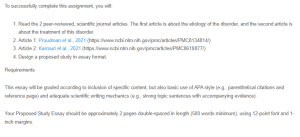
To successfully complete this assignment, you will:
- Read the 2 peer-reviewed, scientific journal articles. The first article is about the etiology of the disorder, and the second article is about the treatment of this disorder.
- Article 1: Proudman et al., 2021 (https://www.ncbi.nlm.nih.gov/pmc/articles/PMC8134814/)
- Article 2: Karrouri et al., 2021 (https://www.ncbi.nlm.nih.gov/pmc/articles/PMC8610877/)
- Design a proposed study in essay format.
Enhancing Depression Treatment Through Digital Cognitive Behavioral Therapy
Requirements
This essay will be graded according to inclusion of specific content, but also basic use of APA style (e.g., parenthetical citations and reference page) and adequate scientific writing mechanics (e.g., strong topic sentences with accompanying evidence).
Your Proposed Study Essay should be approximately 2 pages double-spaced in length (500 words minimum), using 12-point font and 1-inch margins.