
Project Translation and Planning
The proposed change is for individual departments in a healthcare facility to have a formal staffing plan that ensures every patient receives care from the most appropriately skilled nurse (Griffiths et al., 2020). The second proposal is to decrease nurse turnover by limiting mandatory overtime, delegating tasks to other qualified staff, improving workflow by adopting up-to-date technology, and offering competitive compensation in line with a nurse’s experience (Shaffer & Curtin, 2020), and lastly, having a staffing committee that will provide input on procedures on scheduling and staffing policies. It will also ensure that the standards proposed are consistent throughout the department or healthcare facility. By having set guidelines, the chances of poor nurse-to-patient ratio are reduced (McDonald, 2019).
When these proposed changes are put in place, the nurse turnover should have decreased, nurses’ job dissatisfaction should be minimal to none, and nurse to patient ratio should be improved. To measure these changes, the first step would be to form the nurse staffing committee, which will then create a simplified version of the policies. The second will be to have the department create its staffing plans and communicate these to the staff. The third step would be to have a nurse staff training where the new changes will be communicated. In the staff training, the nurses will get an opportunity to share their feedback and give suggestions on what they believe would work best in dealing with nurse shortages.
After three months following the implementation of the changes, the nursing and committee staff will attend another staff meeting and give their feedback. Nurses will fill in a questionnaire to assess their job satisfaction and overall satisfaction with the changes. The committee will also discuss the effectiveness of the plan and the current nurse-to-patient ratios.
The list of outcomes includes reduced nurse-to-patient ratio, increased job satisfaction, efficient nurse staffing process, and reduced nurse turnover rates. The first outcome of reducing nurse to patient ratio will be assigned to the department heads in charge of creating the staffing plan. The second outcome will be assigned a change agent who will be a nurse among the nurses. The change agent will be tasked with motivating the other staff to stay on course with the new changes. The third outcome will be assigned to the staffing committee, which will ensure that the right number of nurses are available at any given time to cater to patients, mandatory overtime is limited, there is delegation of tasks to other qualified staff, there is improved workflow, and competitive compensation packages are offered.
In achieving these outcomes, the individual departments will ensure that decisions on staffing address the most common factors, such as a nurse’s expertise level, number of discharges and admissions, and patient acuity. As mentioned, the facility will consider limiting mandatory overtime, delegating paperwork to other qualified staff, adopting updated technology, and offering competitive remuneration. Additionally, the committee will ensure that the guidelines are in line with reducing poor working conditions for nurses, including overworking.
The main resources needed will be a new staff scheduling computer software system that will allow for fair and effective staff numbers. The system will ensure that there are sufficient numbers of nurses at any given time and that nurses are not overworked. Also, the system will ensure that the most appropriately qualified nurses are scheduled for patients to avoid work duplication and ensure patients get optimal care. Another resource that will be needed is for the healthcare facility to hire an additional ten nurses and offer competitive remuneration. The additional nurses will fill the current gap and, hence, reduce shortages. The competitive remuneration will attract nurses to stay and ideally be more satisfied with their jobs, hence reducing nurse turnover. That said, the HR department and the finance department will need to recruit new staff and fund the new technology system and remuneration, respectively.
The milestones will be set on a quarterly basis. After every three months, the committee and the department heads will need to report on their progress. Nurses will need to fill in a questionnaire to determine their level of satisfaction with the new changes. After a year, the project will be deemed as successfully implemented or a failure.
The potential setbacks include a lack of finances to accommodate ten new nursing staff within the first quarter of the project implementation. A second possible setback is linked to the first, where nurses will be dissatisfied with their jobs because of overworking, and consequently, some may resign from work. To mitigate these risks, the healthcare facility should consider having voluntary student nurses to fill in the existing labor gap. The student nurses can be assigned simpler tasks such as taking patients’ vitals and wound dressing, among others. These student nurses will fill the gap as the facility sources funds to hire ten permanent staff.
The finance department will need to give an update every three months on their progress as regards sourcing funds to hire the additional staff. Also, the HR department will need to put out advertisements for job openings. The HR department will need to give updates to the change team on the recruitment progress.
The PARIHS framework comprises three elements: the evidence’s nature, implementation context quality, and appropriate facilitation approaches. The evidence is the knowledge source, as the stakeholders perceive it to be. Context is the environment’s quality where the implementation of the project will take place. Facilitation refers to the technique of supporting all stakeholders in changing their skills and attitudes (Harvey & Kitson, 2015).
Evaluation Plan
Short-term outcomes will include the development of a staffing plan and the installation of the software system. The department staff in charge of staff will be trained on how to use the system to manage nurse staff numbers. The second short outcome will be for HR to start the nurse recruiting process and have some candidates they are considering. The third short-term outcome will be the committee having the policy documents ready by the first quarter of the project evaluation. The long-term outcomes will be increased job satisfaction by nurses, appropriate nurse-to-patient ratio, ten new nurses recruited, better remuneration of nurses, and effective staffing based on skilled nurses attending to patients based on their specialty area.
Data will be collected after every three months. Nurse satisfaction will be determined through nurses filling out questionnaires to determine their satisfaction levels. Data on staffing ratios will also be collected and presented every three months and should reflect an improvement from the current situation. The data on the rate of nurse turnover will also be collected, and the numbers should have declined at the end of each quarter.
The evaluation points will be established in the areas above where data will be collected. After every three months, the stakeholders will meet, and each will give their feedback on the progress of the project. The HR and finance departments will update the stakeholders on the recruitment and software implementation progress, respectively. The nurses’ job satisfaction will be determined through the questionnaires they fill. The number of staff turnover rates and nurse-to-patient ratios will determine the effectiveness of the system.
References
Griffiths, P., Saville, C., Ball, J., Jones, J., Pattison, N., Monks, T., & Safer Nursing Care Study Group. (2020). Nursing workload, nurse staffing methodologies, and tools: A systematic scoping review and discussion. International Journal of Nursing Studies, 103, 103487.
Harvey, G., & Kitson, A. (2015). PARIHS re-visited: introducing the i-PARIHS framework. In Implementing Evidence-Based Practice In Healthcare (pp. 25-46). Routledge.
McDonald, B. (2019). Utilizing nurse staffing committees to engage direct care nurses in developing alternative shift lengths. Nurse leader, 17(2), 147-150.
Shaffer, F. A., & Curtin, L. (2020). Nurse turnover: Understand it, reduce it. My American Nurse, 15(8), 57-59.
ORDER A PLAGIARISM-FREE PAPER HERE
We’ll write everything from scratch
Question 
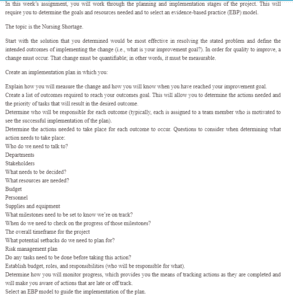
In this week’s assignment, you will work through the planning and implementation stages of the project. This will require you to determine the goals and resources needed and to select an evidence-based practice (EBP) model.
Project Translation and Planning
The topic is the Nursing Shortage.
Start with the solution that you determined would be most effective in resolving the stated problem and define the intended outcomes of implementing the change (i.e., what is your improvement goal?). In order for quality to improve, a change must occur. That change must be quantifiable; in other words, it must be measurable.
Create an implementation plan in which you:
Explain how you will measure the change and how you will know when you have reached your improvement goal.
Create a list of outcomes required to reach your outcomes goal. This will allow you to determine the actions needed and the priority of tasks that will result in the desired outcome.
Determine who will be responsible for each outcome (typically, each is assigned to a team member who is motivated to see the successful implementation of the plan).
Determine the actions needed to take place for each outcome to occur. Questions to consider when determining what action needs to take place:
Who do we need to talk to?
Departments
Stakeholders
What needs to be decided?
What resources are needed?
Budget
Personnel
Supplies and equipment
What milestones need to be set to know we’re on track?
When do we need to check on the progress of those milestones?
The overall timeframe for the project
What potential setbacks do we need to plan for?
Risk management plan
Do any tasks need to be done before taking this action?
Establish budget, roles, and responsibilities (who will be responsible for what).
Determine how you will monitor progress, which provides you the means of tracking actions as they are completed and will make you aware of actions that are late or off track.
Select an EBP model to guide the implementation of the plan.
Remember that without a measure, progress becomes a matter of opinion, and opinions can easily change throughout an implementation timeline.
Create an evaluation plan. Your evaluation plan will define the standard of measurement for progress and will include:
Measurable outcomes (both short-term and long-term – formative assessments and summative assessments)
Data to be collected and how and when it is to be collected
Established evaluation points where data can be evaluated and adjustments made to the implementation plan as a result.