
Professional Identity of the Nurse- Role of the Nurse and Scope of Practice
Nurses are an important element of health care. They provide care services to patients and people within communities that are in need of care. Nursing roles include collaborating and assisting physicians and other healthcare workers in improving patient and population health outcomes. Nursing roles vary from simple roles, such as providing direct care to patients, to the management and leadership of nursing and health care systems. This paper describes the roles of registered nurses (RNs) and the scope of practice for RNs in Minnesota State and compares and contrasts the scope of practice for LPNs and RNs as per the Minnesota Nurse Practice Act.
Roles of a Registered Nurse (RN)
RNs provide services. They provide consultations and other family care services at the primary care in rural and urban settings. The development of the RN role has greatly contributed to the accessibility of health care services as well as the development of accountability in health care (McNee, 2020). The roles of RNs are defined by their State’s Board of Nursing and the existing policies on nursing and RNs’ scope of practice. RNs’ roles include carrying out physical assessments and diagnostic tests on patients, collaborating with medical teams to deliver quality and safe care, providing bedside care, recording the symptoms of the patients, recording their medical history, and supporting and educating patients (Health Research Policy, 2022). Additionally, RNs operate medical equipment, monitor the development of patient health, and administer medications and treatments under physician supervision.
Scope of Practice for Registered Nurses in Minnesota
The Minnesota Nurse Practice Act (Minnesota NPA) defines the scope of practice nurses of various qualifications are authorized to practice. However, nurses have the responsibility to ensure that they practice professionally, are accountable, and ensure that they provide care as per their authority, education, and competency (Minnesota Board of Nursing, n.d.). According to the Minnesota Board of Nursing Nurse Practice Act-Minnesota Statute Section 148.171 (Minnesota Board of Nursing, 2020), RNs are legalized to perform disease diagnoses across the states. The Minnesota NPA also allows RNs to collect, analyze, and synthesize patient health data to determine the patient’s health status and establish a diagnosis. RNs are also authorized to add new diagnoses to an existing diagnosis as well as add or develop new care plans to fit in with a new diagnosis or the patient’s health status. In addition, RNs are also authorized to operate medical equipment within the wards or during the management of patients. The RNs, as per their broader scope of practice, are allowed to administer medications within the state of Minnesota. Additionally, RNs in Minnesota are permitted to develop personalized nursing interventions for individual patients to improve existing or new care plans.
Comparing and Contrasting the Scope of Practice for LPN and RN Roles as per the Minnesota Nurse Practice Act
A review of the Minnesota NPA as established by the standards of practice indicates that RNs and LPNs are legalized to practice almost similar roles. The standards of care under the Minnesota NPA define the roles of LPNs and RNs as both focused on the provision of primary health care services such as educating the patients on health issues, their health care plans, supporting physicians in the delivery of care services, and updating patient information and their development as per the health care plans.
However, the RN’s scope of practice is broader than the LP’s scope of practice, as RNs are authorized to perform roles beyond the LP’s level of competence. RNs in Minnesota can operate health equipment, diagnose diseases, administer medications, and perform other duties in collaboration with physicians, such as changing care plans and diagnosis, and directly contribute to the development of nursing and health care policies. On the other hand, the scope of practice for LPNs is limited, as defined by the Minnesota NPA. LPNs are authorized only to carry out simpler tasks than RNs and play a participatory role in primary care settings, including providing physicians with support during the diagnosis of a patient. LPNs are expected to ensure the safety of the health care setting, manage unlicensed assistive personnel, and play an advocacy role for individual patients. Despite their scope of practice, LPNs are required to perform their roles under the supervision of RNs.
Conclusion
Nurses play an important role within healthcare systems in the U.S and worldwide. Nurses’ roles are defined by the scope of practice within the state they practice their roles. However, they are accountable for the safety and quality of care they provide to their patients. The scope of practice for nurses is determined by their level of education, specialization, and their state’s NPA. RNs in Minnesota have a broader scope of practice than LPNs. As an RN, I will always refer to the provisions of the Minnesota NPA to ensure that I deliver care as per my skills and authority to avoid medical errors and risks to patient safety. I will also use the scope of practice to make decisions on my future career development nursing specialization.
References
Health Research Policy. (2022). What are the Roles of a Registered Nurse?. https://www.healthresearchpolicy.org/roles-registered-nurse/
McNee, P. (2020). Context of Care and Service Delivery. Nursing Care of Children and Young People with Long‐Term Conditions, 31–54. https://doi.org/10.1002/9781119653134.CH2
Minnesota Board of Nursing. (2020). Minnesota Board of Nursing Nurse Practice Act-Minnesota Statute Section 148.171. https://mn.gov/boards/assets/NPA_2013_Combined_Def_12-2020_tcm21-37252.pdf
Minnesota Board of Nursing. (n.d.). Scope of Practice. Retrieved October 27, 2022, from https://mn.gov/boards/nursing/practice/nursing-practice-topics/scope-of-practice.jsp
ORDER A PLAGIARISM-FREE PAPER HERE
We’ll write everything from scratch
Question 
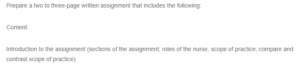
Prepare a two to three-page written assignment that includes the following:
Content:
Introduction to the assignment (sections of the assignment; roles of the nurse, scope of practice, compare and contrast scope of practice)
Professional Identity of the Nurse- Role of the Nurse and Scope of Practice
Describe the roles of the nurse for the program you are currently enrolled
Identify the scope of practice for the nurse in the state where you intend to practice
Using the Nurse Practice Act for the state where you intend to practice, compare and contrast the scope of practice for the LPN and RN
Conclusion (reflect on the assignment including how you will use the scope of practice to support your role)
Use at least two credible resources to support your findings. For example, one of the resources could be the State Board of Nursing website, and another resource could be a textbook. These resources must be integrated into the body of your paper using at least two in-text citations. Be sure to use proper APA format and style.
Format:
Standard American English (correct grammar, punctuation, etc.)
Logical, original, and insightful
Professional organization, style, and mechanics in APA format and style
Run your paper through Grammarly and make corrections to identify errors before submission. Note: You must use the following link to create your Grammarly account. You must use your Rasmussen student email address: https://www.grammarly.com/signin?page=edu