
Presentation – Leadership Style

Hello, and welcome to today’s presentation. The brief presentation offers a self-assessment report based on Goleman’s leadership style framework. Having conducted a self-assessment based on the framework, the presentation will provide assessment outcomes, with the highest score being my leadership style. I conducted the self-assessment before reviewing the corresponding leadership styles; hence, it is a true reflection of my preferences.
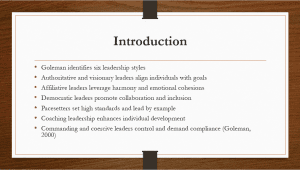
Daniel Goleman provides a leadership framework that categorizes leadership into six distinct styles applicable across different industries. Firstly, authoritative and visionary leaders clearly articulate organizational goals and guide the team toward achieving those goals. Secondly, affiliative leaders are interested in building relationships, enhancing harmony, and ensuring emotional cohesion in teams. On the other hand, democratic leaders promote collaboration and inclusion, incorporating every team member’s input into decision-making. In pacesetting leaders, leaders set high expectations and lead by example in pursuing these goals. Coaching leaders focus on individual development, hoping that this will motivate individuals to exploit their potential. Finally, commanding and coercive leaders assert control and demand immediate compliance, making them the sole decision-makers (Goleman, 2000).
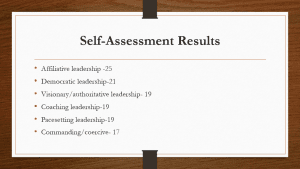
In my self-assessment, affiliative leadership had the most points at 25, as I agreed with all elements characterized by this leadership style. Democratic leadership ranked second at 21 points. This is not a coincidence since affiliative leadership and democratic leadership share common elements. The other three leadership styles, including visionary/authoritative, coaching, and pacesetting, tied for the third position with 19 points. Finally, the commanding/coercive leadership style emerged last with just 17 points. Based on this assessment outcome, I align with the affiliative leadership style. According to Steinmann et al., (2016), affiliative leadership is concerned with building positive relationships and emotional connections, two traits I value.
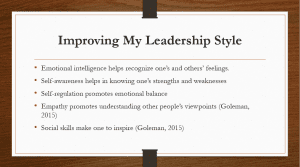
I can leverage Goleman’s theory of emotional intelligence to improve my affiliative leadership style. He provides six elements of emotional intelligence that can bolster a leader’s relational qualities. From the outset, self-awareness, which refers to understanding one’s strengths and weaknesses, can improve an affiliative leader’s effectiveness as they can focus on their strengths and delegate roles they are weak. Besides, self-regulation will be helpful, especially in an affiliative leadership style, because leadership entails working with individuals with different behavioral patterns. A great leader must understand their followers and know how to accommodate them. Another key component of emotional intelligence is empathy, which enables leaders to understand diverse viewpoints by ‘putting oneself in other people’s shoes.’ Also, social skills will improve the effectiveness of an affiliative leader because leaders with social skills can communicate, persuade, and influence others (Goleman, 2015)
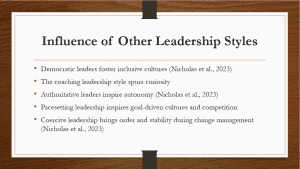
Apart from the affiliative leadership style, the other five leadership styles in Goleman’s leadership model are also crucial in an organizational setting. The democratic leadership style fosters inclusivity, where every follower feels valuable to the organization, knowing that their input matters. The coaching leadership style inspires curiosity as leaders help followers attain individual development and discover their hidden capabilities. On the other hand, visionary and authoritative leaders foster an autonomous culture by setting clear expectations and informing followers of the expected end goal. Pacesetting leadership inspires goal-driven cultures and competition as leaders set a high bar for followers. Finally, even though coercive leadership seems undesirable, it is vital during change management as it brings stability and order since followers must comply with what a leader commands (Nicholas et al., 2023).
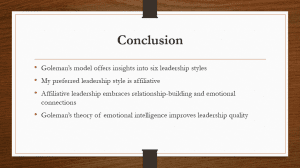
In summary, Goleman’s leadership styles model provides insights into six leadership models applicable across different industries. They include authoritative, coaching, pacesetting, coercive, democratic, and affiliative coaching styles. Having carried out a self-assessment, I scored the most on the affiliative leadership element, and I agree that this is my preferred leadership style. Affiliative leaders foster harmony, emotional connections, and positive relationships in a team. Goleman provides an emotional intelligence (EI) theory, giving insight into elements of EI that can be used to improve leadership, including self-awareness, social skills, self-regulation, and empathy, all of which improve the quality of leadership.
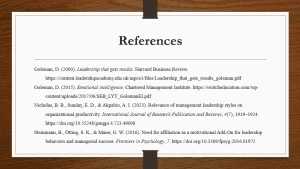
Goleman, D. (2000). Leadership that gets results. Harvard Business Review. https://content.leadershipacademy.nhs.uk/aspce3/files/Leadership_that_gets_results_goleman.pdf
Goleman, D. (2015). Emotional intelligence. Chartered Management Institute. https://switcheducation.com/wp-content/uploads/2017/06/SEB_LYT_GolemanEI.pdf
Nicholas, B. B., Sunday, E. D., & Akpabio, A. I. (2023). Relevance of management leadership styles on organizational productivity. International Journal of Research Publication and Reviews, 4(7), 1919–1924. https://doi.org/10.55248/gengpi.4.723.49098
Steinmann, B., Ötting, S. K., & Maier, G. W. (2016). Need for affiliation as a motivational Add-On for leadership behaviors and managerial success. Frontiers in Psychology, 7. https://doi.org/10.3389/fpsyg.2016.01972
ORDER A PLAGIARISM-FREE PAPER HERE
We’ll write everything from scratch
Question 
Scenario
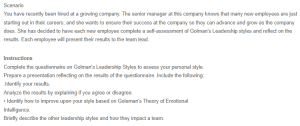
You have recently been hired at a growing company. The senior manager at this company knows that many new employees are just starting out in their careers, and she wants to ensure their success at the company so they can advance and grow as the company does. She has decided to have each new employee complete a self-assessment of Golman’s Leadership styles and reflect on the results. Each employee will present their results to the team lead.
Presentation – Leadership Style
Instructions
Complete the questionnaire on Golman’s Leadership Styles to assess your personal style.
Prepare a presentation reflecting on the results of the questionnaire. Include the following:
.Identify your results.
Analyze the results by explaining if you agree or disagree.
• Identify how to improve upon your style based on Goleman’s Theory of Emotional
Intelligence.
Briefly describe the other leadership styles and how they impact a team.