
PRAC 6665/6675 Clinical Skills
Self-Assessment Form
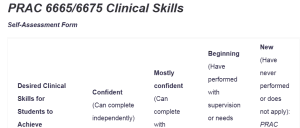
| Desired Clinical Skills for Students to Achieve | Confident (Can complete independently) | Mostly confident (Can complete with supervision) | Beginning (Have performed with supervision or needs supervision to feel confident) | New (Have never performed or does not apply): PRAC 6665/6675 Clinical Skills |
| Comprehensive psychiatric evaluation skills in: | ||||
| Recognizing clinical signs and symptoms of psychiatric illness across the lifespan | Beginning | |||
| Differentiating between pathophysiological and psychopathological conditions | Beginning | |||
| Performing and interpreting a comprehensive and/or interval history and physical examination (including laboratory and diagnostic studies) | Confident | |||
| Performing and interpreting a mental status examination | Confident | |||
| Performing and interpreting a psychosocial assessment and family psychiatric history | Confident | |||
| Performing and interpreting a functional assessment (activities of daily living, occupational, social, leisure, educational). | Confident | |||
| Diagnostic reasoning skill in: | ||||
| Developing and prioritizing a differential diagnoses list | Mostly confident | |||
| Formulating diagnoses according to DSM 5-TR based on assessment data | Mostly confident | |||
| Differentiating between normal/abnormal age-related physiological and psychological symptoms/changes | Mostly confident | |||
| Pharmacotherapeutic skills in: | ||||
| Selecting appropriate evidence based clinical practice guidelines for medication plan (e.g., risk/benefit, patient preference, developmental considerations, financial, the process of informed consent, symptom management) | Confident | |||
| Evaluating patient response and modify plan as necessary | Confident | |||
| Documenting (e.g., adverse reaction, the patient response, changes to the plan of care) | Confident | |||
| Psychotherapeutic Treatment Planning: | ||||
| Recognizes concepts of therapeutic modalities across the lifespan | Confident | |||
| Selecting appropriate evidence based clinical practice guidelines for psychotherapeutic plan (e.g., risk/benefit, patient preference, developmental considerations, financial, the process of informed consent, symptom management, modality appropriate for situation) | Confident | |||
| Applies age appropriate psychotherapeutic counseling techniques with individuals and/or any caregivers | Confident | |||
| Develop an age appropriate individualized plan of care | Confident | |||
| Provide psychoeducation to individuals and/or any caregivers | Mostly confident | |||
| Promote health and disease prevention techniques | ||||
| Self-assessment skill: | ||||
| Develop SMART goals for practicum experiences | Confident | |||
| Evaluating outcomes of practicum goals and modify plan as necessary | Confident | |||
| Documenting and reflecting on learning experiences | Confident | |||
| Professional skills: | ||||
| Maintains professional boundaries and therapeutic relationship with clients and staff | Confident | |||
| Collaborate with multi-disciplinary teams to improve clinical practice in mental health settings | Mostly confident | |||
| Identifies ethical and legal dilemmas with possible resolutions | Mostly confident | |||
| Demonstrates non-judgmental practice approach and empathy | Confident | |||
| Practices within scope of practice | ||||
| Selecting and implementing appropriate screening instrument(s), interpreting results, and making recommendations and referrals: | ||||
| Demonstrates selecting the correct screening instrument appropriate for the clinical situation | Confident | |||
| Implements the screening instrument efficiently and effectively with the clients | Confident | |||
| Interprets results for screening instruments accurately | Confident | |||
| Develops an appropriate plan of care based upon screening instruments response | Confident | |||
| Identifies the need to refer to another specialty provider when applicable | Confident | |||
| Accurately documents recommendations for psychiatric consultations when applicable | Confident | |||
Summary of Strengths:
| I have specific strengths in selecting screening instruments that are appropriate for the presenting clinical complaint. My scores were high in selecting situation-specific screening instruments and implementing screening instruments efficiently. I am also confident in performing self-assessments and maintaining professional relationships during clinical engagements.
My ability to perform psychiatric assessments is also one of my strengths. I can confidently perform a physical exam, mental status examination, and functional assessment for all patients. |
Opportunities for Growth:
| I still need to improve in the areas of recognizing the clinical signs and symptoms of some mental health disorders. I am also just beginning to distinguish psychopathological and pathophysiological conditions. Developing and prioritizing differential diagnosis, providing psychoeducation, formulating, and collaborating with multidisciplinary teams during clinical engagements are other areas I need to work on. |
Goals and Objectives
| 1. Goal: To be able to recognize the signs and symptoms of the most common psychiatric illnesses encountered within the healthcare facility within the third week of the practicum.
a. Objective: I will engage my preceptor and other staff members in discussing the signs and symptoms of mental health disorders. b. Objective: I will allocate two hours every day to read textbooks that document the signs and symptoms of various mental health illnesses. c. Objective: I will utilize the hospital library to access texts and journals on mental health disorders. 2. Goal: To be able to distinguish pathophysiological from psychopathological conditions by the seventh week of the practicum. a. Objective: I will allocate two hours every day to reading about mental health disorders. b. Objective: I will read and understand some of the overlapping symptoms of common pathophysiological and psychopathological illnesses. c. Objective: I will engage my preceptor continuously to better understand challenging psychopathological conditions. 3. Goal: To be able to come up with differential diagnoses that are related to the findings from functional assessment of patients by the third week of the practicum. a. Objective: I will attend at least three clinical rounds to improve my understanding of how to formulate differential diagnoses based on clinical manifestations. b. Objective: I will watch at least two videos that demonstrate how nurses can formulate differential diagnoses. c. Objective: To engage my preceptor and peers continuously to improve my understanding of how to come up with differential diagnoses. 4. Goal: To be able to provide psychoeducation to different populations confidently within the tenth week of the practicum. a. Objective: I will read about what constitutes a best practice when communicating with patients from different cultures. b. Objective: I will allocate at least 30 minutes to learn about the best strategies to manage mental health disorders. c. Objective: I will consult my peers and other health educators on the skills necessary to educate patients on mental health disorders. |
Signature:
Date:
Course/Section:
ORDER A PLAGIARISM-FREE PAPER HERE
We’ll write everything from scratch
Question 
Clinical Skills Self-Assessment
This critical self-reflection is especially important for developing clinical skills such as those for advanced practice nursing.
The PMHNP Clinical Skills List and PMHNP Clinical Skills Self-Assessment Form provided in the Learning Resources can be used to celebrate your progress throughout your practicum and identify skills gaps. The skills list covers all necessary skills you should demonstrate during your practicum experiences.
For this Assignment (just as you did in PRAC 6645), you assess where you are now in your clinical skill development and make plans for this practicum. Specifically, you will identify strengths and opportunities for improvement regarding the required practicum skills. In this practicum experience, when developing your goals and objectives, be sure to keep assessment and diagnostic reasoning in mind. As you complete your self-assessment this week, you may wish to look back over your self-assessments from prior practicums to reflect on your growth.
PRAC 6665/6675 Clinical Skills
To Prepare
- Review the clinical skills in the PMHNP Clinical Skills List document. It is recommended that you print out this document to serve as a guide throughout your practicum.
- Review the “Developing SMART Goals” resource on how to develop goals and objectives that follow the SMART framework.
- Review the resources on nursing competencies and nursing theory, and consider how these inform your practice.
- Download the PMHNP Clinical Skills Self-Assessment Form to complete this Assignment.
The Assignment
Use the PMHNP Clinical Skills Self-Assessment Form to complete the following:
- Rate yourself according to your confidence level performing the skills identified in the Clinical Skills Self-Assessment Form.
- Based on your ratings, summarize your strengths and opportunities for improvement.
- Based on your self-assessment and theory of nursing practice, develop three to four (3–4) measurable goals and objectives for this practicum experience.
Include them on the designated area of the form.
By Day 7 of Week 1
Submit your completed PMHNP Clinical Skills Self-Assessment Form.
submission information
Before submitting your final assignment, you can check your draft for authenticity. To check your draft, access the Turnitin Drafts from the Start Here area.
- To submit your completed assignment, save your Assignment as WK1Assgn2+last name+first initial.
- Then, click on Start Assignment near the top of the page.
- Next, click on Upload File and select Submit Assignment for review.