
Plan of Care
Consultations
The patient in the case study had a positive diagnosis of viral gastroenteritis. Viral gastroenteritis is a self-limiting disease that often does not require specific treatments (Leung & Hon, 2021). In this patient’s case, a history of presenting illness reveals that the symptoms of diarrhea and vomiting are slowly beginning to wane, as evident by the reduction in the number of diapers used. However, clinical consultation may be necessitated by the persistence of vomiting and diarrhea. Excessive vomiting and diarrhea often lead to dehydration and electrolyte derangements that, in turn, complicate the clinical presentation. Diarrhea and vomiting cause loss of electrolytes. Of significance are sodium and potassium losses (Karampatsas, Osborne, Seah, Tong & Prendergast, 2018). The consequence of these derangements is usually evident in the deterioration of the general health of the baby and may lead to shock.
Close monitoring in a healthcare facility by a pediatrician may be required to prevent further complications. Referral to these specialists should indicate the unresolved nature of the symptoms and the evidence of a diagnosis of viral gastroenteritis. Additionally, a nutritionist may also be consulted to aid in the determination of dietary requirements that may quickly enable the replacement of the lost fluids.
Therapeutic Consultations
The mainstay modality of management in viral gastroenteritis is rehydration. Rehydration entails taking a lot of fluids as well as administering fluid-rich foods. In severe cases, intravenous fluid administration may be necessary (Leung & Hon, 2021). Fluids may include water, fruit juice, and oral rehydration solutions. Sugar-containing fluids such as soft drinks are discouraged as they may exacerbate dehydration, a joint presentation in gastroenteritis. Additionally, milk-containing fluids should be avoided as they may worsen diarrhea and vomiting. Pharmacological treatment is not often required, although zinc sulfate tablets may be necessary as they may aid the absorption of water and electrolytes.
Health Promotions
Several factors have been implicated in the development of viral gastroenteritis in children. These include poor hygiene and lack of rotavirus vaccine. As health promotion strategies, households should be advised to vaccinate children before age six against rotavirus, as rotaviruses have increasingly been implicated in viral gastroenteritis. Poor hygiene enables the spread of viruses (Parashar, Nelson & Kang, 2016). Children who develop symptoms of the disease should not be allowed to share items such as feeding plates as this may increase the risk of spreading the virus.
Patient Education
The patients and their family members should be educated on the predisposing factors to viral gastroenteritis and the preventive measures against the disease. Poor hygiene is the most common cause of viral gastroenteritis. Therefore, These families should be advised on the need for hygiene maintenance and the strategies utilized in maintaining good hygiene. Proper handwashing with soap and running water, use of alcohol-based hand sanitizers to clean hands in the absence of soap and running water, and decontaminating surfaces with bleach-based fluid cleaners can all be beneficial in preventing the spread of these viruses. Handwashing with soap and water should be done after toilet visitation, changing diapers, and handling foodstuffs (Gosselin, Généreux, Gagneur & Petit, 2016). They should also be warned against the consumption of water or foods that may be contaminated.
Disposition/follow-up instructions
Several specific sets of instructions should be given to the patient’s caretaker upon disposition. Strict fluid therapy should be observed with dietary fluids such as water and oral rehydration solutions. The patient should be monitored closely in the next few days to establish the progression of the disease. In case of persistence in the symptoms of diarrhea and vomiting, the patient should be brought to the clinic for further examination. The patient should be rushed to the emergency department in case severe dehydration and electrolyte derangements develop as a consequence of fluid and electrolyte losses. The patient should, therefore, be monitored closely in the next few days to enable the discovery of these problems.
Viral gastroenteritis is a self-limiting disease presenting with vomiting and diarrhea. The symptoms usually resolve after a few days but may persist in some instances. The disease has been implicated in poor hygienic situations and the absence of the rotavirus vaccine among children. Fluid rehydration is the mainstay of management in viral gastroenteritis. Persistence in vomiting and diarrhea may cause severe electrolyte derangements and dehydration that may warrant admission to the emergency department.
References
Gosselin, V., Généreux, M., Gagneur, A., & Petit, G. (2016). Effectiveness of rotavirus vaccine in preventing severe gastroenteritis in young children according to socioeconomic status. Human Vaccines & Immunotherapeutics, 12(10), 2572-2579. DOI: 10.1080/21645515.2016.1189038
Karampatsas, K., Osborne, L., Seah, M., Tong, C., & Prendergast, A. (2018). Clinical characteristics and complications of rotavirus gastroenteritis in children in east London: A retrospective case-control study. PLOS ONE, 13(3), e0194009. DOI: 10.1371/journal.pone.0194009
Leung, A., & Hon, K. (2021). Pediatrics: how to manage viral gastroenteritis. Drugs In Context, 10, 1-11. DOI: 10.7573/dic.2020-11-7
Parashar, U., Nelson, E., & Kang, G. (2016). Diagnosis, management, and prevention of rotavirus gastroenteritis in children. BMJ, 347(dec30 1), f7204-f7204. DOI: 10.1136/bmj.f7204
ORDER A PLAGIARISM-FREE PAPER HERE
We’ll write everything from scratch
Question 
Nutritional Intake
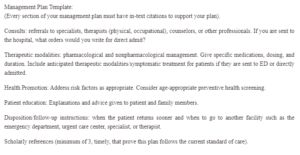
Management Plan Template:
(Every section of your management plan must have in-text citations to support your plan).
Consults: referrals to specialists, therapists (physical, occupational), counselors, or other professionals. If you were sent to the hospital, what orders would you write for direct admission?
Therapeutic modalities: pharmacological and nonpharmacological management. Give specific medications, dosing, and duration. Include anticipated therapeutic modalities/symptomatic treatment for patients who are sent to the ED or are directly admitted.
Health Promotion: Address risk factors as appropriate. Consider age-appropriate preventive health screening.
Patient education: Explanations and advice given to patient and family members.
Disposition/follow-up instructions: when the patient returns sooner and when to go to another facility such as the emergency department, urgent care center, specialist, or therapist.
Scholarly references (minimum of 3, timely, that prove this plan follows the current standard of care).