
PICO(T) Questions and an Evidence-Based Approach – Chronic Kidney Disease
Chronic kidney disease (CKD) is a progressive condition defined by the gradual loss of kidney function, often leading to serious complications such as hyperphosphatemia. The poor control of phosphate in non-dialysis patients with stages 3 to 5 CKD increases the chance of vascular calcification and heart issues (Vaidya & Aeddula, 2024). Despite official treatment guidelines, doctors still have different approaches and patients often fail to follow the suggested treatments. Appropriate management of phosphate in the blood helps CKD patients live better and longer. Accordingly, applying evidence-based practice (EBP) helps find the most effective ways, like using phosphate binders and restricting phosphates in food. Baccalaureate-prepared nurses help integrate medical research into actual patient care. In this paper, a PICO(T) method is used to explore the control of phosphate in CKD and guide the researcher in examining the most crucial research findings.
Defining the Practice Issue and Developing a PICO(T) Question
Hyperphosphatemia is a prevalent and dangerous complication in adults with CKD, especially in stages 3 to 5 before dialysis is initiated. Inadequately treated phosphate in CKD patients who are not on dialysis may lead to vascular calcification and heart-related conditions. Treatment guidelines may vary, and patients tend not to follow the plans recommended by doctors. The right monitoring and treatment of phosphate benefits the lives and longevity of people with CKD.
The use of EBP leads to the discovery of the most helpful approaches, which include phosphate binders and restricting the number of phosphates in one’s diet. Research results are widely used in healthcare because of the efforts of baccalaureate-trained nurses. Using the PICO(T) approach, this paper examines how phosphate is controlled in CKD patients and looks into the most important studies to build better treatment methods.
P (Population): Adults with stage 3-5 CKD not on dialysis
I (Intervention): Phosphate binders
C (Comparison): Dietary phosphate restriction alone
O (Outcome): Improved serum phosphate levels and reduced complications
T (Time): 3 to 6 months
PICO(T) Question
In adults with stage 3-5 CKD not on dialysis (P), how does the use of phosphate binders (I), compared to dietary phosphate restriction alone (C), affect serum phosphate levels and clinical outcomes (O) over a three-to-six-month period (T)?
Sources of Evidence for Answering the PICO(T) Question
When selecting valid research on phosphate management in non-dialysis kidney disease, scholars must work within the strict rules and guidelines set by the PICO(T) framework. Assessing the literature means considering the topics discussed in clinical trials, the quality of evidence presented, and the intersection with CKD interventions and results. Using the ACE Star Model, Johns Hopkins EBP Model, or the PARiHS Model allows one to choose databases best suited to answer the PICO(T) question.
ACE Star Model of Knowledge Transformation
The ACE Star Model provides a framework for applying research to clinical practice by moving through five stages: knowledge discovery, evidence summary, translation into clinical recommendations, practice integration, and evaluation (Brunt & Morris, 2023). When studying strategies related to phosphate in people with non-dialysis CKD, this model helps organize the search for useful studies. Both PubMed and CINAHL are helpful sources in the discovery and summarization processes because they supply access to studies and reviews that peers have examined. PubMed covers a wide variety of nephrology research, and CINAHL provides advice specific to nursing care about diet and following care plans. The data in these sources help respond to the PICO(T) question by presenting evidence on various intervention options and their results in patients.
Johns Hopkins Evidence-Based Practice Model
This model supports rational clinical decisions by encouraging a step-by-step process of asking a practice question, getting relevant information, and using it in practice. The Cochrane Library and GOLD Guidelines are effective when using this model with a PICO(T) question. Cochrane’s systematic reviews synthesize large bodies of evidence regarding care coordination and discharge interventions, while GOLD guidelines provide annual, expert-based recommendations on COPD management that include post-discharge care strategies. These resources are chosen using the Johns Hopkins model because they offer high-level, credible evidence that directly informs nursing roles in managing serum phosphate levels and improving clinical outcomes in non-dialysis CKD patients.
PARiHS Model
The Promoting Action on Research Implementation in Health Services (PARiHS) Model focuses on three key components: evidence quality, context, and facilitation. This model reinforces selecting sources that are not only scientifically robust but also adaptable to the realities of clinical settings. For the phosphate management intervention defined in the PICO(T) question, the Cochrane Library, CINAHL, and PubMed databases can be useful as the sources present the evidence from the same setting as outpatient and nephrology care. Regarding the objectives, these sources relate to nursing roles of educational, monitoring, and supportive nature that can be performed within the context of managing phosphate levels in non-dialysis CKD patients. “The PARIHS framework is a commonly used conceptual framework that posits successful implementation (SI) as a function (f) of the nature and type of evidence (E)…, the qualities of the context (C) of implementation (including culture, leadership, and evaluation), and the way the implementation process is facilitated” (Bergström et al., 2020, p. 2).
Findings from Articles
Since hyperphosphatemia and its associated complications are major clinical challenges in non-dialysis CKD patients, strategies such as phosphate binders and dietary phosphorus management are considered more effective than routine monitoring alone. Key control strategies include pharmacological intervention, nutritional guidance, and promoting long-term adherence to phosphorus-lowering protocols. When it comes to evaluating the efficacy of phosphate management in CKD stages 3 to 5, particularly in non-dialysis patients, two relevant peer-reviewed studies emerge—one by Luo et al. (2023), which is a systematic review and network meta-analysis and another by Colombijn et al. (2022), which assessed quality of life outcomes in relation to phosphate binder use.
A systematic review and network meta-analysis by Luo et al. (2023), which included 68 randomized controlled trials covering 12 different phosphate-lowering drugs, aimed to assess the comparative efficacy and acceptability of these treatments in adults with hyperphosphatemia and CKD. The study demonstrated that non-calcium-based binders, particularly ferric citrate and sevelamer, were more effective in lowering serum phosphate levels and were better tolerated than calcium-based therapies. The analysis applied robust methods, including Bayesian network modeling and GRADE assessment, reinforcing the high credibility of the findings. Results favored iron-based binders as first-line agents, showing a meaningful improvement in phosphorus control and patient acceptability, which are vital in managing CKD progression in outpatient populations.
Similarly, Colombijn et al.’s (2022) study focused on phosphate binders’ influence on the quality of life of dialysis patients. Although the study included non-dialysis CKD patients, its findings show how medicines, especially those managed with binders, can impact a patient’s lifestyle. According to the study, those who take more phosphate binder pills had lower physical and mental quality of life. This reveals the importance of clinicians focusing on the biochemical benefits of drugs and their presence in a patient’s daily life since such considerations are significant in pre-dialysis care.
Both studies demonstrate that controlling phosphate plays a key role in treating CKD. Luo et al. (2023) present large-scale data on several interventions that help clinicians personalize treatment depending on what patients can manage and which treatments are more effective. Additionally, Colombijn et al. (2022) outline how care for patients is impacted by using binders, especially the clash between drug efficacy and its effects on patient’s quality of life. These studies back up a sensible and scientific strategy for controlling phosphate in non-dialysis CKD that matches what patients want.
Relevance of the Findings to the PICO(T) Question
The study by Luo et al. (2023) offers high-level evidence through a meta-analysis of phosphate binders, identifying ferric citrate and sevelamer as the most effective and well-tolerated, aligning with the intervention and outcome of the PICO(T) question. Similarly, Colombijn et al. (2022) provide complementary insight into patient-reported outcomes, showing that increased binder burden negatively affects the quality of life—relevant to treatment adherence in non-dialysis CKD. Zheng et al. (2025) further support iron-based binders as clinically superior, reinforcing Luo et al.’s conclusions. Lee et al. (2022) confirm the long-term efficacy and safety of ferric citrate, with added anemia control benefits, making it a practical choice for advanced CKD management. Among these, Luo et al.’s (2022) findings are the most comprehensive, but the collective findings present a strong, evidence-based rationale for phosphate control strategies that optimize both clinical outcomes and patient experience, directly guiding nursing interventions in non-dialysis CKD care.
Conclusion
All in all, research suggests that phosphate binders, specifically iron-based binders, are effective for controlling phosphate levels in patients with non-dialysis CKD. These measures meet the goals of nursing by enhancing patient care and improving daily living. Putting evidence-based approaches in action provides better patient care and allows clinicians to create tailored, evidence-based treatment plans.
References
Bergström, A., Ehrenberg, A., Eldh, A. C., Graham, I. D., Gustafsson, K., Harvey, G., Hunter, S., Kitson, A., Rycroft-Malone, J., & Wallin, L. (2020). The use of the PARIHS framework in implementation research and practice—A citation analysis of the literature. Implementation Science, 15(1). https://doi.org/10.1186/s13012-020-01003-0
Brunt, B., & Morris, M. (2023, March 4). Nursing professional development evidence-based practice. National Library of Medicine. https://www.ncbi.nlm.nih.gov/books/NBK589676/
Colombijn, J. M. T., Vonk, S., Cornelis, T., Boorsma, S., Krekels, M. M. E., Abrahams, A. C., & Van Jaarsveld, B. C. (2022). Impact of phosphate binders on quality of life in dialysis patients: Results from the prospective Dutch nOcturnal and hoME dialysis study to improve clinical outcomes study. Nephrology, 27(10), 834–844. https://doi.org/10.1111/nep.14088
Lee, C., Lee, C., Wu, M., Chiu, Y., Leu, J., Wu, M., Peng, Y., Wu, M., & Tarng, D. (2022). Long-term safety and efficacy of ferric citrate in phosphate-lowering and iron-repletion effects among patients with on hemodialysis: A multicenter, open-label, Phase IV trial. PLoS ONE, 17(3), e0264727. https://doi.org/10.1371/journal.pone.0264727
Luo, H., Feng, J., Xue, G., Zhang, Y., Li, Y., Huang, X., Chen, X., You, S., Dong, H., Li, L., Li, J., Xiao, H., Ai, X., Li, X., & Huang, B. (2023). Comparative efficacy and acceptability of 12 phosphorus-lowering drugs in adults with hyperphosphatemia and chronic kidney disease: A systematic review and network meta-analysis. Blood Purification, 52(7-8), 609–620. https://doi.org/10.1159/000531577
Vaidya, S., & Aeddula, N. (2024). Chronic kidney disease. National Library of Medicine; StatPearls Publishing. https://www.ncbi.nlm.nih.gov/books/NBK535404/
Zheng, C., Liu, J., Wang, T., Hu, H., & Chen, Y. (2025). A network meta-analysis of therapies for hyperphosphatemia in CKD based on randomized trials. Scientific Reports, 15(1). https://doi.org/10.1038/s41598-024-84942-8
ORDER A PLAGIARISM-FREE PAPER HERE
We’ll write everything from scratch
Question 
PICO(T) Questions and an Evidence-Based Approach – Chronic Kidney Disease
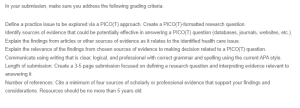
In your submission, make sure you address the following grading criteria:
PICO(T) Questions and an Evidence-Based Approach – Chronic Kidney Disease
Define a practice issue to be explored via a PICO(T) approach. Create a PICO(T)-formatted research question
Identify sources of evidence that could be potentially effective in answering a PICO(T) question (databases, journals, websites, etc.).
Explain the findings from articles or other sources of evidence as it relates to the identified health care issue.
Explain the relevance of the findings from chosen sources of evidence to making decision related to a PICO(T) question.
Communicate using writing that is clear, logical, and professional with correct grammar and spelling using the current APA style.
Length of submission: Create a 3-5 page submission focused on defining a research question and interpreting evidence relevant to answering it.
Number of references: Cite a minimum of four sources of scholarly or professional evidence that support your findings and considerations. Resources should be no more than 5 years old.