
Pharmacological Treatment Regimen
18-Year-Old Female with Complaint of Headache
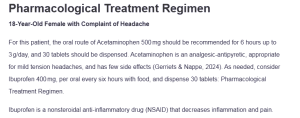
For this patient, the oral route of Acetaminophen 500 mg should be recommended for 6 hours up to 3 g/day, and 30 tablets should be dispensed. Acetaminophen is an analgesic-antipyretic, appropriate for mild tension headaches, and has few side effects (Gerriets & Nappe, 2024). As needed, consider Ibuprofen 400 mg, per oral every six hours with food, and dispense 30 tablets: Pharmacological Treatment Regimen.
Ibuprofen is a nonsteroidal anti-inflammatory drug (NSAID) that decreases inflammation and pain. Monitor the liver in case of heavy use of acetaminophen and renal in case of NSAID use. Provide assurance, hear her triggers, and educate her to perform stress and screen-time management in compassionate care.
47-Year-Old Male with Gout
In the case of the 47-year-old male with gout, prescribe Indomethacin 50 mg via oral route, three times a day for over five days, and dispense 15 capsules. Indomethacin is a successful NSAID as an acute therapeutic agent in gout flares, as it inhibits the synthesis of prostaglandins (van Durme et al., 2021). Consider Colchicine 0.6 mg orally, two tablets at flare onset (1.2 mg), then one tablet one hour later, max 1.8 mg/day, dispense three tablets.
In case of frequent attacks, prescribe Allopurinol 100 mg orally and dispense 30 units, then up-titrate to keep uric acid below 6 mg/dL. Allopurinol is an xanthine oxidase inhibitor that reduces uric acid production. Monitor kidney functioning, liver enzymes, and uric acid. Give food recommendations and water management strategies, and discuss flare-up prevention in a friendly manner.
77-Year-Old Female with Osteoarthritis
For this patient, start with Acetaminophen 500 mg, by mouth every six hours as needed, not to exceed 3 g/day, 60 tablets. For older adults, pain relief is safe with acetaminophen. In the event of persistent pain, add Naproxen 250mg orally, two tablets with meals, and dispense 28 tabs. Naproxen is an NSAID that lowers inflammation (Ahmed & Clarke, 2023).
Co-prescribe it with Omeprazole 20 mg via oral route, and dispense 30 capsules to protect the gastric lining, as it is a proton pump inhibitor. Monitor renal functions, CBC, and hepatic enzymes. Additionally, consider the patient’s mobility concerns, provide assistance in daily activities, and listen actively to her to facilitate comfort and trust.
References
Ahmed, A., & Clarke, J. O. (2023, May 1). Proton pump inhibitors (PPI). PubMed; StatPearls Publishing. https://www.ncbi.nlm.nih.gov/books/NBK557385/
Gerriets, V., & Nappe, T. M. (2024). Acetaminophen. National Library of Medicine; StatPearls Publishing. https://www.ncbi.nlm.nih.gov/books/NBK482369/
van Durme, C. M., Wechalekar, M. D., Landewé, R. B., Pardo Pardo, J., Cyril, S., van der Heijde, D., & Buchbinder, R. (2021). Nonsteroidal anti-inflammatory drugs for acute gout. Cochrane Database of Systematic Reviews, 2021(12). https://doi.org/10.1002/14651858.cd010120.pub3
ORDER A PLAGIARISM-FREE PAPER HERE
We’ll write everything from scratch
Question 
Create a pharmaceutical treatment regimen for each of the following.
- 18-year-old female with complaint of headache
- 47-year-old male with gout
- 77-year-old female with osteoarthritis
The patient specific details are yours to develop and consider to support your choices.
The non-prescription medication if any, AND the prescription details must be present.
Pharmacological Treatment Regimen
You may apply more than one prescription:
- For each the drug name, dose, route, frequency of administration and if prescribed, the quantity to dispense must be present.
- Include the drug class details
- Justify your reasoning
- What labs will you monitor? Why
- Include considerations for compassionate care.
- Provide 3 evidence based support for your stance using standard APA format.
Cite every paragraph appropriately.