
Pharmacological Case Study Analysis
Pharmacotherapy plays a significant role in the management of chronic diseases and improves patient outcomes. In this essay, four patients will be assessed, and recommendations regarding regimes of prescribed drugs will be made based on their needs since they all require individualized regimes in terms of medication. These are prescription error cases, asthma cases, hypertension cases, and a case of diabetes management involving a patient with Alzheimer’s disease. Each of the patients will be provided with pharmacotherapeutic actions that will be suitable to the given patient, with a detailed investigation of the patient, their medical history, current medications, and evidence-based guidelines. This kind of procedure will ensure the optimization of drug treatment, a higher level of patient safety, and an adherence to the contemporary trends in clinical practice, and that would be effective and would help deal with diseases.
Scenario 1: Prescription Errors and Corrections
Medication mistakes may impact the treatment response and patient safety. Mistakes in prescribing linagliptin, Tresiba, tiotropium, Qulipta, and levothyroxine, such as wrong formulation and error in route of administration, should be addressed to ensure the best care.
The first error involved linagliptin, prescribed at 5 mg once daily. Nonetheless, it was not emphasized whether it is advisable to take it with food. The revised prescription shows that the patient can take the drug with or without meals, which makes it their responsibility to take the linagliptin (Rosenthal & Burchum, 2020). Linagliptin belongs to the family of DPP-4 inhibitors, and its action implies binding to the enzyme DPP-4, thus increasing the effects of incretin hormones, leading to an increase in insulin secretion and a decrease in glucagon secretion, thereby lowering the concentration of glucose in the blood.
For Tresiba, a long-acting insulin, the prescription erroneously instructed the patient to administer TID. Tresiba provides stable glucose management for 24 hours with once-daily usage. The revised prescription makes it clear that it has to be used once a day and at the same time every day (Delgado & Bajaj, 2022). Tresiba belongs to long-acting insulin, and it helps to increase the uptake of glucose into the cell and prevents hepatic glucose production.
The third error was with tiotropium, which was incorrectly prescribed orally. Tiotropium is an inhaled medication used for managing chronic obstructive pulmonary disease (COPD) and asthma. The revised prescription includes inhalation in order to deliver it to the lungs. Tiotropium is a long-acting muscarinic antagonist (LAMA), and the adverse effect is that it inhibits airways’ acetylcholine receptors, resulting in bronchodilation and enhancement of airflow.
Qulipta, a PRN prescription, was also to be used daily as a migraine-prevention medication. The correction undertaken makes the patient aware of the importance of administering daily doses to deter migraine attacks (Rizzoli et al., 2024). Qulipta belongs to the group of CGRP receptor antagonists, and its mechanism of action is related to the ability to block the binding of CGRP to the CGRP receptor, thus preventing vasodilation and neurogenic inflammation, which are the factors leading to migraines.
Lastly, there was a correction of levothyroxine not in micrograms but in milligrams to 88 mcg PO daily, followed by ensuring the dose is appropriate (Tsegaye et al., 2020). Levothyroxine, on the other hand, is a copy of a thyroid hormone, and the MOA is a restock of the lacking thyroid hormone to control metabolism and energy production in hypothyroidism patients.
Scenario 2: Asthma Treatment Plan (PK)
The patient (PK) is a 16-year-old girl with mild persistent asthma who complains about an increase in the number of occurring inhalations by albuterol and many nocturnal manifestations, such as coughing. Her medications presently consist of Flovent HFA, Proventil HFA, and fexofenadine, along with diphenhydramine. Considering the added occurrence of albuterol intake and symptoms at night, it is apparent that PK’s asthma is uncontrolled. An integrated management program must be ensured to improve the management of her asthma.
First, the dose of Flovent HFA should be increased to 110 mcg twice a day to achieve better control of inflammation (Remien & Bowman, 2024). Although PK has been taking albuterol every day, her asthma is not well controlled, and this means that her inhaled corticosteroid (ICS) needs to be augmented in order to enhance long-term control (Johnson & Bounds, 2024). It would also be beneficial to add a leukotriene receptor antagonist (LTRA) like Montelukast 10 mg PO daily to help treat inflammation and bronchoconstriction. Proventil HFA (SABA) must be currently used not more than twice a week, with its frequent usage being a sign of poor asthma control (Zeng et al., 2024). Fexofenadine will be a proper treatment of allergic rhinitis symptoms; however, diphenhydramine, with its sedative effects, should be avoided because it may disrupt effective sleep and general asthma control (Craun & Schury, 2020).
Complete Medication Order
- Flovent HFA 110 mcg, two puffs twice daily, #30 inhalers, with one refill.
- Proventil HFA 90 mcg, two puffs every 4-6 hours as needed, #200 inhalers, with one refill.
- Montelukast 10 mg PO daily, #30 tablets, with one refill
Monitoring
Monitor PK’s asthma control through peak flow measurements and symptom tracking. Also, encourage a follow-up visit in two weeks to assess treatment effectiveness.
Patient Education
Teach PK proper inhaler technique, the importance of adhering to daily controller medications, and recognizing worsening asthma symptoms. Encourage reducing exposure to asthma triggers.
Scenario 3: Hypertension Treatment (ES)
ES is an African American male whose hypertension is not well controlled, and his current blood pressure is 142/89 mmHg. He reports occasional compliance with medications related to the effects of bisoprolol, his current antihypertensive treatment. The recommended goal of blood pressure control of ES is less than 140/90 mmHg as stipulated by the JNC 8, ACC, and AHA guidelines for people with established hypertension, especially those at high risk of hypertension such as ES.
During his visit, ES should be trained on the need to take medications as prescribed and how this can minimize the occurrence of complications like stroke, heart attack, and kidney damage. I would clarify that the bisoprolol drug is taken on a daily basis, as directed, to ensure his blood pressure is controlled (Bazroon & Alrashidi, 2023). Furthermore, lifestyle changes suggested, including dietary sodium restriction, physical activity, and weight reduction where appropriate, should be addressed as being an important part of his management plan. I would also recommend him to check his blood pressure regularly at home.
To improve his therapeutic regime, I would prescribe lisinopril 10 mg per day along with his current medication. Lisinopril is an ACE inhibitor that is useful to manage blood pressure and have renal protection, especially in hypertensive patients. Continuation of Bisoprolol 5 mg per day should be achieved (Choudhry et al., 2021).
Complete Medication Order:
- Bisoprolol 5 mg PO daily, #30 tablets, with one refill.
- Lisinopril 10 mg PO daily, #30 tablets, with one refill (Lopez et al., 2024).
Monitoring: Blood pressure should be monitored regularly, and follow-up appointments should assess both blood pressure control and renal function.
Scenario 4: Diabetes and Alzheimer’s Treatment (TF)
TF is a 60-year-old male diagnosed with both Alzheimer’s disease and type 2 diabetes. His current medications include donepezil, lecanemab, and atorvastatin. Still, his lab results show an HbA1c of 8.5%, fasting blood glucose of 195 mg/dL, and impaired renal function with a serum creatinine of 1.9 and an eGFR of 28. The goal for TF’s diabetes management should be an HbA1c below 7%, though his renal function must be carefully considered when selecting medications.
Given TF’s renal impairment, metformin is contraindicated due to the risk of lactic acidosis (Corcoran & Jacobs, 2023). Therefore, I recommend initiating sitagliptin 50 mg PO daily. Sitagliptin, a DPP-4 inhibitor, is safe for patients with reduced renal function, as its dosage can be adjusted based on eGFR. Sitagliptin improves glucose control by inhibiting DPP-4, which prolongs the action of incretin hormones, increasing insulin secretion and reducing glucagon levels (Kasina & Baradhi, 2023). TF’s current statin therapy with atorvastatin 40 mg daily should be continued for cardiovascular protection, especially in patients with diabetes and cognitive decline.
Complete Medication Order
- Sitagliptin 50 mg PO daily, #30 tablets, with one refill
- Atorvastatin 40 mg PO daily, #30 tablets, with one refill (McIver & Siddique, 2020).
Monitoring
Monitor TF’s blood glucose levels regularly and assess renal function (serum creatinine, eGFR) every three months. HbA1c should also be measured periodically to ensure the target is met.
Patient Education
Educate TF about the importance of diabetes management, focusing on proper medication adherence and regular monitoring of blood glucose and kidney health. Discuss the potential side effects of medications and the need for frequent follow-up visits.
References
Bazroon, A. A., & Alrashidi, N. F. (2023, August 17). Bisoprolol. PubMed; StatPearls Publishing. https://www.ncbi.nlm.nih.gov/books/NBK551623/
Choudhry, N. K., Kronish, I. M., Vongpatanasin, W., Ferdinand, K. C., Pavlik, V. N., Egan, B. M., Schoenthaler, A., Houston Miller, N., & Hyman, D. J. (2021). Medication adherence and blood pressure control: A scientific statement from the American Heart Association. Hypertension, 79(1). https://doi.org/10.1161/hyp.0000000000000203
Corcoran, C., & Jacobs, T. F. (2023). Metformin. National Library of Medicine; StatPearls Publishing. https://www.ncbi.nlm.nih.gov/books/NBK518983/
Craun, K. L., & Schury, M. P. (2020). Fexofenadine. PubMed; StatPearls Publishing. https://www.ncbi.nlm.nih.gov/books/NBK556104/
Delgado, B. J., & Bajaj, T. (2022). Tiotropium. PubMed; StatPearls Publishing. https://www.ncbi.nlm.nih.gov/books/NBK541127/
Johnson, D. B., & Bounds, C. G. (2024). Albuterol. National Library of Medicine; StatPearls Publishing. https://www.ncbi.nlm.nih.gov/books/NBK482272/
Kasina, S. V. S. K., & Baradhi, K. M. (2023, May 22). Dipeptidyl peptidase IV (DPP IV) inhibitors. PubMed; StatPearls Publishing. https://www.ncbi.nlm.nih.gov/books/NBK542331/
Lopez, E. O., Parmar, M., & Terrell, J. M. (2024). Lisinopril. PubMed; StatPearls Publishing. https://www.ncbi.nlm.nih.gov/books/NBK482230/
McIver, L. A., & Siddique, M. S. (2020, September 25). Atorvastatin. Nih.gov; StatPearls Publishing. https://www.ncbi.nlm.nih.gov/books/NBK430779/
Remien, K., & Bowman, A. (2024, May 2). Fluticasone. PubMed; StatPearls Publishing. https://www.ncbi.nlm.nih.gov/books/NBK542161/
Rizzoli, P., Marmura, M. J., Robblee, J., McVige, J., Sacco, S., Nahas, S. J., Ailani, J., De Abreu Ferreira, R., Ma, J., Smith, J. H., Dabruzzo, B., & Ashina, M. (2024). Safety and tolerability of atonement for the preventive treatment of migraine: A post hoc analysis of pooled data from four clinical trials. The Journal of Headache and Pain, 25(1). https://doi.org/10.1186/s10194-024-01736-z
Rosenthal, L. D., & Burchum, J. R. (2020). Lehne’s pharmacotherapeutics for advanced practice nurses and physician assistants (2nd ed.). Elsevier
Tsegaye, D., Alem, G., Tessema, Z., & Alebachew, W. (2020). Medication administration errors and associated factors among nurses. International Journal of General Medicine, 13(13), 1621–1632. https://doi.org/10.2147/ijgm.s289452
Zeng, S., Nishihama, M., Weldemichael, L., Lozier, H., Gold, W. M., & Arjomandi, M. (2024). Effect of twice daily inhaled albuterol on cardiopulmonary exercise outcomes, dynamic hyperinflation, and symptoms in secondhand tobacco-exposed persons with preserved spirometry and air trapping: A randomized controlled trial. BMC Pulmonary Medicine, 24(1). https://doi.org/10.1186/s12890-023-02808-7
ORDER A PLAGIARISM-FREE PAPER HERE
We’ll write everything from scratch
Question 
Pharmacological Case Study Analysis
Assignment: Case Studies

Case studies are a useful way for you to apply your knowledge of pharmacokinetics and pharmacodynamic aspects of pharmacology to specific patient cases and health histories.
For this Assignment, you evaluate drug treatment plans for patients with various disorders and justify drug therapy plans based on patient history and diagnosis.
Pharmacological Case Study Analysis
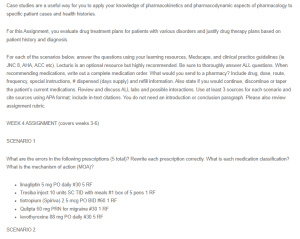
For each of the scenarios below, answer the questions using your learning resources, Medscape, and clinical practice guidelines (ie JNC 8, AHA, ACC etc). Lecturio is an optional resource but highly recommended. Be sure to thoroughly answer ALL questions. When recommending medications, write out a complete medication order. What would you send to a pharmacy? Include drug, dose, route, frequency, special instructions, # dispensed (days supply) and refill information. Also state if you would continue, discontinue or taper the patient’s current medications. Review and discuss ALL labs and possible interactions. Use at least 3 sources for each scenario and cite sources using APA format; include in-text citations. You do not need an introduction or conclusion paragraph. Please also review assignment rubric.
WEEK 4 ASSIGNMENT (covers weeks 3-6)
SCENARIO 1
What are the errors in the following prescriptions (5 total)? Rewrite each prescription correctly. What is each medication classification? What is the mechanism of action (MOA)?
- linagliptin 5 mg PO daily #30 5 RF
- Tresiba inject 10 units SC TID with meals #1 box of 5 pens 1 RF
- tiotropium (Spiriva) 2.5 mcg PO BID #60 1 RF
- Qulipta 60 mg PRN for migraine #30 1 RF
- levothyroxine 88 mg PO daily #30 5 RF
SCENARIO 2
PK is a 16-year-old female diagnosed with mild persistent asthma since age 12. During her visit today, she reports having to use her albuterol MDI 3 days per week over the past 2 months. Over the past week she has been using albuterol at least once per day. She reports being awakened by a cough 5 nights during the last month. She also has a fluticasone MDI, which she uses “most days of the week.” Her current medications include: Flovent HFA 44 mcg two puffs BID, Proventil HFA two puffs Q 4-6 hr PRN shortness of breath, fexofenadine 180 mg po daily, diphenhydramine 50 mg qhs prn. What treatment plan would you implement for PK? What medication changes would you make? Include a complete medication order. How would you monitor the effectiveness of this plan, and what patient education would you provide?
SCENARIO 3
ES is a 45-year-old African American male that was prescribed bisoprolol for his high blood pressure. Blood pressure today is 142/89 HR 60 RR 15. He states that he only occasionally takes the medication because he does not like the side effects. What information would you provide to the patient at his visit? What is his goal blood pressure? How is hypertension treated per current guidelines (JNC 8, ACC, AHA)? How would you improve his treatment? Include a complete medication order.
SCENARIO 4
TF is a 60 year old male presenting to the clinic for medication refills. Current medications include acetylcholinesterase inhibitor donepezil 5 mg po qhs, anti-amyloid monoclonal antibody lecanemab (Leqembi) 10 mg/kg IV every 2 weeks for early Alzheimer’s disease, and atorvastatin 40 mg po daily. His lab work today includes: fasting BG is 195 mg/dL; HgA1C = 8.5%. Basic Metabolic Profile (BMP) is normal except for Cr 1.9 and eGRF 28. What is his goal A1C? Please SELECT and DISCUSS which of the following would be best to prescribe for TF:
- canagliflozin (Invokana) 100 mg PO daily
- exenatide (Byetta) 5 mcg SC twice daily
- glimepiride 1 mg PO daily
- glyburide 2.5 mg PO daily
- metformin 500 mg PO daily
- semaglutide (Ozempic) 0.25 mg SC once weekly
- sitagliptin (Januvia) 50 mg PO daily
- Rosenthal, L. D., & Burchum, J. R. (2021). Lehne’s pharmacotherapeutics for advanced practice nurses and physician assistants (2nd ed.). Elsevier.
- Chapter 64, “Drugs for Peptic Ulcer Disease” (pp. 589a–597)
- Chapter 65, “Laxatives” (pp. 598–604)
- Chapter 66, “Other Gastrointestinal Drugs” (pp. 605–616)
- Chapter 68, “Drugs for Weight Loss” (pp. 627–637)