
Pharmacodynamic and Pharmacokinetic Analysis of Antidiabetic Drug Classes
Four Antidiabetic Drug Classes Analysis
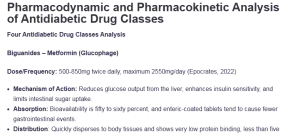
Biguanides – Metformin (Glucophage)
Dose/Frequency: 500-850mg twice daily, maximum 2550mg/day (Epocrates, 2022)
- Mechanism of Action: Reduces glucose output from the liver, enhances insulin sensitivity, and limits intestinal sugar uptake.
- Absorption: Bioavailability is fifty to sixty percent, and enteric-coated tablets tend to cause fewer gastrointestinal events.
- Distribution: Quickly disperses to body tissues and shows very low protein binding, less than five percent.
- Metabolism: Untouched by hepatic enzymes and passes out of the body in its original form.
- Excretion: Cleared through the kidneys, with a plasma half-life of around five hours in people with normal renal function.
- Contraindications: Not to be used if estimated glomerular filtration rate falls below thirty mL/min/1.73 m2, in severe liver disease, or during acute heart failure (Epocrates, 2022).
- Transporters: Requires organic cation transporters (OCT1, OCT2) for disposition: Pharmacodynamic and Pharmacokinetic Analysis of Antidiabetic Drug Classes
Sulfonylureas – Glipizide (Glucotrol)
Dose/Frequency: 2.5-10mg once daily, maximum 20mg/day (Epocrates, 2022)
- Mechanism of Action: The drug prompts pancreatic beta cells to release insulin by inhibiting ATP-sensitive potassium channels.
- Absorption: The drug is rapidly absorbed, demonstrating 90-100% bioavailability.
- Distribution: Roughly 98-99% binds to plasma proteins and crosses the placental barrier.
- Metabolism: The liver breaks the drug down primarily via the cytochrome P450 isoenzyme CYP2C9.
- Excretion: About 80% leaves the body through the kidneys as metabolites, and 10% in the stool.
- Contraindications: Condition must not be used in type 1 diabetes, diabetic ketoacidosis, or severe renal and liver disease (Epocrates, 2022).
- Half-life: 2-5 hours
GLP-1 Receptor Agonists – Semaglutide (Ozempic)
Dose/Frequency: 0.25mg weekly x4 weeks, then 0.5mg weekly, max 2mg weekly (Epocrates, 2022)
- Mechanism of Action: Activates GLP-1 receptors, enhances glucose-dependent insulin secretion, slows gastric emptying
- Absorption: Subcutaneous injection, 89% bioavailability
- Distribution: Extensive tissue distribution, 99% protein bound
- Metabolism: Proteolytic cleavage to smaller peptides
- Excretion: Primarily renal elimination of metabolites
- Contraindications: Personal/family history of medullary thyroid carcinoma, MEN syndrome type 2 (Epocrates, 2022)
- Half-life: Approximately 165 hours (weekly dosing)
SGLT2 Inhibitors – Empagliflozin (Jardiance)
Dose/Frequency: 10mg once daily, may increase to 25mg daily (Epocrates, 2022)
- Mechanism of Action: Inhibits sodium-glucose cotransporter 2 in proximal renal tubules, increasing urinary glucose excretion
- Absorption: 78% bioavailability, minimal food effect
- Distribution: 86% protein bound, volume of distribution 73.8L
- Metabolism: Primarily glucuronidation (UGT1A3, UGT1A8, UGT1A9)
- Excretion: 54% renal, 41% fecal
- Contraindications: eGFR <30 mL/min/1.73m², severe hepatic impairment, type 1 diabetes (Epocrates, 2022)
- Half-life:5-13.1 hours
New Advancements in Diabetes Treatment
Ultra-Long-Acting Insulin – Insulin Icodec
The present-day pharmacological developments are on improved patient compliance with new drug delivery systems (ElSayed et al., 2023). Insulin icodec is a breakthrough as an insulin analog for receptor-mediated clearance with steady-state pharmacodynamics having the hypoglycemic effect evenly distributed over a dosing interval of seven days.
Precision Medicine through Pharmacogenomics
Pharmacogenomic studies have established that the response to antidiabetic drugs and side effects are highly correlated with gene polymorphisms, allowing for drug treatment tailored to the individual based on genomic and genetic information (Zeng et al., 2020). This innovation allows for personalized treatment approaches, as meta-analyses have indicated improved efficacy profiles when genetics are incorporated into treatment selection (Salmen et al., 2023).
CYP450 and Drug Metabolism
Cytochrome P450 (CYP450) has 57 functional genes that are classified into 18 families and include CYP1, CYP2, and CYP3 family genes, most implicated in drug metabolism. Knowledge about CYP450 polymorphisms is extremely valuable to maximize antidiabetic treatment.
Example
Genetic variations in CYP2C9 have a significant impact on sulfonylurea metabolism, as seen in pharmacogenomics studies (Zeng et al., 2020). Patients with CYP2C9*2 or *3 alleles exhibit reduced enzyme activity, which enhances drug exposure and hypoglycemia risk. Frequencies of CYP2C9 alleles differ in populations: approximately 35% of Caucasians possess variant alleles versus 1-3% for Asian populations, necessitating population-specific doses to be used for therapeutic outcomes.
References
ElSayed, N. A., Aleppo, G., Bannuru, R. R., Bruemmer, D., Collins, B. S., Ekhlaspour, L., Gaglia, J. L., Hilliard, M. E., Johnson, E. L., Khunti, K., Lingvay, I., Matfin, G., McCoy, R. G., Perry, M. L., Pilla, S. J., Polsky, S., Prahalad, P., Pratley, R. E., Segal, A. R., . . . Gabbay, R. A. (2023). 9. Pharmacologic approaches to glycemic treatment: Standards of care in diabetes—2024. Diabetes Care, 47(Supplement_1), S158–S178. https://doi.org/10.2337/dc24-s009
Epocrates. (2022). Epocrates. Epocrates.com. https://www.epocrates.com/
Salmen, T., Serbanoiu, L., Bica, I., Serafinceanu, C., Muzurović, E., Janez, A., Busnatu, S., Banach, M., Rizvi, A. A., Rizzo, M., & Stoian, A. P. (2023). A critical view over the newest antidiabetic molecules in light of efficacy—A systematic review and meta-analysis. International Journal of Molecular Sciences, 24(11), 9760. https://doi.org/10.3390/ijms24119760
Zeng, Z., Huang, S.-Y., & Sun, T. (2020). Pharmacogenomic studies of current antidiabetic agents and potential new drug targets for precision medicine of diabetes. Diabetes Therapy, 11(11), 2521–2538. https://doi.org/10.1007/s13300-020-00922-x
ORDER A PLAGIARISM-FREE PAPER HERE
We’ll write everything from scratch
Question 
The goal of this journal entry is to analyze current and emerging evidence of pharmacodynamic and pharmacokinetic principles that are basic to the mechanism of action of antidiabetic drug classes.
- Choose four anti-diabetic drug classes providing one medication example each with doses and frequency. Include mechanisms of action, absorption, distribution, metabolism, excretion and contraindication details. At least 7 points of content per drug.
- Address new advancements in treatment of diabetes related to pharmacodynamics or pharmacokinetics. Provide 2 examples.
- Include content on CYP450 chromosomes to better understand drug metabolism among different patient populations. Provides an example.
Pharmacodynamic and Pharmacokinetic Analysis of Antidiabetic Drug Classes
- Provide evidence based support for your stance using standard APA format.
- Use Epocrates drug references in all four drugs or other drug references.
- Cite Epocrates in each drug appropriately or any other drug references.
use 3-4 citations