
Perspectives on Digital Societies – The Case of the Brown Family
Digital societies define the different aspects of our society through their impact on daily activities such as working, shopping, and the creation of identity. There is no doubt that sociology as a science has made significant progress; to explain this change, sociologists employ three principal theoretical approaches: functionalism, conflict theory, and symbolic interactionism. Functionalism focuses on the roles of stability and integration that are offered by the existing digital systems. The conflict theory, on the other hand, concerns the roles it plays in perpetuating dominance and oppression of subordinate groups (Campbell, 2021). Finally, symbolic interactionism explains the meanings that users give to such interactions and the formation of cyberlives. Paying attention to such perspectives, one can understand how technology impacts specific users like Kristina Brown and social interactions.
Sociological Perspectives on Kristina’s Digital Lifestyle
| Excerpt from Scenario | Functionalism | Conflict Theory | Symbolic Interactionism |
| Kristina opts to work from the comfort of her home. | Functionalism emphasizes how working from home integrates Kristina into society’s economic system by providing flexibility and increasing productivity. The arrangement benefits both individual well-being and society by optimizing labor force participation (De Oliveira, G. S., 2022) | Conflict theory critiques remote work as it exacerbates inequalities in the workforce. Those with access to technology thrive, while others, especially low-income workers, are left behind due to a lack of resources (Zhang et al., 2020). Moreover, remote work can blur the line between personal and professional life, leading to potential exploitation of workers. | Symbolic interactionism explores how Kristina’s sense of self and professional identity is shaped in a home office environment. The home becomes both a personal and professional space, influencing her interactions, routines, and the meaning she attaches to her work (Bosun-Arije & Ekpenyong, 2023). |
| She frequently relies on delivery services like Grubhub or Uber Eats. | Functionalism sees these services as fulfilling societal needs, ensuring that food delivery systems are more efficient and accessible. This aligns with broader social systems that emphasize convenience and consumer satisfaction in the digital age. | Conflict theory highlights the exploitation embedded in gig work. Food delivery workers often face low wages and poor working conditions, while companies profit from the demand for convenience, widening the gap between consumers and workers. | Symbolic interactionism focuses on how Kristina’s interaction with food delivery services shapes her consumer identity. The apps’ interfaces and the act of ordering food online are social rituals that influence her perception of convenience, status, and social norms (Paula et al., 2021). |
| Kristina’s cyber identity, represented by her usernames and passwords, holds significant importance. | Functionalism posits that digital identities serve functional roles, such as enabling secure online transactions and facilitating communication. Cyber identities help integrate individuals into the digital economy, ensuring that people can participate in modern social systems. | Conflict theory argues that cyber identities are commodified by corporations and governments, who collect personal data for profit and surveillance. This commodification perpetuates power imbalances, as individuals are often unaware of the extent to which their data is exploited. | Symbolic interactionism examines how Kristina’s online identity, reflected in her usernames and passwords, affects her sense of self. It’s a performance of identity that is shaped by the meanings she assigns to her digital presence and how she believes others perceive her online (Bosun-Arije & Ekpenyong, 2023). |
Conclusion
Kristina Brown’s digital lifestyle, through different sociological perceptions, depicts how technology affects various aspects of people’s lives. The functionalist approach has a positive attitude towards integration and the integration benefits of digital capitalism, while the conflict perspective focuses on the tensions and inequalities inherent in it. Symbolic interactionism centered on interactionalism deliberately addresses how virtual contexts become influential in giving meaning to one’s identity. Together, the two approaches paint a wider perspective on current society and review the real-life encounters of a ‘Digital Citizen’ incorporating clients such as Kristina.
References
Bosun-Arije, S. F., & Ekpenyong, M. S. (2023). Using the theory of symbolic interactionism to inform assessment processes in nurse education. Nurse Education in Practice, 72, 103781. https://doi.org/10.1016/j.nepr.2023.103781
Campbell, B. (2021). Social justice and sociological theory. Society, 58(5), 355–364. https://doi.org/10.1007/s12115-021-00625-4
De Oliveira, G. S. (2022). From something old to something new: Functionalist lessons for the cognitive science of scientific creativity. Frontiers in Psychology, 12. https://doi.org/10.3389/fpsyg.2021.750086
Paula, A., Reis Mairink, A., Page, Valim, C., Gradim, C., Marislei, & Panobianco, S. (2021). Use of the symbolic interactionism theory in nursing research. Quest Journals Journal of Research in Humanities and Social Science, 9(9), 2321–9467. https://www.questjournals.org/jrhss/papers/vol9-issue9/Ser-4/E09093437%20.pdf
Zhang, S., Moeckel, R., Moreno, A. T., Shuai, B., & Gao, J. (2020). A work-life conflict perspective on telework. Transportation Research Part A Policy and Practice, 141, 51–68. https://doi.org/10.1016/j.tra.2020.09.007
ORDER A PLAGIARISM-FREE PAPER HERE
We’ll write everything from scratch
Question 
Perspectives on Digital Societies – The Case of the Brown Family
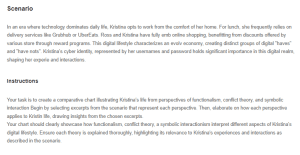
Scenario
In an era where technology dominates daily life, Kristina opts to work from the comfort of her home. For lunch, she frequently relies on delivery services like Grubhub or UberEats. Ross and Kristina have fully emb online shopping, benefitting from discounts offered by various store through reward programs. This digital lifestyle characterizes an evolv economy, creating distinct groups of digital “haves” and “have nots”. Kristina’s cyber identity, represented by her usernames and password holds significant importance in this digital realm, shaping her experie and interactions.
Perspectives on Digital Societies – The Case of the Brown Family
Instructions
Your task is to create a comparative chart illustrating Kristina’s life from perspectives of functionalism, conflict theory, and symbolic interaction Begin by selecting excerpts from the scenario that represent each perspective. Then, elaborate on how each perspective applies to Kristin life, drawing insights from the chosen excerpts.
Your chart should clearly showcase how functionalism, conflict theory, a symbolic interactionism interpret different aspects of Kristina’s digital lifestyle. Ensure each theory is explained thoroughly, highlighting its relevance to Kristina’s experiences and interactions as described in the scenario.