
Personal Mastery Scenario-Based Solver Projects
| Scenario #1 |
| In the third week of orientation, Emily was a new nurse working in a high-acuity medical-surgical unit. During a medication pass, under the supervision of her preceptor, one evening, she accidentally gave atenolol, a beta-blocker meant to be given to the patient in Room 206, to the patient in Room 204. She noticed the mistake as she went through the medication administration record and promptly notified her preceptor. Michelle, the charge nurse, was informed and examined the stable patient. The doctor was consulted and prescribed monitoring without further action. Even though nothing bad happened, Emily got silent and unresponsive. She did not make eye contact and rushed off after her handoff documentation was done. In the morning, Michelle was informed by another nurse that Emily was thinking about quitting. Michelle was worried, and later that day, she called Emily to talk to her alone. Throughout the conversation, Emily cried and said she feared that she was not a good person to be a nurse. Michelle encouraged her, complimented her on her honesty and started a supportive talk about how to make the experience a learning experience instead of a career-ending fault. |
| Skill Application #1 |
| Opportunity Statement
The present unwanted condition is that a newly employed nurse committed a medication error and is now emotionally overwhelmed, ashamed, and doubtful of her ability to continue staying in the profession. When this scenario is not handled tactfully and delicately, the nurse may have a high probability of resigning, hence leading to the loss of a potentially great member of staff and instilling fear in other novice nurses on the need to report mistakes. The modification that should be implemented is establishing a positive environment that will foster learning upside-downs and hold accountability and psychological safety. The expected outcome is that the nurse will feel supported and not lose her confidence but will learn from the incident and stay dedicated to her progress as a safe and practical nurse. In turn, the unit creates a culture of openness and growth.
Social and Emotional Power Skill – Self-Awareness The power skill that the nurse leader ought to apply in this case is self-awareness. Michelle shows self-awareness since she understands that her response to the error made by Emily may either uplift or demoralize her more (Majolo et al., 2023). Michelle deliberately tries to react with understanding and places herself in Emily’s shoes. She also knows that Emily is vulnerable emotionally and does not judge her for her distress. Michelle does not imply blame or frustration; she focuses on learning and growing opportunities. This reflection exercise is central to developing trust and professionalism. Michelle demonstrates this ability by controlling her tone and behavior and providing guidance, caring and firmly.
Strength – Emotional Insight and Compassion The strengths I would apply in the situation would be emotional insight and compassion. By observing Emily’s body language and verbal expressions, I noticed that she felt scared and inadequate. I would answer by acknowledging her situation, explaining that it is normal to make mistakes and learn and that she is professional by being honest. Compassion would enable me to relate with her emotionally and establish a non-threatening background to talk. These strengths are needed to restore confidence and enhance a culture of nurses not fearing to report mistakes and learn through them.
Communication Strategy – Reflective Debriefing and Empathy I would employ selective debriefing and empathy as communication strategies in this case. I would give Emily a chance to process the mistake in a supportive environment by providing her with a calm and secluded place to have conversely soft and positive words like, “Let us go through this together.” I would make her realize that what she did after the mistake showed her accountability. The appropriateness of this communication strategy is associated with the fact that it helps to facilitate emotional recovery, fosters confidence, and correlates to enhance psychological safety (Fey & Morse, 2024). It also addresses the opportunity statement directly, as it will prevent resignation and promote professional growth. |
| Scenario #2 |
| Ashley, an experienced nurse manager in a busy telemetry unit, came to work on a Monday morning only to realize that three staff nurses had called in sick. This news greatly affected the day’s workflow because the unit already had limited coverage due to a staffing shortage. This led to a rapid increase in tensions as the remaining staff members could not cope with the number of patients. Ashley felt intimidated and angry. A new graduate nurse came to Ashley to clear up a medication order, and Ashley replied, snapping, “Please read the chart before you come asking me simple questions!” The novice nurse stormed off in disappointment. Ashley realized straightaway that her expression of anger was not professional and appropriate. Excusing herself at the nurses’ station, she went into her office. She took a few minutes of deep breathing there and reminded herself about the necessity of staying composed in crises. Ashley calmed down and returned to the floor to meet the new nurse. She apologized for her earlier tone and explained, “I am sorry I reacted in that way. That was a stressful situation, but it was not your fault.” The new nurse nodded and thanked her for the apology. Ashley later called a short meeting in the afternoon with the staff to recognize the challenging change and appreciate her staff’s flexibility and dedication. She also initiated the concept of a rotating on-call backup system that would assist in mitigating future staffing disturbance and her team’s morale on high-stress days. |
| Skill Application #2 |
| Opportunity Statement
The present unwanted state of affairs is that a nurse leader, under the pressure of staffing shortage and rising patient demands, lost her emotional control, impacting the staff morale and trust. This action was dangerous in discouraging new nurses and creating a tense atmosphere at the workplace. The opportunity exists in the leader understanding the value of self-regulation and demonstrating professionalism even in pressurizing situations. By dealing with this problem, trust will be restored, accountability will be enhanced, and open communication will be promoted within the team. The intended transformation is to provide the leader with emotional control tools and install the systems to actively manage crises in advance, enhancing team building and leadership reputation.
Social and Emotional Power Skill The skill of power that the nurse leader ought to apply in the situation is self-management. Self-management in practice can be seen in the case of Ashley, who could identify the emotional reaction and physically remove herself to restore control. Instead of letting her frustration grow or persist in affecting her communication, she acted immediately to control her response. She even sent a subsequent apology, which showed humility and professionalism. Self-management enabled her to react rather than act immediately and demonstrated to staff that leadership errors can be discussed and fixed (Qama et al., 2022).
Strength – Self-Management Emotional control and accountability are the strengths that I would apply in such a situation. Accepting what I did and apologizing will show self-awareness and integrity. The ability to control my emotions will help me become a good leader, particularly in stressful situations, whereas accountability will help me build trust in the staff. These strengths help avoid miscommunication and foster a healthy culture in the workplace (Kadović et al., 2022).
Communication Strategy – Restorative Communication The communication approach that I would apply in this case is restorative communication. This consists of harm recognition, accepting responsibility and effort to restore relationships (Sawin et al., 2023). It is suitable at this place as it covers the emotional consequences of the actions performed by the leader and the regaining of respect and trust. Such a strategy would help the teams to become resilient, display emotional maturity, and facilitate psychological safety among the employees. |
| Scenario #3 |
| Ana, a Spanish-speaking patient in her early sixties, was admitted to the medical-surgical unit of Lakeside Community Hospital with complaints of abdominal pain. There was a communication gap, which resulted in a delayed admission process. The nursing team acted upon nonverbal consent, assuming they had consent and understanding and could not access the interpretation services. During the following 24 hours, Ana grew more and more withdrawn, rejecting medications and never paying attention to food trays. Her daughter, who came later in the evening, got frustrated and questioned why nobody had talked to her mother in Spanish. The situation grew more intense when a staff nurse tried to give Ana some medication, and she declined, noticeably scared and shaking her head. Leah, the charge nurse, was informed about the incident and instantly identified that a cultural and language barrier had been ignored. Leah apologized to the daughter and promised to call an interpreter. Then, Leah went to see Ana, accompanied by a certified Spanish interpreter, introduce herself and explain all the procedures. When the interpreter repeated the information in Ana’s native language, she visibly calmed down, nodded in comprehension and started reacting to care. Leah marked the requirement of interpreter services on Ana’s chart and reminded all nursing members in the next huddle about the use of language support for non-English-speaking patients. Leah also asked the interpreter service contact cards to be hung at each nurse’s workstation. She started working with the administration to institute mandatory cultural competency refresher courses required of the clinical staff. |
| Skill Application #3 |
| Opportunity Statement
The present unwanted circumstance is that a patient was accidentally ignored due to language and cultural barriers. The patient was not able to express her discomfort and confusion, and the care team did not notice it in time, which resulted in delays in care, emotional distress, and family dissatisfaction. The potential opportunity is to raise staff awareness about the role of differences in cultures and language in patient care and reinforce the policies that would consistently use language services. By addressing the gap, communication, trust, and clinical outcomes of patients with disparate backgrounds will be enhanced and inclusivity and respect will be promoted throughout the unit.
Social and Emotional Power Skill The power skill adopted in this situation is social awareness. It is a sign of good social awareness that Leah can identify the emotional and cultural needs of the patient even following the initial breakdown. She managed to recognize that the declination of care offered to Ana was not a sign of defiance but fear and misunderstanding due to the absence of culturally adequate communication. Leah also realized the frustration experienced by the family and accepted responsibility on behalf of the unit (Walter & Hazan-Liran, 2025). Following emotional signals and the ability to analyze the social situation, Leah adequately shaped her leadership reaction in a manner that allowed reestablishing trust and dealing with the inherent problem of cultural insensitivity.
Strength – Cultural Humility and Empathy Cultural humility and empathy are the strengths that I would apply in this situation. These strengths would assist me in being appreciative of the fact that I might not inherently know what it is like to live in the patient’s experience but can demonstrate the desire to learn and act accordingly. Empathy is essential to making the patient and family feel listened to, appreciated, and advocated (Sullivan-Detheridge et al., 2024). Such a strategy confirms patient dignity and strengthens culturally competent care.
Communication Strategy- Inclusive Communication with Interpreter Services The communication plan that I would employ in this scenario is an inclusive communication plan and interpreter services. It is suitable since it maintains proper communication with respect to the accuracy of information sharing and respects a patient’s language preference. It also averts misinterpretation and assists in mutual decision-making. The opportunity is directly linked to this strategy because it will enhance patient engagement and trust and foster equity in care delivery (Ono & Yang, 2024). |
| Scenario #4 |
| Jordan was a competent, soft-spoken registered nurse who had worked on the orthopedic floor for the last three months. Jordan was silent in daily team huddles, and most informal staff conversations excluded him, although he performed well in patient care. Some nurses had already begun circumventing him in assigning or negotiating workflow efficiencies. One afternoon, Jordan was preparing a complicated discharge, and he remained reluctant to voice his concern when the discharge plan clashed with physician notes. It was not until later that the mistake was realized, resulting in patient transfer delay and inconvenience to the facility receiving the patient. As the incident was debriefed in the post-incident meeting, the charge nurse, Rachel, observed that Jordan was uncomfortable and contributed less to the discussion. She was worried and therefore arranged another talk with him. During their conversation, Rachel said, “Do you feel comfortable speaking up when something does not feel right?” Jordan replied, “I am scared of saying something wrong or being judged, so I just stay quiet.” Rachel assured him that his contribution was essential and that teamwork needed each voice to be heard. She volunteered to work with him through team-building exercises and role-playing activities to make him feel more comfortable communicating. In the following two weeks, she had Jordan assigned to a mentor nurse who was well-known for inclusive communication. She also encouraged Jordan to provide patient reports during shift huddles. By the end of the month, Jordan was more involved, participated in discussions, and even lobbied for a change in discharge procedures from what he had learned. |
| Skill Application #4 |
| Opportunity Statement
The unwanted situation is that a capable nurse feels secluded and uncertain about speaking up in the team, leading to an avoidable delay in patient care. This inability to speak up discourages personal performance and jeopardizes teamwork and patient safety. The opportunity is to enhance the interpersonal communication skills of the nurse and render him a more productive member of the team. Giving the nurse the power to share ideas and concerns will promote inclusivity, decrease errors, and enhance the communication culture of the unit. Developing a context that respects each voice will encourage team performance and psychological safety.
Social and Emotional Power Skill – Interpersonal Communication The power skill utilized here is interpersonal communication. The nurse leader, Rachel, understands that communication is not merely exchanging information but knowing and being trusted. By communicating privately with Jordan on a one-to-one basis in a non-judgmental environment, she opens the way for him to express his doubts. She uses effective listening, reflective questioning, and constant encouragement to empower Jordan to develop. Rachel also arranges mentorship and formal opportunities for Jordan to build communication confidence (Abed et al., 2023). Through Jordan’s active involvement in shift reports and the promotion of peer-to-peer work, Rachel stimulates his voice and reminds him that he is a valuable team member.
Strength – Approachability and Coaching The strength I would utilize in this situation is approachability and coaching. These strengths would enable me to provide a secure space for feedback and development. While supporting Jordan in a non-pressuring way, I can lead him toward greater participation while still honoring his communication style (Deiorio et al., 2022). My approachability would make him comfortable asking questions and attempting new techniques without judgment. Coaching builds up rather than corrects and enables the person to develop confidence in their own time.
Communication Strategy – Supportive Feedback and Peer Mentoring The communication technique I would employ is supportive feedback with peer mentoring. The method is suitable because it provides structure and encouragement. Feedback sessions at regular intervals reinforce improvement, and peer mentorship provides modeling and practice in communication in real-time (Murrell et al., 2021). This meets the opportunity by enhancing Jordan’s interpersonal skills, team collaboration, and unit cohesion. It ultimately promotes a culture of inclusion and collective responsibility. |
| Scenario #5 |
| At Riverbend General Hospital, the clinical operations department notified staff that the hospital would convert to a new electronic health record (EHR) system in six weeks. While the system was touted to make charting more efficient and patient care safer, frontline nurses expressed worry over the accelerated deadline and the absence of hands-on training. Within the second week of the rollout, errors in medication documentation and care plans were reported. Staff members started to exhibit signs of burnout, venting frustration in huddles and seeking frequent technical assistance. Melanie, the unit manager of the telemetry floor, noticed increased disengagement and knew she had to act quickly. She held a staff meeting to hear concerns and discovered that most errors were due to uncertainty regarding the new EHR templates and a lack of time to practice before going live. Following the meeting, Melanie developed a phased implementation plan for her unit. She reorganized shifts so small groups could attend focused training without impacting patient ratios. She also worked with IT to provide a unit-based EHR “superuser” nurse for peer support. Within two weeks, documentation errors fell off, staff stress levels improved, and confidence in using the system increased. Melanie tracked the feedback and process enhancements, presenting and sharing them with leadership and recommending rollout modifications hospital-wide. |
| Skill Application #5 |
| Opportunity Statement
The unpleasant case is that the abrupt implementation of a new EHR system has overwhelmed staff, causing workflow confusion, clinical documentation mistakes, and increasing nurse dissatisfaction. If left unresolved, these problems can endanger patient safety, lower staff morale, and harm the success of the system’s adoption. The chance is to execute a strategic plan that deals with frontline issues, assists personnel throughout the transition, and enhances general system integration. This would increase adoption rates, decrease burnout from stress, and improve charting accuracy, translating to safer, more efficient patient care and a healthier, more adaptable team.
Social and Emotional Power Skill – Executive Function The power skill utilized in this situation is executive function. Melanie exhibits executive function as she thinks critically, plans strategically, and juggles several moving pieces amid an organizational change that is not easy. She assesses the team’s needs through observation and direct communication, plans a workable training schedule, delegates responsibilities efficiently, and revises the rollout plan according to frontline feedback. Her capacity to harmonize employee needs with organizational objectives enables her to effect sustainable, systematic solutions under pressure. Melanie never acts impulsively but instead, with data, feedback, and foresight, leads through change with little disruption.
Strength – Strategic Planning and Decision-Making I would utilize strategic planning and decision-making strengths in this situation. These strengths enable me to break down a complicated problem, set up a logical course of action, and execute it in a manner that enhances team functioning and patient safety. By assessing employee feedback, working with technical specialists, and championing implementation flexibility, I can provide the team with the tools and assistance necessary for success (Eldredge, 2024). These strengths enable me to be proactive and responsive, leading change by intention rather than urgency.
Communication Strategy – Transparent Planning and Structured Feedback Loop My communication strategy would be a structured feedback loop with transparent planning. This involves clearly communicating the timelines, collecting feedback regularly, and making real-time adjustments to the approach. It is appropriate since it fosters staff trust, makes concerns audible, and aligns implementation action with real user needs. This solution meets the challenge by providing employees with a voice throughout the transition, enhancing system usability, and building leadership credibility during organizational change (Rapin et al., 2023). |
References
Abed, L. G., Abed, M. G., & Shackelford, T. K. (2023). Interpersonal communication style and personal and professional growth among Saudi Arabian employees. International Journal of Environmental Research and Public Health, 20(2), 910. https://doi.org/10.3390/ijerph20020910
Deiorio, N. M., Moore, M., Santen, S. A., Gazelle, G., Dalrymple, J. L., & Hammoud, M. (2022). Coaching models, theories, and structures: An overview for teaching faculty in the emergency department and educators in the offices. AEM Education and Training, 6(5). NCBI. https://doi.org/10.1002/aet2.10801
Eldredge, J. (2024). Decision making. Evidence Based Practice – NCBI Bookshelf. https://www.ncbi.nlm.nih.gov/books/NBK603119/
Fey, M. K., & Morse, K. J. (2024). The essentials of debriefing and reflective practice. Nursing Clinics of North America, 59(3), 391–400. https://doi.org/10.1016/j.cnur.2024.01.008
Kadović, M., Mikšić, Š., & Lovrić, R. (2022). Ability of emotional regulation and control as a stress predictor in healthcare professionals. International Journal of Environmental Research and Public Health, 20(1), 541. https://doi.org/10.3390/ijerph20010541
Majolo, M., Gomes, W. B., & DeCastro, T. G. (2023). Self-consciousness and self-awareness: Associations between stable and transitory levels of evidence. Behavioral Sciences, 13(2), 117. https://doi.org/10.3390/bs13020117
Murrell, A. J., Blake-Beard, S., & Porter, D. M. (2021). The importance of peer mentoring, identity work and holding environments: A study of African American leadership development. International Journal of Environmental Research and Public Health, 18(9), 4920. https://doi.org/10.3390/ijerph18094920
Ono, N., & Yang, J. (2024). Communication skills of medical interpreters: A qualitative explanatory study of healthcare professionals’ and medical interpreters’ perceptions. Healthcare, 12(20), 2073. https://doi.org/10.3390/healthcare12202073
Qama, E., Rubinelli, S., & Diviani, N. (2022). Factors influencing the integration of self-management in daily life routines in chronic conditions: A scoping review of qualitative evidence. BMJ Open, 12(12), e066647. https://doi.org/10.1136/bmjopen-2022-066647
Rapin, J., Gendron, S., Mabire, C., & Dubois, C.-A. (2023). Feedback on clinical team performance: How does it work, in what contexts, for whom, and for what changes? A critical realist qualitative multiple case study. BMC Health Services Research, 23(1). https://doi.org/10.1186/s12913-023-09402-x
Sawin, G., Klasson, C. L., Kaplan, S., Sawin, J. L., Brown, A., Israni, S. T., Schonberg, J., & Gregory, A. (2023). Scoping review of restorative justice in academics and medicine: A Powerful tool for justice equity diversity and inclusion. Health Equity, 7(1), 663–675. https://doi.org/10.1089/heq.2023.0071
Sullivan-Detheridge, J. H., Reifsnider, E., Mengsteab, M., Merie, K., Staller, J., & Allen, A. M. (2024). Cross cultural empathetic behavior in health care providers: A review of 3 countries. Journal of Primary Care & Community Health, 15. https://doi.org/10.1177/21501319241226765
Walter, O., & Hazan-Liran, B. (2025). Thinking at the edge: Enhancing self-awareness in social work education. Behavioral Sciences, 15(3), 323. https://doi.org/10.3390/bs15030323
ORDER A PLAGIARISM-FREE PAPER HERE
We’ll write everything from scratch
Question 
Personal Mastery Scenario-Based Solver Projects
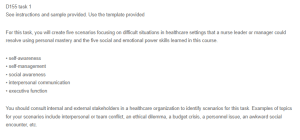
D155 task 1
See instructions and sample provided. Use the template provided
For this task, you will create five scenarios focusing on difficult situations in healthcare settings that a nurse leader or manager could resolve using personal mastery and the five social and emotional power skills learned in this course.
Personal Mastery Scenario-Based Solver Projects
• self-awareness
• self-management
• social awareness
• interpersonal communication
• executive function
You should consult internal and external stakeholders in a healthcare organization to identify scenarios for this task. Examples of topics for your scenarios include interpersonal or team conflict, an ethical dilemma, a budget crisis, a personnel issue, an awkward social encounter, etc.