
Peer Responses
Responding to Ebony Marie Trahan
Hello,
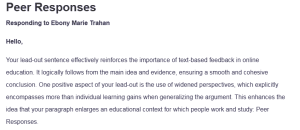
Your lead-out sentence effectively reinforces the importance of text-based feedback in online education. It logically follows from the main idea and evidence, ensuring a smooth and cohesive conclusion. One positive aspect of your lead-out is the use of widened perspectives, which explicitly encompasses more than individual learning gains when generalizing the argument. This enhances the idea that your paragraph enlarges an educational context for which people work and study: Peer Responses.
For further refinement, adding a transition sets up the next point if this paragraph is part of a larger discussion. This would create an even stronger flow between ideas, as emphasized in the Walden University Writing Center video (WUWritingCenter, 2017). Additionally, implicit or explicit transitions could enhance the continuity of your argument. Exploring how these transitions impact reader comprehension may add further depth to writing.
References
WUWritingCenter. (2017, November 9). Types of transitions Part 1: Transitions between paragraphs [Video]. YouTube. https://www.youtube.com/watch?v=yguYdUgkyeI
Responding to Patricia Diane Mote
Hello,
Your lead-out effectively ties together the importance of timely and personalized feedback while maintaining a strong academic tone. It provides a clear sense of closure while reinforcing the paragraph’s argument. The emphasis on the broader significance of personalized feedback in online learning aligns well with best practices in student-centered education (Gredler, 2018). Additionally, your focus on how feedback impacts student motivation and engagement add depth to your analysis, demonstrating a comprehensive understanding of the topic.
To add on, incorporating an implicit transition that subtly hints at the next idea would enhance this paragraph if it were part of a larger essay. The Walden Writing Center (n.d.) suggests that lead-outs should not only conclude but also set up the next section to maintain coherence.
One strategy to achieve this could be using key terms from the following paragraph to create a natural flow. Notably, refining one’s approach to transitions could significantly enhance the overall readability and impact of one’s work. Also, exploring various transition techniques may help maintain reader interest throughout the piece.
References
Gredler, J. (2018). Postsecondary online students’ preferences for text-based instructor feedback. International Journal of Teaching and Learning in Higher, 30(2), 195–206. https://files.eric.ed.gov/fulltext/EJ1184996.pdf
ORDER A PLAGIARISM-FREE PAPER HERE
We’ll write everything from scratch
Question 
By Day 6
Respond to at least two colleagues by doing one of the following:
- Give feedback on their lead-out
- Consider: Does the lead-out match the main idea sentence? Does the lead-out logically and smoothly follow the evidence and analysis? Do you feel a sense of closure after reading it?
- Share insights on writing the lead-out
- Address one of the questions or challenges your colleague posed, based on your experience or knowledge
ET
Mar 27 8:03am| Last reply Mar 27 8:53am
Manage Discussion by Ebony Marie Trahan
Reply from Ebony Marie Trahan
Add a lead-out sentence to the existing paragraph you have developed of main idea evidence, and analysis.
L (Lead-out):
These qualities of text-based feedback highlight its ability to create a more inclusive and effective educational experience, making it an essential tool for supporting students in online learning environments.
Additionally, reflect on the process of writing the lead-out. Pose any questions and/or explain challenges that came up during the process.
Writing the lead-out sentence required careful consideration of how to summarize the main points while emphasizing their overall significance. One challenge was ensuring that the sentence not only concluded the paragraph but also reinforced the argument cohesively without introducing new ideas. Additionally, I aimed to maintain an academic tone while tying the discussion back to the larger context of online education. A question that arose during the process was how to balance brevity with enough depth to leave a lasting impression.
References
Gredler, J. J. (2018). Postsecondary online students’ preferences for text-based instructor feedback. International Journal of Teaching and Learning in Higher Education, 30(2), 195–206.
Prince, S. (2014). Breaking down the MEAL plan: Adding analysis. Walden University Writing Center. http://waldenwritingcenter.blogspot.com/2014/05/breaking-down-meal-plan-adding-analysis.htmlLinks to an external site.
Walden University Writing Center. (n.d.). How to use a lead-out sentence to strengthen transitions [Video]. YouTube.
Peer Responses
Mar 25 9:35am
Manage Discussion by Patricia Diane Mote
Reply from Patricia Diane Mote
Online postsecondary students strongly prefer personalized, constructive, and timely text-based feedback from instructors, which greatly improves their learning experience and academic success (M). Evidence from Gredler (2018) supports this main idea. For instance, the article reveals that online postsecondary students find feedback from their instructors to be most effective when it is detailed and specifically addresses their unique needs and areas for improvement (Gredler, 2018) (E).
Additionally, students reported that timely feedback helps them understand their mistakes and make necessary adjustments before subsequent assignments, enhancing their overall learning outcomes (Gredler, 2018) (E). Thus, feedback that is not only timely but also tailored to individual needs serves as a critical tool for fostering academic growth and improving the overall online learning experience (L).
Writing the lead-out sentence had me reflecting on the main takeaway from the paragraph while also trying to maintain its connection to the overall main idea. One challenge I had with this was ensuring that the lead-out provided a sense of closure without just repeating the main idea. I also aimed to emphasize the broader significance of personalized and timely feedback in online learning.
One question I found myself contemplating was how could the lead-out transition seamlessly to the next paragraph if my argument were to continue? This balance between wrapping up and setting up the next section is something I will need to continue refining.
reference
Gredler, J. J. (2018). Postsecondary online students’ preferences for text-based instructor feedback. International Journal of Teaching and Learning in Higher Education, 30(2), 195-206. https://link.springer.com/article/10.1007/s12103-011-9142-2