
Pediatric URI Case Study
Upper respiratory tract infections (URIs) are common in the outpatient setting. Most URIs are self-limiting. Poorly managed URIs are associated with both acute and long-term complications. Complications are common in children. As such, concerted efforts to manage childhood URIs should be adopted. This requires collaboration between parents and healthcare providers. This paper discusses the diagnosis and management of a patient with a URI.
Diagnosis
The child is likely to have an acute viral upper respiratory tract infection. URI presents with rhinitis, fever, sore throat, nasal congestion, coughing, headache, and sneezing (Wei et al., 2019). Furthermore, manifestations such as rhinorrhea, watery red eyes, and mucoid discharge are present in the common cold (Wei et al., 2019). A bacterial URI is ruled out by various observations. Firstly, the patient presents with a low-grade fever that has not worsened over the past three days. Bacterial URIs present with a fever of about 102oF and above (Wei et al., 2019). This fever is usually of severe onset. Secondly, the patient’s sneezing and mild cough have not demonstrated a worsening course that is a characteristic of bacterial URI. Thirdly, further evaluation revealed the absence of exudate and indicated that the tonsils are normal. This rules out bacterial URIs that present with exudates and swelling of the tonsils and the pharynx (Wei et al., 2019).
More specifically the patient is likely to have rhinitis. Viruses that have been implicated include parainfluenza, rhinoviruses, adenoviruses, respiratory syncytial viruses, influenza viruses, and coxsackie viruses (Dykewicz et al., 2020). This infection is highly contagious and may not be accompanied by sinusitis. Differential diagnoses for the patient include acute pharyngitis, laryngotracheobronchitis, rhino sinusitis, and otitis media. Acute pharyngitis presents with throat pain of sudden onset, edema, fever, headache, and soft palate petechiae (Mustafa & Ghaffari, 2020). The absence of these findings formed the basis for ruling out this diagnosis. Laryngotracheobronchitis presents with hoarseness of voice, odynophagia or dysphagia, fever, barking cough, and stridor (Ernest & Khandha, 2022). This diagnosis is ruled out because the patient lacks these hallmark features. Rhino-sinusitis is usually accompanied by inflammation of the sinuses. Furthermore, it presents with facial pressure, halitosis, sore throat, and earache (Çatl et al., 2020). The diagnosis is ruled out because the patient lacks these manifestations. Suzuki et al. (2020) report that otitis media presents with congestion of the ears, ear aches, and severe fever. As such, this diagnosis is ruled out.
Treatment Plan
The management should accomplish three goals. To begin with, it should provide adequate symptom control. Secondly, it should prevent the development of complications. Complications are likely to occur in the presence of bacterial colonization. Thirdly, it should avert the transmission of the infection. The patient can benefit from antitussives and decongestants. Notably, antitussives work by blocking the cough reflex mechanism. Examples of these agents include dextromethorphan and benzonatate (Dykewicz et al., 2020). Analgesics medications such as acetaminophen are relevant to this patient. Notably, these medications should be administered to relieve mild fever. The patient should be monitored continuously to modify the analgesics as needed. Antihistamines will help to control sneezing. In this context, first-generation antihistamines such as chlorpheniramine should be used (Dykewicz et al., 2020). Nasal dryness and congestion are likely to occur when antihistamines are administered. As such, they should be accompanied by decongestants such as oxymetazoline spray to prevent the exacerbation of nasal congestion (Dykewicz et al., 2020). However, it should be noted that decongestants have shown minimal efficacy in managing pediatric symptoms (Çatl et al., 2020). Intranasal saline should be given to promote thinning of secretions (Çatl et al., 2020). Antibiotics should not be administered because the patient’s illness is not of bacterial origin.
Various non-pharmacological approaches can be embraced. Increased fluid intake will promote hydration, prevent the formation of tenacious secretions, and soothe an inflammatory throat (Çatl et al., 2020). Also, enough rest builds body strength and promotes symptom control. If the inflammation progresses, the patient will use saline gargles to manage sore throats. Dykewicz et al. (2020) report that petrolatum ointments will be used to manage nasal dryness that may be caused by antihistamines and the disease process.
Communication Plan
Communication will occur via face-to-face interaction with the patient’s father, Mr. Smith. Therapeutic communication (TC) will be used to build rapport, create buy-in, and increase the likelihood of adherence to the communication plan (Xue & Heffernan, 2021). Therapeutic communication promotes patient engagement and autonomy. By so doing, TC is an enabler of patient-centeredness and holistic care. Holistic care promotes cultural sensitivity. In turn, cultural sensitivity increases healthcare access and the likelihood of adherence to the treatment plan.
The communication plan will also entail comprehensive patient education. In this context, Mr. Smith will be informed about the dosing instructions for all medications. The information will be provided in a handwritten note and a handout. This will include details such as the route of administration, administration technique, dosing frequency, doses, and storage conditions. Furthermore, the relevance of adhering to the treatment plans and finishing medications will be communicated. The father will be educated about the potential adverse of the medications and how to manage them adequately. Moreover, potential drug-drug or drug-food interactions will be communicated. Mr. Smith will be required to report any adverse effects recorded during medication use. A checklist will be used to accomplish this reporting. Also, the patient should return to the hospital if symptoms persist or deteriorate. Notably, immediate help should be sought if the patient’s fever worsens, he refuses to eat, demonstrates difficulty breathing, or has purulent discharge. Worsening symptoms could indicate a bacterial disease. Poorly managed viral infections will likely progress to bacterial infections requiring antibiotic therapy.
Resources
The first resource is the CDC website, which discusses respiratory tract infections (RTI). This website allows the user to download reference material and access it offline. Notably, the website discusses the clinical manifestations of the infections, epidemiologic considerations, diagnosis, management, and prevention of these infections. I would also recommend the Medscape website, which discusses upper RTIs. This website provides detailed information on pathophysiology, etiology, epidemiology, and prognosis and provides elaborate patient education. Furthermore, it addresses both pharmacological and non-pharmacological management of upper RTIs. Lastly, I would download relevant research articles published in peer-reviewed journals and make them available to the patient’s father. Peer-reviewed articles are specific and provide a detailed discussion of the intended topic.
Conclusion
Dykewicz et al. (2020) report that adenoviruses, respiratory syncytial viruses, influenza viruses, and coxsackie viruses have been implicated in viral URI. Pharmacological approaches in the management of rhinitis include antitussives, antihistamines, and analgesics. Fluid intake, bed rest, and petrolatum ointments are examples of relevant non-pharmacological approaches. A communication plan identifies the type of information and method of disseminating and evaluating the information. A communication plan promotes compliance with the treatment plan and optimizes patient outcomes. As such it should be concise and contains relevant information. Healthcare providers should avail themselves of resources that enable patients to embrace continuous education and gain an in-depth understanding of their conditions.
References
Çatlı, T., Atilla, H., & Miller, E. K. (2020). Acute Viral Rhinitis. All Around the Nose: Basic Science, Diseases and Surgical Management, 199-202. https://doi.org/10.1007/978-3-030-21217-9_23
Dykewicz, M. S., Wallace, D. V., Amrol, D. J., Baroody, F. M., Bernstein, J. A., Craig, T. J., Dinakar, C., Ellis, A. K., Finegold, I., Golden, D. B. K., Greenhawt, M. J., Hagan, J. B., Horner, C. C., Khan, D. A., Lang, D. M., Larenas-Linnemann, D. E. S., Lieberman, J. A., Meltzer, E. O., Oppenheimer, J. J., … Wang, J. (2020). Rhinitis 2020: A practice parameter update. Journal of Allergy and Clinical Immunology, 146(4), 721–767. https://doi.org/10.1016/j.jaci.2020.07.007
Ernest, S., & Khandhar, B., P. (2022). Laryngotracheobronchitis. https://www.ncbi.nlm.nih.gov/books/NBK519531/#:~:text=Laryngotracheobronchitis%2C%20as%20the%20name%20implies,be%20difficult%20to%20distinguish%20clinically
Mustafa, Z., & Ghaffari, M. (2020). Diagnostic Methods, Clinical Guidelines, and Antibiotic Treatment for Group A Streptococcal Pharyngitis: A Narrative Review. Frontiers in Cellular and Infection Microbiology, 10(October), 1–10. https://doi.org/10.3389/fcimb.2020.563627
Suzuki, H. G., Dewez, J. E., Nijman, R. G., & Yeung, S. (2020). Clinical practice guidelines for acute otitis media in children: A systematic review and appraisal of European national guidelines. BMJ Open, 10(5). https://doi.org/10.1136/bmjopen-2019-035343
Wei, X., Zhang, Z., Hicks, J. P., Walley, J. D., King, R., Newell, J. N., Yin, J., Zeng, J., Guo, Y., Lin, M., Upshur, R. E. G., & Sun, Q. (2019). Long-term outcomes of an educational intervention to reduce antibiotic prescribing for childhood upper respiratory tract infections in rural China: Follow-up of a cluster-randomized controlled trial. PLoS Medicine, 16(2), 1–20. https://doi.org/10.1371/journal.pmed.1002733
Xue, W., & Heffernan, C. (2021). Therapeutic communication within the nurse–patient relationship: A concept analysis. International Journal of Nursing Practice, 27(6), 1–8. https://doi.org/10.1111/ijn.12938
ORDER A PLAGIARISM-FREE PAPER HERE
We’ll write everything from scratch
Question 
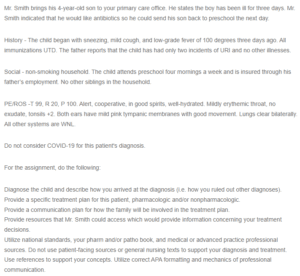
Mr. Smith brings his 4-year-old son to your primary care office. He states the boy has been ill for three days. Mr. Smith indicated that he would like antibiotics so he could send his son back to preschool the next day.
Pediatric URI Case Study
History – The child began with sneezing, mild cough, and low-grade fever of 100 degrees three days ago. All immunizations UTD. The father reports that the child has had only two incidents of URI and no other illnesses.
Social – non-smoking household. The child attends preschool four mornings a week and is insured through his father’s employment. No other siblings in the household.
PE/ROS -T 99, R 20, P 100. Alert, cooperative, in good spirits, well-hydrated. Mildly erythemic throat, no exudate, tonsils +2. Both ears have mild pink tympanic membranes with good movement. Lungs clear bilaterally. All other systems are WNL.
Do not consider COVID-19 for this patient’s diagnosis.
For the assignment, do the following:
Diagnose the child and describe how you arrived at the diagnosis (i.e. how you ruled out other diagnoses).
Provide a specific treatment plan for this patient, pharmacologic and/or nonpharmacologic.
Provide a communication plan for how the family will be involved in the treatment plan.
Provide resources that Mr. Smith could access which would provide information concerning your treatment decisions.
Utilize national standards, your pharm and/or patho book, and medical or advanced practice professional sources. Do not use patient-facing sources or general nursing texts to support your diagnosis and treatment.
Use references to support your concepts. Utilize correct APA formatting and mechanics of professional communication.