
Pediatric Illness
Asking proper questions about a patient is essential to gaining a clinical picture of the problem. It helps confirm the disease a patient is suffering from and its onset, severity, and duration (Flugelman et al., 2021). It also helps in developing an impression and differential diagnosis of the disease the patient is suffering. A thorough general and systemic examination can back findings in history-taking. Subsequently, proper investigations can be ordered and treatment planned according to investigation findings.
Hire our assignment writing services if your assignment is devastating you.
Questions
- What are the characteristics of the fever?
The beginning and duration of the fever, its severity and measurement method, and response to fever medication need to be known. Properly characterizing fever will help identify its etiology (Doria et al., 2019). Additionally, appropriate treatment can be started as soon as possible.
- What is the characteristic of diarrhea?
It is essential to know the number of times the baby has passed stool. Knowing the stool’s color, consistency, and odor (Florez et al., 2020). The presence or absence of blood in the stool needs to be ascertained. Knowledge of these characteristics will aid in determining the severity and appropriate management of diarrhea.
- What were other symptoms associated with the fever and diarrhea?
Associating symptoms may indicate if the disease is due to dysfunction in a particular body system (Florez et al., 2020). For instance, convulsions may occur due to central nervous system dysfunction.
- Is there any recent sick contact or travel abroad?
Close contact with a sick person can predispose to infection manifesting with fever and diarrhea. Visits to endemic areas can also indicate the source of fever and diarrhea.
- What other symptoms have been witnessed?
Fever and diarrhea may occur secondary to a systemic dysfunction (Dian et al., 2020). Other signs and symptoms may point out the particular system.
Additional symptoms
Development of danger signs or symptoms in the patient would necessitate transfer
to the emergency room (ER). For instance, if the patient develops cyanosis, weak breathing, or severe respiratory distress, he will be transferred to the emergency room (Ames et al., 2019). Other signs and symptoms to look out for are a fast or slow respiratory rate, weak, rapid, or absent pulse rate, and the duration of capillary refill. The capillary refill should be less than 2 seconds. Convulsions would also warrant a transfer to the ER, where life-saving treatment will be started.
Differential diagnoses
My top three differential diagnoses are gastroenteritis, giardiasis, and Rota viral enteritis. The patient presented with complaints of fever, diarrhea, and poor feeding. Notably, gastroenteritis, ICD-10 code A09, presents with fever, diarrhea, and poor feeding. Giardiasis, ICD-10 code A07.1, also presents with fever and diarrhea. Also, Rotavirus infection, ICD-10 code A08.0, presents with diarrhea, fever, and loss of appetite.
References
Ames, S. G., Davis, B. S., Marin, J. R., Fink, E. L., Olson, L. M., Gausche-Hill, M., & Kahn, J. M. (2019). Emergency department pediatric readiness and mortality in critically ill children. Pediatrics, 144(3). https://doi.org/10.1542/peds.2019-0568
Dian, Z., Sun, Y., Zhang, G., Xu, Y., Fan, X., Yang, X., & Miao, Z. (2021). Rotavirus-related systemic diseases: clinical manifestation, evidence, and pathogenesis. Critical Reviews in Microbiology, 47(5), 580-595. https://doi.org/10.1080/1040841X.2021.1907738
Doria, M., Careddu, D., Ceschin, F., Libranti, M., Pierattelli, M., Perelli, V., & Chiappini, E. (2019). Understanding discomfort to treat fever appropriately. https://doi.org/10.3390/ijerph16224487
Florez, I. D., Niño-Serna, L. F., & Beltrán-Arroyave, C. P. (2020). Acute infectious diarrhea and gastroenteritis in children. Current infectious disease reports, 22(2), 1-12. https://doi.org/10.1007/s11908-020-0713-6
Flugelman, M. Y. (2021). History-taking revisited: Simple techniques to foster patient collaboration, improve data attainment, and establish trust with the patient. GMS Journal for Medical Education, 38(6). https://doi.org/10.3205%2Fzma001505
ORDER A PLAGIARISM-FREE PAPER HERE
We’ll write everything from scratch
Question 
Assignment Prompt
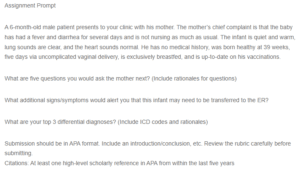
A 6-month-old male patient presents to your clinic with his mother. The mother’s chief complaint is that the baby has had a fever and diarrhea for several days and is not nursing as much as usual. The infant is quiet and warm, lung sounds are clear, and the heart sounds normal. He has no medical history, was born healthy at 39 weeks, five days via uncomplicated vaginal delivery, is exclusively breastfed, and is up-to-date on his vaccinations.
Pediatric Illness
What are five questions you would ask the mother next? (Include rationales for questions)
What additional signs/symptoms would alert you that this infant may need to be transferred to the ER?
What are your top 3 differential diagnoses? (Include ICD codes and rationales)
Submission should be in APA format. Include an introduction/conclusion, etc. Review the rubric carefully before submitting.
Citations: At least one high-level scholarly reference in APA from within the last five years