
Pediatric Illness Guidelines
Various causative factors have been implicated in the cases of ingestion of harmful substances among the pediatric population. Home and household products account for the most significant percentage of cases. These products include drugs, cosmetics, pesticides, and topical agents (van Groen et al., 2021). Data demonstrates that approximately 85% of these ingestions are accidental (van Groen et al., 2021). Furthermore, about one million cases of ingestion of harmful substances among the pediatric population are reported in the USA annually (BMJ Best Practice, 2022).
The pathophysiology of ingesting harmful substances depends on the type of ingested substance. Children are especially prone to harm from consuming small quantities of toxic substances. Their low body mass predisposes them to the toxicities of ingested substances. Furthermore, children’s phase I and II metabolic pathways are not fully developed (van Groen et al., 2021). This increases the toxicity of harmful substances ingested by children. Findings indicate that only sulfation, a phase II conjugation pathway, fully develops during childhood (BMJ Best Practice, 2022).
Hire our assignment writing services if your assignment is devastating you.
The clinical manifestations of ingestion of harmful substances range from mild to severe manifestations. The signs and symptoms are dependent on the type of ingested substance. For example, consuming household products such as disinfectants manifests in nausea, vomiting, diarrhea, aspiration pneumonia, and acidosis (van Groen et al., 2021). Important workup considerations for ingesting harmful substances include imaging studies and electrocardiograms (BMJ Best Practice, 2022). Examples of imaging studies include radiography, which can detect ingested radiopaque substances. An electrocardiogram is used to identify abnormal findings such as prolonging the QRS interval caused by ingesting substances such as tricyclic antidepressants (BMJ Best Practice, 2022).
Both pharmacological and nonpharmacological approaches can be used to manage pediatric cases of ingestion of harmful substances. The first approach is evaluating and stabilizing the patient’s airway, breathing, and circulation (BMJ Best Practice, 2022). This should be consistent with the Pediatric Advanced Life Support and Advanced Pediatric Life Support guidelines (BMJ Best Practice, 2022). The second approach is performing gastric lavage within one hour. Intubation benefits comatose patients, whereas bowel irrigation is relevant for patients with delayed gastric lavage. Activated charcoal is used to prevent the absorption of ingested substances (BMJ Best Practice, 2022).
References
BMJ Best Practice. (2022). Toxic ingestions in children. https://bestpractice.bmj.com/topics/en-us/885
van Groen, B. D., Pilla Reddy, V., Badée, J., Olivares-Morales, A., Johnson, T. N., Nicolaï, J., Annaert, P., Smits, A., de Wildt, S. N., Knibbe, C. A. J., & de Zwart, L. (2021). Pediatric Pharmacokinetics and Dose Predictions: A Report of a Satellite Meeting to the 10th Juvenile Toxicity Symposium. Clinical and Translational Science, 14(1), 29–35. https://doi.org/10.1111/cts.12843
ORDER A PLAGIARISM-FREE PAPER HERE
We’ll write everything from scratch
Question 
Pediatric Illness Guidelines
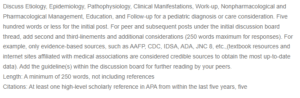
Discuss Etiology, Epidemiology, Pathophysiology, Clinical Manifestations, Workup, Nonpharmacological and Pharmacological Management, Education, and Follow-up for a pediatric diagnosis or care consideration. Five hundred words or less for the initial post. For peer and subsequent posts under the initial discussion board thread, add second and third-linements and additional considerations (250 words maximum for responses). For example, only evidence-based sources, such as AAFP, CDC, IDSA, ADA, JNC 8, etc.,(textbook resources and internet sites affiliated with medical associations are considered credible sources to obtain the most up-to-date data). Add the guideline(s) within the discussion board for further reading by your peers.
Length: A minimum of 250 words, not including references
Citations: At least one high-level scholarly reference in APA from within the last five years, five