
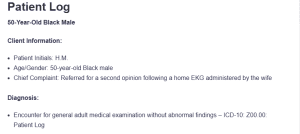
Patient Log
50-Year-Old Black Male
Client Information:
- Patient Initials: H.M.
- Age/Gender: 50-year-old Black male
- Chief Complaint: Referred for a second opinion following a home EKG administered by the wife
Diagnosis:
- Encounter for general adult medical examination without abnormal findings – ICD-10: Z00.00: Patient Log
Procedure:
- Electrocardiogram (EKG) performed in the clinic
- Results indicated normal sinus rhythm with a PR interval of 92 milliseconds
- No acute or abnormal cardiac findings were reported
Treatment Plan and Notes:
H.M. is a 50-year-old African American male who was evaluated following the recommendation of his wife. She is a medical provider, and she had conducted an at-home EKG because she was worried about the condition of his heart. She advised him to seek a second opinion with Dr. McFarland, even though he was asymptomatic.
A 12-lead EKG in the clinic revealed normal sinus rhythm without any arrhythmias or ischemia, and the PR interval was within the normal range (92 milliseconds). The patient denied any chest pain, palpitations, dizziness, or syncope. He did not have a history of any hypertension, diabetes, or cardiovascular disease. Vitals and physical exam were normal.
There was no further diagnostic workup since there were no symptoms and a normal EKG. The patient needed reassurance concerning his heart and preventive counseling, such as directions regarding routine exercise, a heart-friendly diet, and regular checkups. No drugs were prescribed. It was recommended that he make follow-ups every year or earlier in case of the development of symptoms, and he showed relief after the assessment.
54-Year-Old Male
Client Information:
- Patient Initials: D.B.
- Age/Gender: 54-year-old male
- Chief Complaint: Persistent lower back pain for the past two weeks
Diagnosis:
- Chronic Low Back Pain – ICD-10: M54.5
- Essential Hypertension – ICD-10: I10
- Type 2 Diabetes Mellitus without Complications – ICD-10: E11.9
Procedure:
- Comprehensive musculoskeletal assessment
- Pain scale utilized: reported baseline 5/10 with tightness and squeezing sensation
- Pain flares daily up to 8–9/10, lasting 24 hours
- No prior physical therapy or occupational therapy
- No imaging was performed at this visit
Treatment Plan and Notes:
The condition involves a 54-year-old man with chronic back pain; the latter is manifested by a daily feeling of tightness and squeezing heaviness exacerbated by standing and raising heavy objects. The discomfort is mild when stationary and increases with induction. There is no prior history of physical and occupational therapy, and no imaging has been performed. He is presently taking Lisinopril, Metformin, and Ibuprofen.
He was trained on posture, ergonomics, and exercises focusing on core strengthening to manage his back pain. He was referred to a physical therapy session as a way of rehabilitation and systematic exercise. It was recommended to use Ibuprofen further and pay attention to possible gastrointestinal or kidney adverse reactions.
Additional medications, such as muscle relaxants or gabapentin, can be considered in case Neuropathic features are found. Due to his diabetes and hypertension, his pain treatment will be well coordinated to prevent exacerbation of his chronic conditions. He was counseled on lifestyle modification and follow-up after four weeks.
60-Year-Old Male
Client Information:
- Patient Initials: K.L.
- Age/Gender: 60-year-old male
- Chief Complaint: Chronic right foot pain related to prior trench foot injury in 2020
Diagnosis:
- Chronic Pain Syndrome – ICD-10: G89.4
- Asthma, Unspecified – ICD-10: J45.909
Procedure:
- Physical exam of the right foot performed
- Lung sounds clear to auscultation (LS clear)
- Pain intensity assessed: rated 8/10 daily and during flare-ups
- Denies previous surgical intervention or specialist (podiatrist) consultation
Treatment Plan and Notes:
K.L. is a 60-year-old man who was followed up regarding persistent pain in his right foot that developed following trench foot in 2020. His report includes chronic, achy pain with a rating of 8/10 that is aggravated by prolonged standing or sitting. Minimal relief is achieved by using Ibuprofen.
He has not undergone an assessment by a podiatrist and has had no scans or surgery. He also suffers from asthma, which is treated with an albuterol inhaler on a specialty basis.
The patient was referred to the podiatry service to further assess her and have possible imaging to determine the presence of nerve or vascular system complications. He was advised on how to use NSAIDs and warned that he should watch out for the gastrointestinal or renal side effects (Ghlichloo & Gerriets, 2023).
Education comprised periods of standing, sitting, and raising the foot and supportive footwear. His chest sounds were clear, and he was reminded to use his inhaler before exercise. He was advised to record symptoms daily. The follow-up will be done after four weeks or less in case the symptoms deteriorate.
60-Year-Old White Female
Client Information:
- Patient Initials: M.C.
- Age/Gender: 60-year-old White female
- Chief Complaint: Chronic back pain with severe mobility limitation
Diagnosis:
- Chronic Pain Syndrome with Neuropathic Features – ICD-10: G89.4
- Compression Fractures of Vertebrae – ICD-10: M48.58XA
- Herniated Intervertebral Disc – ICD-10: M51.26
- Suspected Neurogenic Bowel and Bladder – ICD-10: N31.9
Procedure:
- Comprehensive musculoskeletal and neurological exam
- Gait and mobility assessment performed
- Pain scale completed (8/10 baseline, 10/10 flares)
- Mobility evaluated; walker use confirmed
Treatment Plan and Notes:
M.C. is a 60-year-old female with chronic severe back pain caused by a fall and multiple motor vehicle accidents in the 90s. Her previous history includes compression fractures, spinal spurs, and a herniated disc. The pain is assessed at 8/10 in activity and ranges from 10/10 daily. She cannot walk three days a week and uses a walker, and she is seeking a mobility scooter to enhance her mobility so that she can be as independent as possible.
She further complains of bilateral lower extremity tingling and extreme pain, but she does not complain of numbness. The incontinence of the bowel and bladder is of concern due to neurogenic involvement. The present treatments can alleviate the condition partially, but are based on Tylenol and Tramadol.
Past CT scanning, physical therapy, and chiropractic interventions had some limited benefit. She has never undergone surgery. Since an urgent diagnosis was to be carried out using MRI, she was further referred to neurology and spine surgery.
A pain management consultation has also been launched. The patient was equipped with knowledge about bowel/bladder tracking, the safety of the device, and medication intake. They will follow up in two weeks or less in case of worsening symptoms.
64-Year-Old White Male
Client Information:
- Patient Initials: J.R.
- Age/Gender: 64-year-old White male
- Chief Complaint: Follow-up after prostate cancer surgery and concerns about urinary incontinence and erectile dysfunction
Diagnosis:
- Post-Prostatectomy Status – ICD-10: Z85.46 (Shahangian et al., 2021)
- Erectile Dysfunction – ICD-10: N52.9
- Urinary Incontinence – ICD-10: N39.3
Procedure:
- PSA test performed today as part of routine monitoring
- History reviewed: prostate biopsy completed and prostate removed on April 1, 2025
- Denies undergoing radiation or chemotherapy
Treatment Plan and Notes:
J.R. is a 64-year-old man who visited to follow up following prostatectomy done in April 2025 due to prostate cancer. He gives a history of intractable urinary incontinence with a wet-pad requirement of two briefs daily and erectile dysfunction after surgery. He is presently using Tamsulosin and denies having problems with voiding.
His next follow-up on urology would be in October 2025. The patient worked at the U.S. Navy between the years 1981 and 1986 and denies having been subjected to radiation or chemotherapy. He denies hematuria and urinary retention as well.
Tamsulosin should be continued, and pelvic floor exercises should be taught. The management of incontinence, such as physical therapy and assistive devices, was addressed. The management of erectile dysfunction was discussed and could involve incorporating phosphodiesterase inhibitors as well as counseling, which should be discussed further with urology.
Today, during the visit, PSA testing was conducted. The patient was assured of post-operation maintenance and told that she should come earlier in case any symptom like hematuria, pelvic pain, or even worsened incontinence comes up before his next scheduled appointment.
Middle-Aged White Male
Client Information:
- Patient Initials: B.M.
- Age/Gender: Middle-aged White male
- Chief Complaint: Chronic bilateral hip and knee pain
Diagnosis:
- Bilateral Hip Pain – ICD-10: M25.551
- Patellofemoral Pain Syndrome (Runner’s Knee) – ICD-10: M22.2X9
Procedure:
- Range of motion (ROM) and pain assessment conducted
- Knee previously imaged; no hip imaging performed to date
- Physical therapy was completed in the past
- Recommendations for treatment and medication submitted to the VA
Treatment Plan and Notes:
The patient is a middle-aged Caucasian male with a history of chronic bilateral hip and knee pains that started in 2016 due to a knee injury that he suffered during his stint in the military service (2014-2019). He injured his runner’s knee when he went into a hole while running. Pain has since spread to the hips, worsening in extended sitting, standing, or lifting cases.
The patient scores hip pain at 5/10 daily, with an intensity of 9/10 flare-ups multiple times every week. He walks on a cane and does not always manage to walk. The patient has been absent from work several times due to refractory pain.
Knee pain is described as dull and sharp, rated 6/10 daily, with morning stiffness and swelling. He wears a knee brace occasionally and takes Ibuprofen for relief. He also reports using alcohol to manage pain.
Currently employed in security, he denies suicidal ideation or homelessness but has stopped participating in hobbies like fishing and family walks. Imaging and orthopedic referral were recommended. Behavioral health referral discussed for alcohol use.
78-Year-Old White Male
Client Information:
- Patient Initials: S.G.
- Age/Gender: 78-year-old White male
- Chief Complaint: Urinary symptoms and diabetic neuropathy
Diagnosis:
- Benign Prostatic Hyperplasia (Post-Laser Procedure) – ICD-10: N40.1
- Type 2 Diabetes Mellitus with Diabetic Neuropathy – ICD-10: E11.40
- Hypertension – ICD-10: I10
- Hyperlipidemia – ICD-10: E78.5
- Urinary Incontinence – ICD-10: N39.3
Procedure:
- Laser prostate reduction completed January 2025
- Prostate biopsy was also performed in January 2025
- Next follow-up with urologist scheduled for 07/03/2025
- No signs of urinary tract infection; urinalysis deferred
Treatment Plan and Notes:
S.G. is a 78-year-old male with a complex medical history including BPH, diabetes with peripheral neuropathy, hypertension, and hyperlipidemia. He was seen today for routine follow-up. He reports persistent urinary incontinence and a weak urinary stream, though he denies dysuria or urinary tract infections.
Laser surgery to reduce prostate size and a biopsy were completed in January 2025. He follows up with urology every 2–3 months and is scheduled for a return visit on July 3, 2025.
He also reports moderate numbness and tingling in his extremities, consistent with diabetic neuropathy. Current medications include Gabapentin 400mg for neuropathy, Losartan 100mg and Chlorthalidone 15mg for hypertension, Rosuvastatin 20mg for hyperlipidemia, and Empagliflozin 10mg for diabetes management.
The patient was advised to continue his current medication regimen and was educated on the importance of glycemic control to slow neuropathy progression. Bladder diary tracking and pelvic floor exercises were recommended for incontinence (Tran & Puckett, 2023). Monitoring for signs of urinary retention, worsening neuropathy, or UTI symptoms was emphasized. Follow-up remains coordinated with urology and primary care.
77-Year-Old White Male
Client Information:
- Patient Initials: W.L.
- Age/Gender: 77-year-old White male
- Chief Complaint: Chronic right shoulder pain
Diagnosis:
- Chronic Shoulder Pain – ICD-10: M25.511
- History of Rotator Cuff Repair – ICD-10: Z98.890
Procedure:
- Rotator cuff surgery was completed in 2018
- Physical therapy was completed post-operatively
- Pain assessment performed
Treatment Plan and Notes:
W.L. presents with chronic right shoulder pain resulting from a lifting injury sustained in 1966. He underwent rotator cuff surgery in 2018, followed by a full course of physical therapy. He now reports episodic shoulder pain occurring about once per week at 4/10 intensity, with monthly flares reaching 7/10, lasting a couple of days. The pain is achy and sharp, aggravated by lifting and relieved with topical IcyHot, Tylenol, and Ibuprofen.
The shoulder remains functional with no acute limitations. A conservative management plan was recommended, including ongoing use of OTC medications and application of heat or cold therapy during flares. The patient was encouraged to continue range-of-motion and strengthening exercises at home.
Imaging is not deemed necessary at this time, but may be considered if the frequency or intensity of flares increases. The patient was advised to avoid repetitive lifting and overhead movements. Follow-up PRN.
27-Year-Old White Male
Client Information:
- Patient Initials: R.T.
- Age/Gender: 27-year-old White male
- Chief Complaint: Chronic right-sided neck pain
Diagnosis:
- Chronic Neck Pain – ICD-10: M54.2
- History of Traumatic Brain Injury (TBI) – ICD-10: S06.2X9S
Procedure:
- Neurological and musculoskeletal exam
- No imaging or surgery previously performed
Treatment Plan and Notes:
R.T. is a 27-year-old male patient who has been experiencing chronic pain on the right side of the neck. In 2021, he had TBIs as a result of a mortar attack in Kuwait and in 2022 due to a motor vehicle accident. The patient reports tension-type pains with 4/10 moderate daily and flares to 6/10 twice a week.
These flares normally take between 3 and 4 hours and are accompanied by spasms. He has had episodes of immobilizing pain twice in a month; however, he denies numbness, tingling, and weakness.
During the last 12 months, while working as a window washer, he has taken seven sick days because of neck stiffness. The patient has no surgery or imaging. The present management involves rest, stretch, and symptomatic relief. Physical therapy was referred for post-TBI musculoskeletal rehabilitation and directed neck range of motion.
A consultation in neurology was advised to evaluate the remaining outcomes of TBI. Trained in posture, trigger avoidance, and ergonomics of safe work. Four-week follow-up or PRN.
70-Year-Old White Male
Client Information:
- Patient Initials: V.S.
- Age/Gender: 70-year-old White male
- Chief Complaint: GERD with Barrett’s esophagus and dysphagia
Diagnosis:
- GERD – ICD-10: K21.9 (Azer & Reddivari, 2024)
- Barrett’s Esophagus – ICD-10: K22.70
- Dysphagia – ICD-10: R13.10
Procedure:
- History of the Link procedure
- EGD performed
- Medication review
Treatment Plan and Notes:
V.S. is a patient who presents with a history of continuous management of the gastroesophageal reflux disease complicated by Barrett’s esophagus and longstanding dysphagia, which dates as far back as the 1990s. He had a Link procedure and is being treated with Omeprazole 40 mg (split doses) and Famotidine daily. GI follow-up by recent endoscopy was made.
The patient is not experiencing any acute symptoms, including chest pain, bleeding, or weight loss. He was advised to change his diet by avoiding spicy food, acidic foods, caffeine, and nighttime meals. He was also recommended sitting up after meals and elevating his head of bed to avoid reflux.
Progression of dysphagia will be observed, and referral to speech-language pathology is advised in case of aggravation. The GI protocol is on EGD surveillance. Keep on with existing medications. Depending on the case, check back at the clinic in 6 months or sooner.
84-Year-Old White Male
Client Information:
- Patient Initials: L.J.
- Age/Gender: 84-year-old White male
- Chief Complaint: Follow-up for Stage 3 chronic kidney disease
Diagnosis:
- Chronic Kidney Disease Stage 3 – ICD-10: N18.3
Procedure:
- Physical assessment for edema and urinary symptoms
- Reviewed nephrology notes; last follow-up within 6 months
Treatment Plan and Notes:
L.J. is an 84-year-old male with Stage 3 chronic kidney disease diagnosed in 2015. He reports frequent urination and lower extremity swelling but denies urinary tract infections, burning, or a history of kidney stones. He has not undergone dialysis or renal surgery. He is followed by a nephrologist every 6 months.
On exam, mild bilateral pedal edema noted. Blood pressure and labs to be monitored regularly. Educated on fluid management, sodium restriction, and avoidance of nephrotoxic medications such as NSAIDs.
Reinforced the importance of consistent nephrology follow-up and monitoring of renal function via creatinine and GFR every 3 months. No signs of acute renal decline. Denies weight loss, hematuria, or fatigue. Return to the clinic in 3 months or sooner if new symptoms arise.
References
Azer, S. A., & Reddivari, A. K. R. (2024, May 1). Gastroesophageal Reflux Disease (GERD). PubMed; StatPearls Publishing. https://www.ncbi.nlm.nih.gov/books/NBK554462/
Ghlichloo, I., & Gerriets, V. (2023). Nonsteroidal Anti-inflammatory Drugs (NSAIDs). PubMed; StatPearls Publishing. https://www.ncbi.nlm.nih.gov/books/NBK547742/
Shahangian, S., Sharma, K. P., Fan, L., & Siegel, D. A. (2021). Use of the prostate‐specific antigen test in the U.S. for men aged 30 to 64 in 2011 to 2017 using a large commercial claims database: Implications for practice interventions. Cancer Reports, 4(4). https://doi.org/10.1002/cnr2.1365
Tran, L., & Puckett, Y. (2023). Urinary Incontinence. PubMed; StatPearls Publishing. https://www.ncbi.nlm.nih.gov/books/NBK559095/
ORDER A PLAGIARISM-FREE PAPER HERE
We’ll write everything from scratch
Question 
Throughout this course, you will also keep a log of patient encounters using Meditrek. AGPCNP students must record at least 100 encounters with GYN patients; FNP students must record at least 125 encounters with patients (100 GYN and 25 OB patients) by the end of this practicum.
The patient log must include the following:
- Client Information
- Diagnosis
- Procedure (Note: Make sure that, as you perform procedures at your practicum site, you also note those on your printed-out Clinical Skills List.)
- Treatment Plan and Notes
Please see attached.
50 black male
- Wife is a provider and did an ekg at home, made husband get a 2nd opinion from Dr mcfarland.
- EKG performed normal sinus rhythm, pr 92. No findings
54 year male present for Back pain 2 week ago
- PHM: Hypertension, Diabetes
- Voiced daily back pain 5/10 tightness, squeezing
- Flare up 7 days per week last for 24 hours, flare up to 8-9/10
- Denies PT/OT
- Exacerbated prolonged standing, lifting
- Medication: Lisinopril, Metformin, Ibuprofen
60 years old male
- PHM trench foot 2020, Asthma
- LS clear
- Follow up foot pain from 2020
- Denies procedure or surgery
- Daily pain 8/10, flare up 8/10, exacerbated by prolong standing, sitting
- Denies Podiatrist
- Medication: ibuprofen, Albuterol inhaler
60 white female
- Back pain since 2010
- Fell down stairs and had 3 MVA in the 90’s
- PT, CT, chiropractic
- No surgery and procedures
- Compression fractures, herniated disk
- Spurrs
- Daily 8/10 pain with any activity
- Flares 10/10 daily
- Can’t walk 3/7 days
- Uses walker
- Trying to get a scooter
- Incontinence of bowl and bladder
- No numbness, moderate tingling and severe pain in ble
- Takes Tylenol and tramadol
Patient Log
64 years old white male
- Prostate cancer 2025
- Erectile dysfunction
- Biopsy completed & prostate removed april 1st 2025
- Have f/u appointment with urologist October 2025
- Denies radiation or chemo
- PSA test done today
- Service 8/1981 to 6/1986 Navy
- Incontinence- wear pull up, 2 briefs per day
- Medication: Tamsulosin
- Denies difficulty voiding
White male presents for routine VA visit. Bilateral hip pain started in 2016.
- Pain started after smashing knee. Denies hx of hip surgeries or procedures. No imaging. PT was completed.
Hip pain is daily, rated 5/10. The pain feels like a sharp/grinding sensation. Takes Ibuprofen. Drinks alcohol to control pain.
Has flareups about 4 days a week. These flareups result in pain rated at 9/10 and can last for hours. Prolonged sitting, standing, lifting exacerbates the pain. Is unable to walk a couple days a week for hours at a time due to hip pain.
Uses a cane to assist with ambulation. Has missed about 6 days of work over the last year due to pain. Currently does security work. Denies being homeless or suicidal. - Knee issues began in early 2016. Injury occurred during a run. He stepped into a hole and had to be carried back to base. He was then transported to hospital where they diagnosed him with runners knee.
Pain exacerbated overtime and radiated to hip. PT was completed. Xrays/imaging done of knee. Future surgery may be pending. 2014-2019 years of service. Knee pain rated 6/10 daily.
Sharp, dull pain that radiates to hip. Pain occurs every day and flare-up to 9. Prolonged sitting makes pain worse. Reports knee swelling.
3-4 days a week he is unable to walk when he first wakes up. This lasts about 3-4 hours. Reports wearing knee brace sometimes. Has missed work about 12-13 days due to knee pain. - Is unable to do fishing, hunting, or family walks.
- Plan: ROM, pain assessment. Recommendations for medication and treatment submitted to VA. Return in 1 year or PRN.
78 years old white male
- PHM: enlarged prostate, Diabetes, Diabetic neuropathy, Hypertension, Hyperlipidemia
- Follow by Urologist – see every 2-3 month, next appt 7/3/2025
- Laser procedure done to shrink the prostate 1/2025, Biopsy done 1/2025
- Incontinence, weak stream
- Denies burning with urination, UTI
- Moderate numbness/tingling extremities
- Medication: Gabapentin 400mg, Losartan 100mg, Chrothiazine 15mg, rosuvastatin 20mg, Empaglizozin 10mg
77 year old white male
- Right shoulder pain 1966 injured from lifting
- Rotator cuff surgery done 2018
- Completed PT
- Pain once a week 4/10, achiness and sharp pain, flare up once a month 7/10, last couple days
- Aggravate by lifting, alleviate by icyhot, Tylenol, Ibuprofen
27 white male
- Neck pain
- TBI 2021 morter fire Kuwait
- TBI 2022 MVA vehicle rolled
- Daily right side 4/10 tension pain
- Flares with movement 2/7 days for 3-4 hours 6/10
- Can’t move it twice a month
- Spasms once weekly
- No numbness/ tingling or devices
- No surgery or procedures
- Missed 7/365 days work as window washer
70 white male
- GERD, barrett’s esophagus, dysphagia 90s
- Link procedure
- Omeprazole 40 mg divided
- Famotidine 1/ day
- EGD
84 years old white
- Kidney Disease Stage 3 2015
- s/s frequent urination, swelling on extremities
- Follow by Nephrologist every 6 months
- Denies dialysis, surgery or procedure
- Denies burning with urination, recurring kidney stone, UTI
- Service 1963-1966