
Patient History Taking
Patient history taking is the primary and first step in finding a solution to patient health issues. In an interview with the patient in the case study (a 21-year-old Filipino college student living in a dorm wanting to know what birth control is), it is essential to create a good relationship by making the patient comfortable and willing to give information about themselves. I will introduce myself by name and role to the patient so that the patient can ascertain how I am of help to them. I will then allow the patient to introduce themself. This interaction creates a communication base where the patient and the clinician share information for diagnosis and therapy. At this stage, face-to-face oral communication is preferred, with only open questions, and the patient is allowed to ask and answer questions (Ball et al., 2019). This communication technology allows the patient to give their views and will enable the clinician to assess the patient body language and perceptions of the facts they are provided with.
Do you need help with your assignment ? Get in touch with us.
The risk assessment instrument for this patient is the risk assessment matrix, which assigns quantitative value to risk. Lemmens et al. (2022) detail that the risk assessment matrix is done by filtering through the risks and making a comparison with the organization’s policy on different management strategies on risks. The matrix is adopted in this patient because it quantifies apparent risks into diverse scales and enables the assessment of their potential impact and probability (Pascarella et al., 2021). In the patient case presented, it will be easy to scale the values through a risk matrix and evaluate them based on the likelihood of their occurrence. This will create a framework for managing these risks and decision-making on contraception to consider.
The questions I would ask the patient include whether they are sexually active, how often they have sex, why they want to have contraception, whether they have used any contraception before, when, whether or not they are on medications, and if they have ever experienced an allergic reaction to any medicine.
References
Ball, J. W., Dains, J. E., Flynn, J. A., Solomon, B. S., & Stewart, R. W. (2019). Seidel’s guide to physical examination: An interprofessional approach (9th ed.). St. Louis, MO: Elsevier Mosby.
Lemmens, S., Lopes van Balen, V., Röselaers, Y., Scheepers, H., & Spaanderman, M. (2022). The risk matrix approach: a helpful tool weighing probability and impact when deciding on preventive and diagnostic interventions. BMC Health Services Research, 22(1). https://doi.org/10.1186/s12913-022-07484-7
Pascarella, G., Rossi, M., Montella, E., Capasso, A., De Feo, G., & Botti, G. et al. (2021). Risk Analysis in Healthcare Organizations: Methodological Framework and Critical Variables. Risk Management and Healthcare Policy, Volume 14, 2897-2911. https://doi.org/10.2147/rmhp.s309098
ORDER A PLAGIARISM-FREE PAPER HERE
We’ll write everything from scratch
Question 
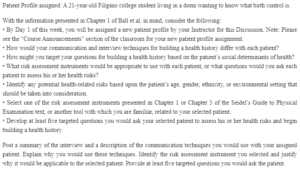
Patient Profile assigned: A 21-year-old Filipino college student living in a dorm wants to know what birth control is.
Patient History Taking
With the information presented in Chapter 1 of Ball et al. in mind, consider the following:
• By Day 1 of this week, you will be assigned a new patient profile by your Instructor for this Discussion. Note: Please see the “Course Announcements” section of the classroom for your new patient profile assignment.
• How would your communication and interview techniques for building a health history differ with each patient?
• How might you target your questions for building a health history based on the patient’s social determinants of health?
• What risk assessment instruments would be appropriate to use with each patient, or what questions would you ask each patient to assess their health risks?
• Identify any potential health-related risks based on the patient’s age, gender, ethnicity, or environmental setting that should be taken into consideration.
• Select one of the risk assessment instruments presented in Chapter 1 or Chapter 5 of Seidel’s Guide to Physical Examination text or another tool with which you are familiar, related to your selected patient.
• Develop at least five targeted questions you would ask your selected patient to assess their health risks and begin building a health history.
Post a summary of the interview and a description of the communication techniques you would use with your assigned patient. Explain why you would use these techniques. Identify the risk assessment instrument you selected and justify why it would be applicable to the selected patient. Provide at least five targeted questions you would ask the patient.