
Organizational Behavior Team Building Presentation
| WEEK 3 | NAME: |
| Answer the 6 questions below ; place your answer in the column entitled RESPONSE | |
| QUESTION | RESPONSE |
| A. Explain the difference between individuals and teams as they are used in an organization. | Individuals in an organization contribute individual skills, knowledge and responsibility to a specific task, and teams combine talents and thus accomplish objectives collectively. Organizations depend on individuals for specialized contributions and teams to provide their expertise and cooperation, innovation, and problem-solving. Teams lead to greater communication and creativity, while individuals lead to depth in knowledge and responsibility. Collectively, they meet the balance of autonomy and cooperation as they are essential for organizational success. |
| B. Explain how individuals and teams can be used effectively in an organization. | Individuals are effective when they use their strengths in jobs that fit their skills and when there are clear objectives and performance measurement in place. Teams are successful when they have established roles, effective communication, and they are cooperation (Aquino et al., 2022). Organizations accomplish maximum effectiveness by utilizing individual talent and building teamwork on those projects that demand coordination, problem-solving, and the multiplicity of views. |
| C. Describe and discuss the 5 phases of group development.
|
The five phases of group development are forming, storming, norming, performing, and adjourning. Forming is when members get to know each other and what they want to accomplish. Storming is where individuals raise conflicts, and role clarity issues are raised. Norming is where there is cohesion and trust. Performing is where efficiency is achieved in the group, and the performing objective is involved. Lastly, adjourning is where the task is terminated, and members dissolve the group. Every stage is seen as a development in the relationships, communication, and productivity. Leadership steers teams easily through these stages, which results in growth. |
| D. List strategies and practices a company could implement to build and maintain individual and team performance. | Companies can promote individuals through recognition programs, performance-based rewards, professional growth, mentoring, and clear objective setting. Team-building activities, collaborative tools, frequent feedback, and sharing successes are some of the practices used to help teams work. These approaches enhance inspiration, responsibility, and collaborative success, maintaining individual and organizational momentum, and driving performance toward organizational objectives. When consistently applied, these strategies create a culture of excellence and long-term engagement. |
| E. Explain how the strategies and practices you identified help engage employees through the phases of group development. | Recognition programs and incentives keep individuals motivated through forming and storming. Mentorship and opportunities to learn professionally lead to growth in norming. Team building activities and cooperative instruments reinforce the trust and the effectiveness of the performance (Engebø et al., 2022). Celebrating common achievements in adjourning honors contributions. These approaches ensure that one can keep all five stages of group development full of consistent engagement and motivation, as well as cohesiveness. |
| F. Explain how your development or facilitations/training would differ for an individual audience versus a group | Individuals would be trained with the focus on personal feedback, goal-setting, and skill training. In the case of groups, facilitation would be addressed to collaboration, communication, and conflict resolution. Individual trainings are more precise and evolutionary, whereas group trainings have their synergetic and shared responsibilities, and create a sense of trust. Group training develops unity and collaborative solving of the problem, whereas individual development builds on a particular set of specific competencies. The adaptation of the methods to the audience guarantees personal growth and the advancement of the organization. |
References
Aquino, J. F., Riss, R. R., Multerer, S. M., Mogilner, L. N., & Turner, T. L. (2022). A step-by-step guide for mentors to facilitate team building and communication in virtual teams. Medical Education Online, 27(1). https://doi.org/10.1080/10872981.2022.2094529
Engebø, A., Klakegg, O. J., Lohne, J., Bohne, R. A., Fyhn, H., & Lædre, O. (2022). High-performance building projects: How to build trust in the team. Architectural Engineering and Design Management, 18(6), 774–790. https://doi.org/10.1080/17452007.2020.1811078
ORDER A PLAGIARISM-FREE PAPER HERE
We’ll write everything from scratch
Question 
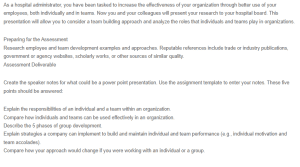
As a hospital administrator, you have been tasked to increase the effectiveness of your organization through better use of your employees, both individually and in teams. Now you and your colleagues will present your research to your hospital board. This presentation will allow you to consider a team building approach and analyze the roles that individuals and teams play in organizations.
Organizational Behavior Team Building Presentation
Preparing for the Assessment
Research employee and team development examples and approaches. Reputable references include trade or industry publications, government or agency websites, scholarly works, or other sources of similar quality.
Assessment Deliverable
Create the speaker notes for what could be a power point presentation. Use the assignment template to enter your notes. These five points should be answered:
Explain the responsibilities of an individual and a team within an organization.
Compare how individuals and teams can be used effectively in an organization.
Describe the 5 phases of group development.
Explain strategies a company can implement to build and maintain individual and team performance (e.g., individual motivation and team accolades).
Compare how your approach would change if you were working with an individual or a group.