
Observation Project Three – Experiments
Child Information
Name: Sarah M.
Age: 3 years, 0 months
Sex: Female
Date of Experiment: May 28, 2025
Location: Home playroom (quiet, well-lit space with a child-sized table)
Experiment Overview
To assess Sarah’s understanding of conservation (a Piagetian preoperational concept), I conducted the liquid quantity task. Using two identical clear glasses and a taller, narrower glass, I poured equal amounts of water into the identical glasses while Sarah observed.
Procedure & Observations
Setup:
- Placed two identical glasses (Glass A and Glass B) on the table and filled them equally with water.
- Asked Sarah, “Do these glasses have the same amount of water?” She confirmed, “Yes, same!”
Transformation:
- Poured water from Glass B into a taller, narrower glass (Glass C) while Sarah watched.
- Asked, “Now, does one glass have more water, or are they still the same?”
Child’s Response:
- Sarah pointed to Glass C and said, “This one has more because it’s bigger!”
- When asked why, she explained, “It’s taller!” and seemed confident in her answer.
Results & Analysis
Sarah demonstrated typical preoperational thinking by focusing on the perceptually salient feature (height) rather than conserved quantity. This aligns with Piaget’s theory that children under 7 lack conservation skills due to centration (fixating on one dimension). Her response confirms she is in the preoperational stage, where logic is influenced by appearance. No frustration was observed, suggesting her cognitive flexibility is still emerging.
Summary of Progress
Sarah’s performance matches the expected milestones for her age. While she did not grasp conservation, her ability to articulate her reasoning (“taller = more”) reflects advancing language and symbolic thought. To support her cognitive growth, caregivers could introduce playful comparisons (e.g., reshaping clay) to gently challenge her perceptions.
ORDER A PLAGIARISM-FREE PAPER HERE
We’ll write everything from scratch
Question 
Observation Project Three – Experiments
Project Overview
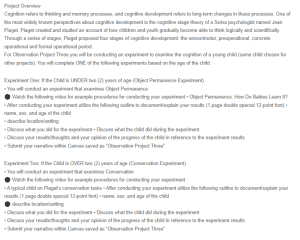
Cognition refers to thinking and memory processes, and cognitive development refers to long-term changes in these processes. One of the most widely known perspectives about cognitive development is the cognitive stage theory of a Swiss psychologist named Jean Piaget. Piaget created and studied an account of how children and youth gradually become able to think logically and scientifically. Through a series of stages, Piaget proposed four stages of cognitive development: the sensorimotor, preoperational, concrete operational and formal operational period.
Observation Project Three – Experiments
For Observation Project Three you will be conducting an experiment to examine the cognition of a young child (same child chosen for other projects). You will complete ONE of the following experiments based on the age of the child:
Experiment One: If the Child is UNDER two (2) years of age (Object Permanence Experiment)
• You will conduct an experiment that examines Object Permanence
⚫ Watch the following video for example procedures for conducting your experiment • Object Permanence: How Do Babies Learn It?
• After conducting your experiment utilize the following outline to document/explain your results (1 page double spaced 12-point font) • name, sex, and age of the child
• describe location/setting
• Discuss what you did for the experiment • Discuss what the child did during the experiment
• Discuss your results/thoughts and your opinion of the progress of the child in reference to the experiment results
• Submit your narrative within Canvas saved as “Observation Project Three”
Experiment Two: If the Child is OVER two (2) years of age (Conservation Experiment)
• You will conduct an experiment that examines Conservation
⚫ Watch the following video for example procedures for conducting your experiment
• A typical child on Piaget’s conservation tasks • After conducting your experiment utilize the following outline to document/explain your results (1 page double spaced 12-point font) • name, sex, and age of the child
⚫ describe location/setting
• Discuss what you did for the experiment • Discuss what the child did during the experiment
• Discuss your results/thoughts and your opinion of the progress of the child in reference to the experiment results
• Submit your narrative within Canvas saved as “Observation Project Three”