
Nurses and Healthcare Systems in Florida
| Criteria | Article 1 | Article 2 | Article 3 | Article 4 |
| Author, Journal (Peer-Reviewed), and
Permalink or Working Link to Access Article
|
Leafman, J. S., & Mathieson, K. (2018).
https://doi.org/10.1080/2331205X.2018.1525148
|
Rush, K. L., Hatt, L., Janke, R., Burton, L., Ferrier, M., & Tetrault, M. (2018). | Contreras, C. M., Metzger, G. A., Beane, J. D., Dedhia, P. H., Ejaz, A., & Pawlik, T. M. (2020).
|
Thomas, E. E., Haydon, H. M., Mehrotra, A., Caffery, L. J., Snoswell, C. L., Banbury, A., & Smith, A. C. (2020).
|
| Article Title and Year Published
|
Perceptions of telemedicine for patient education among online support group patients with chronic or rare conditions. Cogent Medicine, 5(1), 1525148. (2018) | The efficacy of telehealth delivered educational approaches for patients with chronic diseases: A systematic review. Patient education and counseling, 101(8), 1310-1321 (2018) | Telemedicine: patient-provider clinical engagement during the COVID-19 pandemic and beyond. Journal of Gastrointestinal Surgery, 24, 1692-1697.
(2020) |
We are building on the momentum: Sustaining telehealth beyond COVID-19. Journal of telemedicine and telecare, 1357633X20960638.
(2020) |
| Research Questions (Qualitative)/Hypothesis (Quantitative)
|
Do people from high highw and high socioeconomic status groups have different perceptions of problem situations?
|
Whether virtual education delivery on patient outcomes improved or declined compared to the usual care | The impact of telemedicine has been significant enough to warrant future strategies for implementing the same in healthcare. | The impact of the pandemic will shape the way healthcare is delivered. |
| Purposes/Aim of Stexplore | are errin the ing potential benefits of telemedicine for patient education (TPE) and applying the Community of Inquiry (CoI) framework in examining perceptions of TPE among patients diagnosed with chronic or rare conditions. | Comparison of virtual education delivery efficacy on patient outcomes compared to the usual care. | Summarize the current telemedicine envignecessarye necessary changes triggered y COa9, and showing how the, current crisis can be used in informing future use of telemedicine. | Highlight five essential telehealth requirements for long-term sustainability. |
| Design (Type of Quantitative or Type of Qualitative)
|
Cross-sectional, anonymous survey design | Systematic Review | Literature Review | Literature Review |
| Setting/Sample
|
Patients with chronic or rare diseases (N = 274) | Six high to moderate-quality studies sourced from EMBASE, CINAHL, and MEDLINE | The authors compared the use of telemedicine before and during the pandemic and projected its use during the pandemic. | N/A |
| Methods: Intervention/Instruments
|
A 46-item instrument | Comparison of eligible papers in virtual education to usual care and utilizing designs that allowed for causality assessment. | This was a report on the trends in telemedicine implementation pre- and pandemic. | Essential gaps in the healthcare series delivery of telehealth have needed—thelutions are needed for the appropriate use of telehealth interventions by healthcare providers. Also, guidance is necessary for governmental and other funding agencies on financing and regulation of telehealth for the future. |
| Analysis
|
Participants rated CoI items as necessary, with the most important being getting information for answering questions, getting up-to-date information, and patient’s ability to utilize the knowledge gained in improving their health; clear topic communication by a health care provider, clear communication of essential goals; and assisting patients in understanding topics and clarification of thinking. | Modalities of telehealth included television, video conference, telephone, and the web for patients with COPD, IBS, diabetes, and heart failure | Telemedicine platforms can increase clinical services where there are constrained
local physical structures. These can also improve the time interval between patient referral and the first clinical encounter. Less tech-savvy providers and patients prefer telephone-based rather than video-based telemedicine. |
The five critical requirements proposed include a) skilled workforce development, (b) consumer empowerment, (c) funding reform, (d) digital ecosystem improvement, and (e) integration of telehealth into routine care. |
| Key Findings
|
Participants were interested in disease knowledge, greater professional collaboration, better disease management, and education.
TPE may be an acceptable and accessible method of digital delivery communication for patients with literacy and access to computing technology. |
11 of 16 studies improved outcomes through virtual delivery of interventions, while five studies showed comparable results concerning the control conditions. | Increasing the volume of telemedicine can minimize congestion when it comes to patients. Rural healthcare can also improve through telemedicine use.
|
N/A |
| Recommendations
|
User-friendly with accurate information on the patient’s condition that will empower patients to ask better questions and which can improve compliance | Tested, virtual educational interventions offer options to practitioners for chronically ill patients. | Academic medical centers need to integrate telemedicine approaches into the trainee curriculum. Video platforms allow simultaneousimultaneous video streams for interaction between residents and patients under the live supervision of a teaching physician who is remotely located. | The five requirements mentioned were recommended for implementation when using telemedicine. |
| Explanation of How the Article Supports EBP/Capstone Project
|
The questionnaire created for the study will consider the recommendations made from this study. | Gives weight to the use of telemedicine as an intervention for patients with chronic illness | Patients who are less tech-savvy in this study will be contacted vi,a telephone while the rest via zooThe | Themplemented in a phased pro based on the project’s successcess. |
| Criteria | Article 5 | Article 6 based on the project’s success | Article 7 | Article 8 |
| Author, Journal (Peer-Reviewed), and
Permalink or Working Link to Access Article
|
Triana, A. J., Gusdorf, R. E., Shah, K. P., & Horst, S. N. (2020).
https://www.liebertpub.com/doi/pdfplus/10.1089/tmj.2020.0155 |
Rosen, D., McCall, J. D., & Primack, B. A. (2017).
|
Tchero, H., Kangambega, P., Briatte, C., Brunet-Houdard, S., Retali, G. R., & Rusch, E. (2019).
|
Kolltveit, B. C. H., Gjengedal, E., Graue, M., Iversen, M. M., Thorne, S., & Kirkevold, M. (2017). https://doi.org/10.1186/s12912-017-0201-y |
| Article Title and Year Published
|
Technology literacy as a barrier to telehealth during COVID-19. Telemedicine and e-Health, 26(9), 1118-1119.(2020) | Telehealth protocol to prevent readmission among high-risk patients with congestive heart failure. The American journal of medicine, 130(11), 1326-1330.(2017) | Clinical effectiveness of telemedicine in diabetes mellitus: a meta-analysis of 42 randomized controlled trials. Telemedicine and e-Health, 25(7), 569-583.
(2019) |
Conditions for success in introducing telemedicine in diabetes foot care: a qualitative inquiry. BMC Nursing, 16(1), 1-10. (2017)
|
| Research Questions (Qualitative)/Hypothesis (Quantitative)
|
Barriers to accessing and using technology hinder the effective use of telemedicine. | High-risk patients can adhere to telehealth protocol for better health outcomes. | Whether diabetes management can be positively affected by telemedicine | There has been a slow uptake of telemedicine in foot ulcers in diabetic patients. The driving factors needed to be assessed. |
| Purposes/Aim of Study | Determining the impact of technology literacy and accessing telehealth during the COVID-19 pandemic. | They were assessing adherence to and effectiveness of a telehealth protocol. The protocol was designed to prevent CHF hospital admissions. | You are comparing high-level intervention with telemedicine care effectiveness and traditional approaches in diabetes patient management. | We are identifying the perceptions of health care professionals within diverse working settings about facilitators to participation and engagement in telemedicine applications. |
| Design (Type of Quantitative or Qualitative)
|
Report on telehealth application at the Vanderbilt University Medical Center, Nashville | Survey | Meta-analysis study | Interpretive Description, an applied qualitative research strategy. |
| Setting/Sample
|
Physician and patient experience at the Vanderbilt University Medical Center, Nashville | Fifty patients with congestive heart failure with a mean age of 61 years from an MCO. | Studies that reported the outcomes of telemedicine in type 1 and type 2 diabetes patients from CENTRAL and PubMed. were ret.grieved Further review resulted in 38 studies | Healthcare Professionals and Leaders in Western Norway |
| Methods: Intervention/Instruments | Observation and interviewing physicians and patients on their experiences | A telehealth platform was developed, allowing for video conferencing and real-time, daily health status reporting. Comparisons were made between rates of admission and readmission between the prior six months and the 6-month intervention period | N/A | Interactive telemedicine platform comprising a web-based ulcer record and wound assessment images. The text was sent via computer or mobile phone to specialist health care providers from primary health care providers. The health care professionals in specialist health care contacted the primary health care nurse if text or images were not received in case of uncertainty or every week. |
| Analysis
|
Some patients could not download the necessary software, making it challenging to access telecare.
Some patients were wary of scammers and hackers and unwilling to participate in telehealth.. |
Adherence was assesse.as the percentage of days where the patient completed the protocol on daily check-in. Primary outcomes were admissions and readmissions due to CHF, while the secondary outcomes were admissions and readmissions resulting from any other cause. | The effectiveness of telemedicine diabetes management is directly associated with the type of diabetes, patient age, and duration of the selected telemedicine care. | Notes were taken during all focus group interviews. Transcribed material was coded and organized, followed by conceptualizing of findings. |
| Key Findings
|
By implementing additional synergies, widespread telehealth can improve quality of life and health outcomes.
Common barriers include privacy concerns, cost, and self-efficacy. |
96% completed the protocol. 46% were at increased risk for readmission based on standardized measures. Median 120-day adherence was 96%. Equal patients proportions were admitted for all causes during the 6-month intervention compared to the prior period. Half as many patients during the 6-month intervention period were admitted for CHF compared to the comparison period. | Teleconsultation is less cost-effective than remote monitoring of blood glucose levels by self.
Physician unavailability and miscommunication when the patient calls could negatively impact the patients’ confidence in the system |
. hHealthcare professionals were very enthusiastic about telemedicine. However, they encountered challenges in the intervention process of telemedicine in the initial phase. |
| Recommendations
|
When patients can better navigate their applications and web browsers, they will likely feel empowered to message their physicians via the patient portal or look up healthy recipes online.
Improved coverage in insurance and updated regulations shouldrelated to patientiaccessimprove patient aaccessessing issues related to health concerns, mobility, and distance. Licensure across state lines needs to be addressed as there remains a big question with the potential to impact access for many patients. |
Adherence to the telehealth protocol was consistent and excellent, though it should be tested by using a more rigorous randomized design. | Remote monitoring and consultation are best suited for older patients, as these subjects experience memory and cognitactiveecline. | For success in tat elrotational levelcommendations included effective communicatlearnersnnels at the organizational level, the support thingmmitt technology,responsible leaders, havuser-friendlymeande champion in the work setting, and technology and user-friendly training. |
| Explanation of How the Article Supports EBP/Capstone
|
In the pilot test, the patient technology literacy will be assessed, and appropriate steps will be taken to remove bthe obstaclesto telehealth application in this study. | The study gives weight to the current research, sshowing the participants will very likely adhere to the protocols and education they receive. | This study gives weight to the currentResearch recommendationsemedicine is effectiveFuturee self-management oimplemented. | Based on the success o current study, the recomimplemented studybe implemented to future use of telemedicine in the healthcare facility where the study will take place. |
References
Contreras, C. M., Metzger, G. A., Beane, J. D., Dedhia, P. H., Ejaz, A., & Pawlik, T. M. (2020). Telemedicine: patient-provider clinical engagement during the COVID-19 pandemic and beyond. Journal of Gastrointestinal Surgery, 24, 1692-1697.
Kolltveit, B. C. H., Gjengedal, E., Graue, M., Iversen, M. M., Thorne, S., & Kirkevold, M. (2017). Conditions for success in introducing telemedicine in diabetes foot care: a qualitative inquiry. BMC Nursing, 16(1), 1-10.
Leafman, J. S., & Mathieson, K. (2018). Perceptions of telemedicine for patient education among online support group patients with chronic or rare conditions. Cogent Medicine, 5(1), 1525148.
Rosen, D., McCall, J. D., & Primack, B. A. (2017). Telehealth protocol to prevent readmission among high-risk patients with congestive heart failure. The American journal of medicine, 130(11), 1326-1330.
Rush, K. L., Hatt, L., Janke, R., Burton, L., Ferrier, M., & Tetrault, M. (2018). The efficacy of telehealth delivered educational approaches for patients with chronic diseases: A systematic review. Patient education and counseling, 101(8), 1310-1321
Tchero, H., Kangambega, P., Briatte, C., Brunet-Houdard, S., Retali, G. R., & Rusch, E. (2019). Clinical effectiveness of telemedicine in diabetes mellitus: a meta-analysis of 42 randomized controlled trials. Telemedicine and e-Health, 25(7), 569-583.
Thomas, E. E., Haydon, H. M., Mehrotra, A., Caffery, L. J., Snoswell, C. L., Banbury, A., & Smith, A. C. (2020). Building on the momentum: Sustaining telehealth beyond COVID-19. Journal of telemedicine and telecare, 1357633X20960638.
Triana, A. J., Gusdorf, R. E., Shah, K. P., & Horst, S. N. (2020). Technology literacy as a barrier to telehealth during COVID-19. Telemedicine and e-Health, 26(9), 1118-1119
ORDER A PLAGIARISM-FREE PAPER HERE
We’ll write everything from scratch
Question 
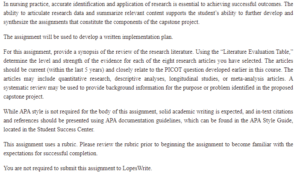
Accurate identification and application of research are essent,isupporthievistudentcin nursing practice. The ability toto develop furtherch data and summarize relevant content supports the student’s ability cap develop further and synthesize the assignments that constitute the components of the capstone project.
Nurses and Healthcare Systems in Florida
The assignment will be used tresearch literature reviewn plan.
For this assignment, provide a synopsis of the research literature review. Using the “Literature Evaluation Table,” determine the level and strength of the evidence for each of fivehe eight research articles you have selected. The articles should be current (within the last five years) and closely relate to the PICOT question developed earlier in this course. The reports may include quantitative research, descriptive analyses, longitudinal studies, or meta-analysis articles. A systematic review may be used to provide background information for the purpose or problem identified in the proposed capstone project.
While APA style is not required for the body of this assignment, solid academic writing is expected, and in-text citations and references shoud be presented using APA documentation guidelines, which can be found in the APA Style Gurubricopriord in the Student Sworkter.
This assignment uses a rubric. Please review the title before,eginning the work to b amiliarize yourselfith the expectations for successful completion.
You are not required to submit this assignment to LopesWrite.