
Nurse Leaders and Managers
Nurse Managers and leaders serve the special responsibilities of healthcare practitioners by supervising nursing personnel, controlling the organizational culture of clinical operations, and directing medical teams within healthcare settings to provide quality care to patients (Cusack et al., 2017). Nurse leaders recruit and dismiss caregivers, encourage professional development, arrange employee training, create budgets, foster quality care standards and policies, and supervise hospital departments, guaranteeing caregivers adhere to established guidelines and practices that guarantee the safety of patients and high-quality services. Nurse leaders and managers are responsible for carrying out decision-making processes within healthcare settings to influence the effectiveness of employees and facilitate the delivery of quality care to patients to enhance their health outcomes (Samuel et al., 2018).
The clinical decision-making approach involves establishing conclusions regarding a patient’s condition and determining the appropriate techniques to apply to satisfy the needs of the patient, as well as assessing the patient’s responsiveness (Mardani et al. 2019). A nursing model known as the decision model is frequently utilized in practice to enhance the process. It involves six steps that guide the decision-making process. The model is designed to help healthcare managers and leaders implement the critical components of decision-making to enhance their decision-making skills and make more informed decisions (Dickison et al., 2019).
A scenario case presented by senior management, where some staff were constantly late and also had negative attitudes toward one another and their patients, illustrates a circumstance needing decision-making expertise. Following an examination of the situation, it was discovered that there was increased conflict among employees, causing many to be dissatisfied at work. As a result, several employees opted to end their employment contracts with the facility voluntarily. Workers were unsatisfied and unmotivated, according to the rationale. The actual issue, according to managers, was a lack of oversight and proper communication within and between departments. As a leader, I would first determine the main problem and determine the need for intervention, followed by an analysis of the possible measures to be taken using the Decide model. Following the analysis, I would devise a well-defined plan of action, which I would then put into action and evaluate the results to judge its effectiveness based on the patients’ reactions to the intervention.
References
Cusack, E., Killoury, F., & Nugent, L. E. (2017). The professional psychiatric/mental health nurse: skills, competencies, and supports required to adopt a recovery‐orientated policy in practice. Journal of psychiatric and mental health nursing, 24(2-3), 93-104.
Samuel, H., Sehar, S., Afzal, M., & Gilani, S. A. (2018). Influence of supportive leadership on nursing clinical decision making in critical care units at tertiary care hospital Lahore. International Journal of Nursing, 5(2), 45-71.
Mardani, A., Hooker, R. E., Ozkul, S., Yifan, S., Nilashi, M., Sabzi, H. Z., & Fei, G. C. (2019). Application of decision making and fuzzy sets theory to evaluate the healthcare and medical problems: a review of three decades of research with recent developments. Expert Systems with Applications, 137, 202-231.
Dickison, P., Haerling, K. A., & Lasater, K. (2019). Integrating the National Council of State Boards of Nursing Clinical Judgment model into nursing educational frameworks. Journal of Nursing Education, 58(2), 72-78.
ORDER A PLAGIARISM-FREE PAPER HERE
We’ll write everything from scratch
Question 
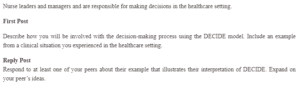
Nurse leaders and managers and are responsible for making decisions in the healthcare setting.
Nurse Leaders and Managers
First Post
Describe how you will be involved with the decision-making process using the DECIDE model. Include an example from a clinical situation you experienced in the healthcare setting.
Reply Post
Respond to at least one of your peers about their example that illustrates their interpretation of DECIDE. Expand on your peer’s ideas.