
NURS 8211 _ Appendix H_ Synthesis and Recommendations Tool
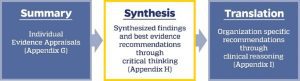
| EBP Question:
|
|||
| Strength | Number of Sources (Quantity) | Synthesized Findings With Article Number(s)
(This is not a simple restating of information from each individual evidence summary—see directions): NURS 8211 _ Appendix H_ Synthesis and Recommendations Tool. |
|
| Level | Overall Quality Rating
(Strong, good, or low) |
||
| Level I
§ Experimental studies |
Strong | 3 | Articles 6, 11, and 15 confirm improved nurse-to-patient ratios lower inpatient falls, reduce missed care, and improve patient safety, satisfaction, and safety culture. |
| Level II
§ Quasi-experimental studies
|
Strong
|
3 | Articles 1, 3, and 7 provide quasi-experimental evidence showing that understaffing increases fall risk. |
| Level III
§ Nonexperimental, including qualitative studies
|
Good | 6 | Articles 4, 5, 8, 10, 12, and 13 illustrate findings where patients and nurses reported increased falls, missed care, and lack of assistance due to high workloads. Also, articles 12 and 13 highlight national policy-level improvements after ratio mandates. |
| Level IV
§ Clinical practice guidelines or consensus panels |
Strong
|
1 | Article 2 is a national clinical guideline from AHRQ emphasizing 1:4 ratios to reduce inpatient falls, improve patient safety scores, and align with CMS quality benchmarks. |
| Level V
§ Literature reviews, QI, case reports, expert opinion
|
Good
|
2 | Articles 9 and 14 recommend avoiding overtime or agency staff and ensuring consistent RN coverage. Article 14 showed a 10% increased mortality in low-staffed shifts. |
| Where does the evidence show consistency? |
| There is strong consistency across all 15 articles. Whether experimental, observational, qualitative, or expert-based, all studies show a clear trend: lower nurse-to-patient ratios (1:4 or better) significantly reduce inpatient fall rates and enhance patient safety. |
| Where does the evidence show inconsistency? |
| Only minor inconsistencies were noted. For instance, article 10 mentioned that patients also attributed falls to personal or environmental causes. However, this did not detract from the overall conclusion that staffing plays a key role in fall prevention. |
| Best evidence recommendations (taking into consideration the quantity, consistency, and strength of the evidence): |
| The best recommendations include, adoption of a nurse-to-patient ratio of 1:4 in inpatient medical-surgical units, minimizing reliance on agency or overtime nurses to reduce safety risks, incorporating regular fall-risk assessments and tracking tools tied to staffing levels, and using internal fall data to adjust staffing policies based on acuity and patient safety trends.
|
| Based on your synthesis, select the statement that best describes the overall characteristics of the body of evidence. |
| ☒ Strong & compelling evidence, consistent resultsà Recommendations are reliable; evaluate for organizational translation.
☐ Good evidence & consistent resultsà Recommendations may be reliable; evaluate for risk and organizational translation. ☐ Good evidence but conflicting resultsà Unable to establish best practice based on current evidence; evaluate risk, consider further investigation for new evidence, develop a research study, or discontinue the project. ☐ Little or no evidenceà Unable to establish best practice based on current evidence; consider further investigation for new evidence, develop a research study, or discontinue the project. |
Directions for use of the Synthesis and Recommendations Tool
Purpose:
This tool guides the EBP team through the process of synthesizing the pertinent findings from the Individual Evidence Summary (Appendix G), sorted by evidence level, to create an overall picture of the body of the evidence related to the PICO question. The synthesis process uses quantity, strength (level and quality), and consistency to generate the best evidence recommendations for potential translation.
Overall quality rating and the total number of sources:
Record the overall quality rating and the number of sources for each level (strong, good, or low), ensuring agreement among the team members.
Synthesized findings:
This section captures key findings that answer the EBP question. Using the questions below, generate a comprehensive synthesis by combining the different pieces of evidence in the form of succinct statements that enhance the team’s knowledge and generate new insights, perspectives, and understandings into a greater whole. The following questions can help guide the team’s discussion of the evidence:
- How can the evidence in each of the levels be organized to produce a more comprehensive understanding of the big picture?
- What themes do you notice?
- What elements of the intervention/setting/sample seem to influence the outcome?
- What are the important takeaways?
Avoid repeating content and/or copying and pasting directly from the Individual Evidence Summary Tool. Record the article number(s) used to generate each synthesis statement to make the source of findings easy to identify.
Using this synthesis tool requires not only the critical thinking of the whole team but also group discussion and consensus building. The team reviews the individual evidence summary of high- and good-quality articles, uses subjective and objective reasoning to look for salient themes, and evaluates information to create higher-level insights. They include and consider the strength and consistency of findings in their evaluation.
Where does the evidence show consistency/inconsistency?
EBP teams must consider how consistent the results are across studies. Do the studies tend to show the same conclusions, or are there differences? The synthesized evidence is much more compelling when most studies have the same general results or point in the same general direction. The synthesized evidence is less compelling when the results from half the studies have one indication, while the findings from the other half point in a different direction.
The team should identify the points of consistency among the evidence as well as areas where the inconsistency is apparent. Both factors are important to consider when developing recommendations or determining the next steps.
Best evidence recommendations:
In this section, the EBP team takes into consideration all the above information related to the strength, quantity, and consistency of the synthesized findings at each level to generate best practice recommendations from the evidence. Consider:
- What is the strength and quantity of studies related to a specific evidence recommendation?
- Is there a sufficient number of high-strength studies to support one recommendation over another?
- Are there any recommendations that can be ruled out based on the strength and quantity of the evidence?
- Does the team feel the evidence is of sufficient strength and quantity to be considered a best evidence recommendation?
Recommendations should be succinct statements that distill the synthesized evidence into an answer to the EBP question. The team bases these recommendations on the evidence and does not yet consider their specific setting. Translating the recommendations into action steps within the team’s organization occurs in the next step (Translation and Action Planning Tool, Appendix I).
Based on the synthesis, which statement represents the overall body of the evidence?
Choose the statement that best reflects the strength and congruence of the findings. This determination will help the team to decide the next steps in the translation process.
When evidence is strong (includes multiple high-quality studies of Level I and Level II evidence), compelling, and consistent, EBP teams can have greater confidence in best practice recommendations and should begin organizational translation
When most of the evidence is good (high-quality Level II and Level III) and consistent or good but conflicting, the team should proceed cautiously in making practice changes. In this instance, translation typically includes evaluating risk and careful consideration for organizational translation.
The team makes practice changes primarily when evidence exists that is of high to good strength. Never make practice changes on little to no evidence (low-quality evidence at any level or Level IV or Level V evidence alone). Nonetheless, teams have a variety of options for actions that include but are not limited to, creating awareness campaigns, conducting informational and educational updates, monitoring evidence sources for new information, and designing research studies.
The exact quantity of sources needed to determine the strength of the evidence is subjective and depends on many factors, including the topic and the amount of available literature. The EBP team should discuss what they consider sufficient given their knowledge of the problem, literature, and setting
ORDER A PLAGIARISM-FREE PAPER HERE
We’ll write everything from scratch
Question 
LITERATURE REVIEW (NO SUBMISSION)
This week, you will begin a Literature Review Assignment, which will be due Day 7 of Week 10. For this three-part Assignment, you will search for evidence using the tools that are part of the Johns Hopkins Translation of Evidence Model.
First, you will select an organization and a practice or organization issue on which to focus. Then, you will complete Appendix B, using the PICOT format, to develop a practice-focused question to address the issue you selected. Based on your practice question, you will search for evidence to support it.
After identifying search terms using Appendix B, you will search for evidence using Appendix E and Appendix F. Based on your identified search terms, you will consider whether you need to explore both research and non-research evidence. For example, if your practice question is about developing a best practice or guideline, you will need to explore non-research evidence, such as guidelines developed by professional or government organizations, or experts in the field.
Next, you will use Appendix H to grade the evidence you found, synthesize it, and select the best evidence to use. As the final step, you will use Appendix G to record the relevant information about the articles you selected and synthesized.
Note: You will begin your Assignment this week, but you will not submit it until Week 10.
Note: This Assignment is hypothetical in nature and is unrelated to your Practicum and DNP Project. However, the work you put in on this Assignment will help prepare you for the Practicum and DNP Project which will come later in your program.
Note: This is a three-part Assignment. By Day 7 of Week 10, you must complete and submit Appendices B, G, and H found in the Dang et.al. text.
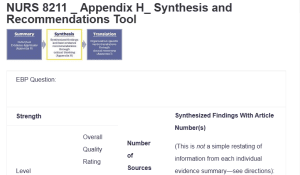
NURS 8211 _ Appendix H_ Synthesis and Recommendations Tool
To Prepare
- Review the Literature Review Assignment resources located in this week’s Learning Resources. Pay special attention to Chapters 19, 20, and 21 of the White et al. text; Chapters 4, 5, 6, and 11 of the Dang et al. text; and the articles addressing the PICOT format.
- Note: Be sure to review Appendices B, E, F, G, and H in the Dang et al. text. You will be required to complete and submit Appendices B, G, and H for this Assignment.
- Select an organization with which you are familiar and a practice or organization issue which needs addressing.
- Note: You may reuse organizations and/or issues that you selected earlier in this course or select new ones. (60701)
- Consider possible practice questions to address the issue you selected. Ask yourself:
- Why is it a problem?
- What has been done about it?
- What is the gap in practice?
- Select one practice question to develop using Appendix B.
- Note: The PICOT components will assist you in identifying search terms. Make sure your practice question is evidence-based, nursing focused, and has measurable outcomes.
- Using the Walden Library, search the evidence to identify 15 or more recent peer-reviewed articles (within the past 5 years) related to your practice question.
- Note: Use Appendices E and F to help you search, but you do not need to submit these for grading.
- Using Appendix H, grade the evidence and select the 10 articles with the strongest evidence ratings.
- Note: if you have more than 10 articles that you deem worthy, you can enter up to 15 into Appendix H.
- Using Appendix H, synthesize the 10 articles you selected.
- Using Appendix G, enter all relevant information about the 10 articles you selected and synthesized.
- Note: This is a three-part Assignment. By Day 7 of Week 10, you must complete and submit Appendices B, G, and H found in the Dang et.al. text.
The Assignment
For this three-part Assignment, you will submit three items as follows:
- Part 1: Submit your completed Appendix B, which demonstrates your fully developed practice question.
- Part 2: Submit your completed Appendix H, which demonstrates your grading and synthesizing of the evidence you identified. Note: You will complete Appendix H before Appendix G, despite being out of order alphabetically.
- Part 3: Submit your completed Appendix G, which lists the relevant information about the evidence you selected.
Submit your Assignment by Day 7 of Week 10.