
Normal Growth and Development
The pathophysiology of bronchiolitis
The most common causative agent of bronchiolitis is the respiratory syncytial virus (RSV) (Polack et al., 2019). This virus causes inflammation of the bronchioles through aspiration of respiratory secretions. This virus damages epithelial cells lining the respiratory linings and impairs the immune cells. After recognizing the RSV virus, there is the secretion of inflammatory cytokines and the recruitment of immune cells into the site of infection (Polack et al., 2019). Increased mucus production, reduced CD8 cell activation, and reduced viral clearance are implicated in the pathogenesis of bronchiolitis. The diagnosis involves chest radiography and a nasopharyngeal swab to test for the virus (Polack et al., 2019). The primary way of diagnosis, however, is through physical examination and thorough history.
Pathophysiology of PDA
Patent ductus arteriosus (PDA) is a structural heart defect. PDA is a connection between the pulmonary artery and the aorta (Conrad & Newberry, 2019). The ductus arteriosus connects the aorta and pulmonary artery when the fetus is in the womb. This is part of fetal circulation since the baby receives oxygen from her mother. After delivery, the ductus arterioles should close so that oxygenated and deoxygenated blood from the aorta and pulmonary artery should not mix. The ductus arteriosus remains patent in PDA, leading to blood build-up, resulting in pulmonary congestion (Conrad & Newberry, 2019). The history of PDA is critical in this case since congenital heart defects are a risk factor for developing bronchiolitis (Polack et al., 2019). It will thus help in ruling out bronchiolitis.
Risks for the development of bronchiolitis
One of the risk factors is prematurity since alveolarization starts at 36 weeks (Conrad & Newberry, 2019). The patient was born at 36 weeks. The second risk factor is congenital heart conditions (Conrad & Newberry, 2019). The patient has PDA, which is linked with pulmonary overcirculation and, hence, increasing pulmonary congestion. The third risk factor is having siblings who attend schools or daycare (Conrad & Newberry, 2019). The patient has two siblings who go to daycare.
Characteristic signs/symptoms of bronchiolitis
The initial signs and symptoms of bronchiolitis include nasal congestion, fever, appetite loss, lethargy, and irritability (Conrad & Newberry, 2019). The infection may extend into the lower tracts, including tachypnea and cough (Conrad & Newberry, 2019). Younger infants may present with apnea and copious secretions (Conrad & Newberry, 2019). These clinical manifestations are used in diagnosis.
The rationale for medication
Acetaminophen is an analgesic that helps in relieving pain and controlling fever. Contraindications include hepatic failure, renal issues, and hepatitis C (Moriarty & Carroll, 2016). The patient presented with a fever. Albuterol was prescribed since the patient presented with wheezing and congestion. Albuterol is a beta-agonist that relaxes the airways’ smooth muscles, hence relieving pulmonary congestion (Voelker, 2020). Some of the contraindications to its use include a hyperactive thyroid gland, diabetes, and hypokalemia (Voelker, 2020). Inflammation is the primary pathology of bronchiolitis. Corticosteroids were thus prescribed to minimize the inflammatory processes implicated in bronchiolitis. Some of the contraindications of corticosteroids include diabetes mellitus, osteoporosis, and uncontrolled hyperglycemia (Iezhitsa, 2014).
Two priority nursing diagnoses
The first nursing diagnosis is ineffective breathing patterns related to wheezing. The first goal is the patient will not experience respiratory failure after two weeks, and the second goal is that the patient’s oxygenation status will return to normal values. The nursing interventions for this diagnosis are assessing the respiratory rate periodically and evaluating the patient’s response to the prescribed medications.
The second nursing diagnosis is the risk for fluid volume deficit related to enhanced metabolic demands. The first goal for this diagnosis is for the patient’s fluid deficiency to be corrected, and the second goal is for the patient to have adequate hydration. The two nursing interventions for this diagnosis are to assess the need for IV fluids and assess mucous membranes for dehydration.
Short and long-term possible complications
The short-term complications of bronchiolitis include cyanosis, apnea, and dehydration, while the long-term complications are recurrent wheezing and respiratory failure leading to hospitalization (Conrad & Newberry, 2019).
Client education
The mother will be educated on how to use the drugs prescribed, their side effects, and the benefits of compliance. In addition to this, she will be educated on proper sanitation and hand hygiene techniques.
References
Conrad, C., & Newberry, D. (2019). Understanding the pathophysiology, implications, and treatment options of patent ductus arteriosus in the neonatal population. Advances in Neonatal Care, 19(3), E1-E2. https://doi.org/10.1097/anc.0000000000000632
Iezhitsa, I. (2014). Corticosteroids. Textbook on Clinical Ocular Pharmacology and Therapeutics, 171-171. https://doi.org/10.5005/jp/books/12384_12
Moriarty, C., & Carroll, W. (2016). Paracetamol: Pharmacology, prescribing, and controversies. Archives of disease in childhood – Education & practice edition, 101(6), 331-334. https://doi.org/10.1136/archdischild-2014-307287
Polack, F. P., Stein, R. T., & Custovic, A. (2019). The syndrome we agreed to call bronchiolitis. The Journal of Infectious Diseases, 220(2), 184-186. https://doi.org/10.1093/infdis/jiz082
Voelker, R. (2020). Generic Albuterol inhaler approved. JAMA, 323(19), 1887. https://doi.org/10.1001/jama.2020.7282
ORDER A PLAGIARISM-FREE PAPER HERE
We’ll write everything from scratch
Question 
This assignment will help to identify the normal growth and development by topic for each age group. In the final column of the project, you need to observe a child apply the information you gathered and document your findings in comparison to the particular age of that child.
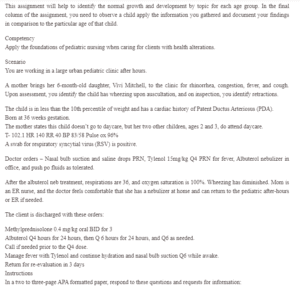
Normal Growth and Development
Competency
Apply the foundations of pediatric nursing when caring for clients with health alterations.
Scenario
You are working in a large urban pediatric clinic after hours.
A mother brings her 6-month-old daughter, Vivi Mitchell, to the clinic for rhinorrhea, congestion, fever, and cough. Upon assessment, you identify the child has wheezing upon auscultation, and on inspection, you identify retractions.
The child is in less than the 10th percentile of weight and has a cardiac history of Patent Ductus Arteriosus (PDA).
She was born at 36 weeks gestation.
The mother states this child doesn’t go to daycare, but her two other children, ages 2 and 3, do attend daycare.
T- 102.1 HR 140 RR 40 BP 83/58 Pulse ox 96%
A swab for respiratory syncytial virus (RSV) is positive.
Doctor orders – Nasal bulb suction and saline drops PRN, Tylenol 15mg/kg Q4 PRN for fever, Albuterol nebulizer in office, and push po fluids as tolerated.
After the albuterol neb treatment, respirations are 36, and oxygen saturation is 100%. Wheezing has diminished. Mom is an ER nurse, and the doctor feels comfortable that she has a nebulizer at home and can return to the pediatric after-hours or ER if needed.
The client is discharged with these orders:
Methylprednisolone 0.4 mg/kg oral BID for 3
Albuterol Q4 hours for 24 hours, then Q 6 hours for 24 hours, and Q6 as needed.
Call if required prior to the Q4 dose.
Manage fever with Tylenol and continue hydration and nasal bulb suction Q6 while awake.
Return for re-evaluation in 3 days
Instructions
In a two to three-page APA formatted paper, respond to these questions and requests for information:
Criteria:
- Describe the pathophysiology of bronchiolitis and identify the most common organism causing this infection.
- What laboratory testing can confirm your suspicion?
- Describe the pathophysiology of PDA and why the history of PDA is significant in this scenario.
- What risk factors place Vivi Mitchell at a greater risk for the development of bronchiolitis?
- What are the characteristic signs/symptoms of bronchiolitis?
- Vivi Mitchell has been prescribed the following medications: acetaminophen, albuterol nebulizer, and corticosteroids.
- Provide the rationale for why each medication has been included as part of her medical management and explain any potential contraindications related to these medications.
- You are designing Vivi Mitchell’s plan of care. Identify two priority nursing diagnoses to include in your plan. For each nursing diagnosis, identify two SMART goals and two interventions for each purpose.
- What short and long-term possible complications should the nurse anticipate?
- What client education is appropriate for Vivi Mitchell as she is discharged from the after-care clinic?