
Negotiation Approaches in Team Psychology – Resolving Conflict
As a team leader, navigating conflicts and managing negotiations is crucial for fostering a positive and productive environment. According to the potential and possible conflictual interactions, five techniques may be employed: competitive, collaborative, compromising, accommodating, and avoiding. All these are effective conflict-solving strategies that, if deployed appropriately, will assist in improving the performance of employees constituting the conflict. Here is a description of the best way to apply each approach when on the negotiating team.
Competitive (Win-Lose) Negotiation
The competitive approach to negotiation is typically described as a “win-lose” approach in which a party prevails over another. This approach is frequently utilized when there is no room for compromise, as there can only be one right answer within a certain time or resource constraints (Emamzadeh, 2020). For instance, consider two team members claiming a leadership position in a given project; each believes that the other person can do the job worse than they can. The team leader may set a high GPA, for instance, and choose the applicant based on this criterion and other merits of the contenders vigorously contesting the position. Regardless of whether the candidate is turned down, the decision is quite clear, and the candidate can continue with the rest of the team members and the chosen leader.
Collaborative (Win-Win) Negotiation
In contrast to the competitive approach, the collaborative approach to negotiation is focused on finding a mutually beneficial solution that satisfies all parties involved, resulting in a “win-win” scenario. It is most useful where there is a common concern for all the team members and if there is some flexibility (Harper, 2022). For example, in the event of a dispute on how to share resources during a given project, the team leader can arrange a joint meeting between the two parties in a disagreement. Thus, if both parties have communicated effectively their requirements and need for resources, then the team leader can find a solution wherein each party gets his due share. It is defused in a manner that fosters unity and equity on the team and among other players.
Compromising (Win-Lose/Win-Lose) Negotiation
The compromise approach is an intermediate process where each party has to surrender a portion of what they want in order to reach a solution. While this approach may not fully satisfy everyone’s needs, it allows the negotiation to move forward without escalating conflict (Shonk, 2025). A potential application of the compromise method can be shown through a conflict based on the setting of a project deadline within a team. While some feel it needs more time, others feel that the current time frame is too large and stringent. Any extensions can only be made by the team leader and will most likely offer a longer deadline than initially desired by the team but less than some members would have preferred. This way, the team can compromise and come up with a solution that will suit all of their needs, though no one gets their way entirely.
Accommodating (Lose-Win) Negotiation
The accommodating approach is used when one party is willing to prioritize the other party’s needs, often at the expense of their interests. This “lose-win” strategy is useful when maintaining harmony or relationships is more important than achieving a specific outcome (UAGC Staff Member, 2023). For example, the team leader can allow the request when a team member asks for an additional day to complete the work while other members believe the initial time should suffice. When the leader approves the extension, they also endear themselves with the requesting team member. That may be slightly irritating to others, but it prevents the team dynamic from becoming negative and fosters it for the better in the long run.
Avoiding (No-Win) Negotiation
Finally, the avoiding approach is a “no-win” strategy in which the negotiation is postponed or avoided altogether. This approach is typically used when the conflict is deemed trivial or when direct resolution may not be feasible. For example, if two team members have an interpersonal and escalating disagreement, the team leader might choose not to act. Instead, the leader affords them time to work, either alone or allowing the tension to die of its own accord. This approach stops any progression of the conflict, though it might not address the causes of the conflict. However, if the conflict remains acute, the team leader can intervene, though the initial non-interference will help maintain calm.
References
Emamzadeh, A.. (2020, December 15). The psychology of negotiation, explained. Psychology Today. https://www.psychologytoday.com/us/blog/finding-new-home/202012/the-psychology-negotiation-explained?scrlybrkr=6f0dda1b
Harper, E. (2022). Collaborative & competitive negotiation | Differences & examples. Study.com. https://study.com/academy/lesson/collaborative-negotiation-definition-strategy-examples.html
Shonk, K. (2025, February 12). Conflict-management styles: Pitfalls and best practices. PON – Program on Negotiation at Harvard Law School. https://www.pon.harvard.edu/daily/conflict-resolution/conflict-management-styles-pitfalls-and-best-practices/
UAGC Staff Member. (2023, December 15). What are 5 conflict resolution strategies? UAGC. https://www.uagc.edu/blog/what-are-5-conflict-resolution-strategies
ORDER A PLAGIARISM-FREE PAPER HERE
We’ll write everything from scratch
Question 
Negotiation Approaches in Team Psychology – Resolving Conflict
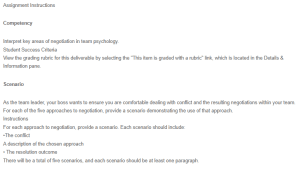
Assignment Instructions
Competency
Interpret key areas of negotiation in team psychology.
Student Success Criteria
View the grading rubric for this deliverable by selecting the “This item is graded with a rubric” link, which is located in the Details & Information pane.
Negotiation Approaches in Team Psychology – Resolving Conflict
Scenario
As the team leader, your boss wants to ensure you are comfortable dealing with conflict and the resulting negotiations within your team. For each of the five approaches to negotiation, provide a scenario demonstrating the use of that approach.
Instructions
For each approach to negotiation, provide a scenario. Each scenario should include:
•The conflict
A description of the chosen approach
• The resolution outcome
There will be a total of five scenarios, and each scenario should be at least one paragraph.