
National Organization of Nurse Practitioner Faculties (NONPF) Competencies
The MSN Psychiatric Nurse Practitioner program has significantly supported my efforts to achieve the core competencies of the NONPF. This reflection explains how I have addressed each of the nine competencies, summarizes a social change project that I intend to undertake in Oakdale, Minnesota, and identifies significant advocacy activities in which the nurse practitioner organizations in my state are involved.
The Nine NONPF Competencies
Scientific Foundations
My experience with advanced courses in pathophysiology, pharmacology, and neuroscience has equipped me with high levels of clinical reasoning capability and evidence-based practice to evaluate and provide care to complex psychiatric conditions (Stein et al., 2022). The foundation serves in proper diagnostics and treatment strategy adaptation, particularly in dealing with disorders like schizophrenia and bipolar disorder.
Leadership
I have acquired leadership skills through team projects, patient case discussions, and change management simulations. I feel ready to mentor new nurses, champion better access to mental health, and initiate multidisciplinary teams.
Quality
I have been educated on quality improvement tools and data on patient outcomes to be used in efficient care delivery. My capstone project on reducing psychiatric readmission rates through follow-up interventions is one such example that integrates the national patient safety goals and clinical benchmarks.
Practice Inquiry
The program has stressed the importance of incorporating research in a clinical practice setting. I completed several evidence-based practice (EBP) assignments, such as literature reviews and protocol development. This has prepared me to apply the recent evidence and clinical guidelines on new forms of psychiatric treatment modalities (Brunt & Morris, 2023).
Technology and Information Literacy
I acquired competence in using electronic health records, clinical databases, and telehealth facilities to document, investigate, and communicate effectively. This skill facilitates the provision of safe medication handling, patient education, and long-distance care, most particularly to underserved rural residents (Flaubert, 2021).
Policy
Coursework requirements on health policy assisted me in learning more about the legislative procedures and evaluating how regulations affect psychiatric practice. I received the training to promote increased NP scope of practice, as well as better reimbursement in mental health care using evidence and strategic communication (Kumar et al., 2021).
Health Delivery System
I learned new information about care coordination, insurance models, and interprofessional collaboration. The program has prepared me to maneuver systems that aid in continuity in care and mitigation of barriers to psychiatric services, particularly for high-risk and low-income groups.
Ethics
I can tackle ethical dilemmas with confidence now and use frameworks that emphasize autonomy, beneficence, and justice. I have been educated to identify risks of coercion in the context of psychiatric treatment and ensure informed consent and culturally sensitive care delivery in any environment (Galderisi et al., 2024).
Independent Practice
The simulation and clinical rotations have strengthened my ability to be an independent professional in psychiatric evaluation, diagnosis, medication management, and psychotherapy. I am willing to work and operate independently under the full practice authority laws of NPs in Minnesota.
Social Change Plan
In Oakdale, I would introduce a mental health education program that would collaborate with the local schools and churches. This effort will entail community workshops to minimize stigma, spot the early warning signs, and connect the residents to care (Semrau et al., 2023). I will also plan a support group of peers of adolescents with anxiety and trauma to promote resilience and a sense of belonging.
Legislative and Advocacy Activities
The Minnesota Nurse Practitioners (MNNP) is actively engaged in advocating for full practice and mental health parity. MNNP promotes telehealth parity laws that would encourage equal payment to psychiatric services and inclusion of the advanced practice registered nurse on statewide behavioral health task forces (Garber et al., 2023). Such activities directly affect my capacity to provide accessible care in Oakdale.
Conclusion
Conclusively, this program has been more than adequate in preparing me to be a competent, ethical, and independent psychiatric nurse practitioner. I believe in providing clinical excellence, advocating for policy, and grassroots promotion of mental health in specific ways that can serve my community. As a result, I will enable measurable and sustainable change.
References
Brunt, B., & Morris, M. (2023). Nursing professional development evidence-based practice. National Library of Medicine. https://www.ncbi.nlm.nih.gov/books/NBK589676/
Flaubert, J. (2021). The role of nurses in improving health care access and quality. In www.ncbi.nlm.nih.gov. National Academies Press (US). https://www.ncbi.nlm.nih.gov/books/NBK573910/
Galderisi, S., Appelbaum, P. S., Gill, N., Gooding, P., Herrman, H., Melillo, A., Myrick, K., Pathare, S., Savage, M., Szmukler, G., & Torous, J. (2024). Ethical challenges in contemporary psychiatry: An overview and an appraisal of possible strategies and research needs. PubMed, 23(3), 364–386. https://doi.org/10.1002/wps.21230
Garber, K., Chike-Harris, K., Vetter, M. J., Kobeissi, M., Heidesch, T., Arends, R., Teall, A. M., & Rutledge, C. (2023). Telehealth policy and the advanced practice nurse. The Journal for Nurse Practitioners, 19(7). https://doi.org/10.1016/j.nurpra.2023.104655
Kumar, A., Kearney, A., Hoskins, K., & Iyengar, A. (2021). The role of psychiatric mental health nurse practitioners in improving mental and behavioral health care delivery for children and adolescents in multiple settings. Archives of Psychiatric Nursing, 34(5), 275–280. https://doi.org/10.1016/j.apnu.2020.07.022
Semrau, M., Gronholm, P. C., Eaton, J., Maulik, P. K., Ayele, B., Bakolis, I., Mendon, G. B., Bhattarai, K., Brohan, E., Cherian, A. V., Daniel, M., Girma, E., Gurung, D., Hailemariam, A., Hanlon, C., Healey, A., Kallakuri, S., Li, J., Loganathan, S., & Ma, N. (2023). Reducing stigma and improving access to care for people with mental health conditions in the community: Protocol for a multi-site feasibility intervention study (Indigo-Local). Reducing Stigma and Improving Access to Care for People with Mental Health Conditions in the Community: Protocol for a Multi-Site Feasibility Intervention Study (Indigo-Local). https://doi.org/10.21203/rs.3.rs-3237562/v1
Stein, D. J., Shoptaw, S. J., Vigo, D. V., Lund, C., Cuijpers, P., Bantjes, J., Sartorius, N., & Maj, M. (2022). Psychiatric diagnosis and treatment in the 21st century: Paradigm shifts versus incremental integration. World Psychiatry, 21(3), 393–414. https://doi.org/10.1002/wps.20998
ORDER A PLAGIARISM-FREE PAPER HERE
We’ll write everything from scratch
Question 
National Organization of Nurse Practitioner Faculties (NONPF) Competencies
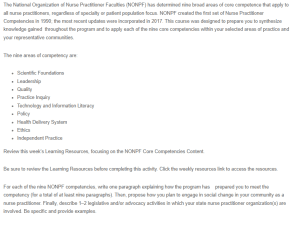
The National Organization of Nurse Practitioner Faculties (NONPF) has determined nine broad areas of core competence that apply to all nurse practitioners, regardless of specialty or patient population focus. NONPF created the first set of Nurse Practitioner Competencies in 1990; the most recent updates were incorporated in 2017. This course was designed to prepare you to synthesize knowledge gained throughout the program and to apply each of the nine core competencies within your selected areas of practice and your representative communities.
National Organization of Nurse Practitioner Faculties (NONPF) Competencies
The nine areas of competency are:
- Scientific Foundations
- Leadership
- Quality
- Practice Inquiry
- Technology and Information Literacy
- Policy
- Health Delivery System
- Ethics
- Independent Practice
Review this week’s Learning Resources, focusing on the NONPF Core Competencies Content.
Be sure to review the Learning Resources before completing this activity. Click the weekly resources link to access the resources.
For each of the nine NONPF competencies, write one paragraph explaining how the program has prepared you to meet the competency (for a total of at least nine paragraphs). Then, propose how you plan to engage in social change in your community as a nurse practitioner. Finally, describe 1–2 legislative and/or advocacy activities in which your state nurse practitioner organization(s) are involved. Be specific and provide examples.