
National Collegiate Athletic Association (NCAA)

Hello, and welcome to today’s presentation. The presentation highlights the National Collegiate Athletics Association’s (NCAA) human resource strategy. In particular, this presentation will highlight the NCAA’s training and human resource development strategy. As an association charged with the responsibility of assuring the well-being and lifelong success of college athletes, the NCAA partners with its members to implement programs and interventions that will help the association achieve its primary goal.
Human resources development (HRD) is a fundamental human resource strategy for any organization. By offering employees learning opportunities, they gain skills, competencies, capacities, and the capability to cope with and successfully implement change (Carter et al., 2023). Additionally, training equips employees with the expertise they need to be prepared for future opportunities. In the same breath, such training equips employees with the skills they require for current and future job demands, given the inevitable environmental changes (Carter et al., 2023). Apart from enhanced productivity, consistent HRD bolsters an ethical workplace culture and climate while creating a non-toxic working environment.
NCAA’s human resource development strategy is geared toward ensuring that athletes are in the best possible condition to show the best performances in their respective sports. At the core of the organization’s athlete development strategy is the promotion of adequate nutrition, hydration, and sleep (NCAA, n.d.-b). NCAA achieves this by providing partner schools with nutritional resources. In the same breath, the NCAA offers information that can help athletes hydrate on time, while showing them the consequences of dehydration. For medical behavioral changes, the organization offers student-athletes access to healthcare centers that provide the requisite advice, while offering instructions on injury minimization strategies (NCAA, n.d.-b).
Apart from the technical aspects, the NCAA also prepares student-athletes to take up leadership positions in the industry. The NCAA organizes workshops in which student-athletes are trained in core leadership skills before they return to campus. Such leadership training mostly focuses on college athletics leadership. One core area such training focuses on is financial literacy, which is vital for successful sports management. Among others, there is the student-athlete leadership forum, which brings key stakeholders together, helping students learn from their seniors. Also, there is a career in sports forum where 200 selected student-athletes are offered the opportunity to explore careers in collegiate athletics. Finally, the NCAA postgraduate internship program focuses on individuals who have started their careers and trains them to become administrators in collegiate athletics (NCAA, n.d.-a).
NCAA also ensures that coaches are trained to keep up with the latest trends and technologies in the industry. Among other areas, coaches are trained to become emotionally intelligent to relate well with players. Besides, the coaches are trained on how to gauge the well-being of student-athletes, so that they can implement the necessary interventions promptly. Further, coaches receive training on public speaking skills, considering the fact that a coach must talk with their players to improve their capabilities. One of the workshops that targets coaches is the NCAA champion forum, where coaches access transformational professional development, helping them gain insight into what it takes to be successful head coaches. Other workshops include the NCAA basketball coaches’ academy and the NFL and NCAA coaches’ academies, among others.
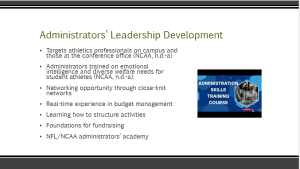
Administrative training targets athletics professionals who work on campus and those at the conference office. Just like coaches, the training seeks to impart emotional intelligence on skills and their capacity to work with a diverse student-athlete community who have varying needs (NCAA, n.d.-a). During these workshops, participants get the opportunity to create close-knit and valuable networks from whom they can consult in the future. Another core training is the real-time budget management training. Given the fact that sports have become commercialized, administrators should learn how to manage team budgets to ensure the long-term financial sustainability of sports organizations (NCAA, n.d.-a). Also, fundraising training is provided, which comes in handy in helping sports administrators learn how to raise alternative revenues to facilitate operations. Key efforts and workshops under administrative training include Foundations for fundraising and the NFL/NCAA administrators’ academy.
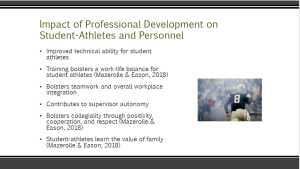
NCAA’s training and development initiatives impact student-athletes and personnel positively. The key objectives of providing training and development initiatives are not just for technical skills, as they help athletes gain crucial values. One such value is that athletes are able to embrace a work-life balance, besides learning the value of family (Mazerolle & Eason, 2018). Most athletes at the collegiate level are young and occupied with academics and sports training schedules. While chasing the dream of playing at a professional level at some point, there is a possibility that athletes may forget their family obligations as they focus on sports. To that end, training on values goes a long way to helping these athletes balance their lives. Also, evidence-based research has shown that professional development initiatives help athletes and personnel achieve collegiality, a workplace environment characterized by respect, positivity, and cooperation (Mazerolle & Eason, 2018). Also, the training helps collegiate athletics administrators embrace autonomy, such that they can design program interventions based on their unique needs.
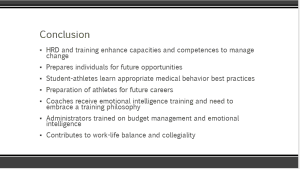
In summary, the NCAA undertakes human resource development and training targeting student-athletes, coaches, and administrators. Such training helps student-athletes and personnel to gain the capacities, abilities, and competencies necessary to adopt change. Also, such training initiatives prepare them for future career opportunities in collegiate athletics. For the athletes, the training seeks to ensure they are in the best conditions to participate in training and match days through proper nutrition, hydration, and sleep. On the other hand, coaches are trained on emotional intelligence, public speaking, and autonomous decision making. For administrators, the interventions seek to help them with budget management. The overall impact of this human resource strategy is that it contributes toward a work-life balance and the collegial spirit, besides enhancing relevant individual technical competencies, abilities, and capabilities.
Carter, A. D., Stokowski, S., Corr, C., & Godfrey, M. (2023). Involving athletes: Implementing a human resource development approach among the NCAA and member institutions. ResearchGate, 2023(3), 1, 11–16. https://www.researchgate.net/publication/371807494
Mazerolle, S. M., & Eason, C. M. (2018). The organizational climate in collegiate athletics: An athletic trainer’s perspective. Journal of Athletic Training, 53(1), 88–97. https://doi.org/10.4085/1062-6050-52.12.24
NCAA. (n.d.-a). College athletes. NCAA.org. https://www.ncaa.org/sports/2016/2/5/college-athletes.aspx
NCAA. (n.d.-b). Training and performance. NCAA.org. https://www.ncaa.org/sports/2024/4/23/training-and-performance.aspx
ORDER A PLAGIARISM-FREE PAPER HERE
We’ll write everything from scratch
Question 
You will create a PowerPoint or other media-type presentation on a human resource strategy (e.g., recruitment, training) and its impact on personnel and students in an athletic organization. Include case studies or examples from real-life sports organizations. You are recommended to select an intercollegiate, interscholastic, recreational, or professional sport organization.

National Collegiate Athletic Association (NCAA)
Length: This assignment must be 7 slides (excluding the title and reference pages).
References: Include 3 scholarly resources.