
Multidimensional Care for Sarah
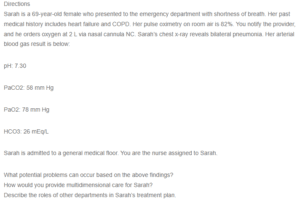
The patient’s readings show that she has developed respiratory acidosis, evidenced by her increased PaCO2 of 58 mm HG (normal range is 35-45 mm HG) and reduced blood pH of 7.35 (normal range is 7.35-7.35). Further, her PaO2 is relatively lowered. Respiratory acidosis is linked to chronic obstructive pulmonary disease (COPD), and this may be exacerbated by acute insults such as pneumonia, as in this patient (Patel & Sharma, 2021). Sarah, presenting with COPD, heart failure and pneumonia, requires close monitoring as many potential problems may arise. Due to the unique cardiopulmonary interactions, respiratory support to Sarah may result in further deterioration of heart function. Her history of COPD may predispose her to ventilator-induced lung injury, which presents as barotrauma, biotrauma, or polytrauma. These may accelerate the acidosis due to the development of hypercapnic acidosis (Tiruvoipati et al., 2020). Systemic acidemia has been reported to impair cardiovascular functioning through weakened contractility and reduced peripheral vascular sensitivity to vasoconstrictors (Frasch & Giussani, 2021). Therefore, multidimensional care for Sarah is necessary.
Evidence-based literature shows that multidimensional care in patients under mechanical ventilation is vital to improving clinical outcomes of treatment. Sedation and pain management intervention helps to manage the pain, anxiety and sometimes delirium that arises in such patients due to the interplay of pathologic, homeostatic and external factors. Other areas of concern include sleep deprivation and the use of physical restraints. Therefore, multidisciplinary teams are involved in planning care and include the patient’s family in care, ensuring anesthesia specialists, other specialized doctors, nurses, and dieticians are involved to ensure that Sarah’s treatment plan is adequately and efficiently implemented. Other departments will be involved to ensure that the patient (and her family) receives drugs, medical devices, housekeeping services, nutrition, counselling and support and other services to ensure the patient’s wellness and safety are upheld.
References
Frasch, M. G., & Giussani, D. A. (2021). Heart during acidosis: Etiology and early detection of cardiac dysfunction. EClinicalMedicine, 37.
Patel, S., & Sharma, S. (2021). Respiratory Acidosis. In StatPearls [Internet]. StatPearls Publishing.
Tiruvoipati, R., Gupta, S., Pilcher, D., & Bailey, M. (2020). Management of hypercapnia in critically ill mechanically ventilated patients—A narrative review of the literature. Journal of the Intensive Care Society, 21(4), 327-333.
ORDER A PLAGIARISM-FREE PAPER HERE
We’ll write everything from scratch
Question 
Directions
Sarah is a 69-year-old female who presented to the emergency department with shortness of breath. Her past medical history includes heart failure and COPD. Her pulse oximetry on room air is 82%. You notify the provider, and he orders oxygen at 2 L via nasal cannula NC. Sarah’s chest x-ray reveals bilateral pneumonia. Her arterial blood gas result is below:
Multidimensional Care for Sarahh
pH: 7.30
PaCO2: 58 mm Hg
PaO2: 78 mm Hg
HCO3: 26 mEq/L
Sarah is admitted to a general medical floor. You are the nurse assigned to Sarah.
What potential problems can occur based on the above findings?
How would you provide multidimensional care for Sarah?
Describe the roles of other departments in Sarah’s treatment plan.