
Medication Teaching Plan
Purpose and Intended Use of the Brochure
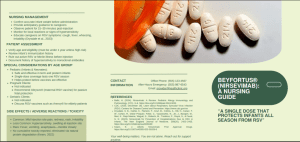
The brochure “Beyfortus® (Nirsevimab) – A Nursing Guide” was developed as an evidence-based educational tool for nurses to learn better and administer respiratory syncytial virus (RSV) prophylaxis to infants. Beyfortus®, approved by the FDA in 2023, is a long-acting monoclonal antibody to prevent severe lower respiratory tract disease caused by RSV in neonates and infants. The brochure is targeted at the nurse as the primary audience and is set at the level of professional literacy to promote clinical accuracy without being excessively long or visually complex. It provides the key pharmacologic information, including drug class, mode of action, route of administration and dosing by weight, drug interactions, and laboratory issues. It also addresses nursing management choices, patient evaluation, and caregiver-specific instruction. According to Balbi (2024), nurses are best positioned to raise awareness about this new agent, ensure correct administration, and educate parents about its benefits, side effects, and appropriate follow-up. This brochure empowers nurses with the tools needed to advocate for RSV prevention, particularly during peak season months.
Revision for Low Health Literacy Audiences
If the audience included low-health-literate patients or caregivers, the brochure would have to be heavily rewritten to be comprehensible and helpful. The level of vocabulary would be at the fifth- or sixth-grade level, without jargon medical vocabulary. For instance, instead of “monoclonal antibody that blocks viral fusion,” it would read, “This drug acts to protect babies from a bad cold virus.” Sentences would be short, to the point, and action-oriented. The large, easy-to-read font would be used throughout, and important messages would be color-coded or highlighted. Visual aids such as cartoons, pictograms, and photographs of caregivers and infants representative of diverse cultures would be used to enhance meaning. Important information such as dosage, advantages, side effects, and post-injection instructions would be displayed in bullet points, numbered instructions, and simple flowcharts (CDC, 2024). Real-life situations, such as when a caregiver is carrying her baby to the clinic before winter, would make it more real and interesting.
References
Balbi, H. (2024). Nirsevimab: A review. Pediatric Allergy Immunology and Pulmonology, 37(1), 3–6. https://doi.org/10.1089/ped.2024.0025
CDC. (2024, August 30). Respiratory Syncytial Virus (RSV). Respiratory Syncytial Virus Infection (RSV). https://www.cdc.gov/rsv

ORDER A PLAGIARISM-FREE PAPER HERE
We’ll write everything from scratch
Question 
Medication Teaching Plan
Purpose
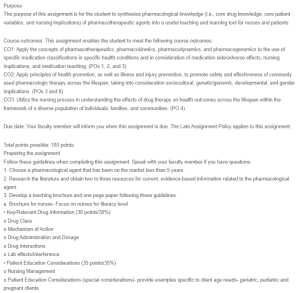
The purpose of this assignment is for the student to synthesize pharmacological knowledge (i.e., core drug knowledge, core patient variables, and nursing implications) of pharmacotherapeutic agents into a useful teaching and learning tool for nurses and patients.
Medication Teaching Plan
Course outcomes: This assignment enables the student to meet the following course outcomes:
CO1: Apply the concepts of pharmacotherapeutics, pharmacokinetics, pharmacodynamics, and pharmacogenomics to the use of specific medication classifications in specific health conditions and in consideration of medication side/adverse effects, nursing implications, and medication teaching. (POs 1, 2, and 3)
CO2: Apply principles of health promotion, as well as illness and injury prevention, to promote safety and effectiveness of commonly used pharmacologic therapy across the lifespan, taking into consideration sociocultural, genetic/genomic, developmental, and gender implications. (POs 3 and 8)
CO3: Utilize the nursing process in understanding the effects of drug therapy on health outcomes across the lifespan within the framework of a diverse population of individuals, families, and communities. (PO 4)
Due date: Your faculty member will inform you when this assignment is due. The Late Assignment Policy applies to this assignment.
Total points possible: 100 points
Preparing the assignment
Follow these guidelines when completing this assignment. Speak with your faculty member if you have questions.
1. Choose a pharmacological agent that has been on the market less than 5 years.
2. Research the literature and obtain two to three resources for current, evidence-based information related to the pharmacological agent.
3. Develop a teaching brochure and one page paper following these guidelines.
a. Brochure for nurses- Focus on nurses for literacy level
• Key/Relevant Drug Information (30 points/30%)
o Drug Class
o Mechanism of Action
o Drug Administration and Dosage
o Drug Interactions
o Lab effects/interference
• Patient Education Considerations (35 points/35%)
o Nursing Management
o Patient Education Considerations (special considerations)- provide examples specific to client age needs- geriatric, pediatric and pregnant clients
o Patient Assessment
o Side Effects/Adverse Effects/Toxicities
• Visual Effects/Creativity (10 points/10%)
o Developed per the required standard
o Appropriate for the intended audience (focus on nurses for literacy level)
o Graphics enhance the purpose of the brochure
o Brochure is visually appealing
b. One Page Paper (15 points/15%)
• Describes intended use of brochure (focus on nurses for literacy level)
• Includes:
o Name
o Date
o Class
o Reference page
• Describe how brochure information would be revised if intended brochure audience had a low health literacy level.
c. APA Format (5 points/5%)
• Includes no more than 3 unique errors with APA format (current ed.)
• At least two (2) scholarly, primary sources from the last 5 years, excluding the textbook, are provided
d. Writing and Mechanics (5 points/5%)
• Clearly written
• Includes no more than three unique errors of grammar
• Includes no more than three unique errors in writing mechanics
• Paper is one page, excluding references and title page
For writing assistance, visit the Writing Center.