
Media Portrayals of Psychological Disorders – Mental Illness
The media plays a powerful role in shaping how society understands and responds to mental illness. Unfortunately, many portrayals have historically contributed to stigma and misunderstanding. A notable negative example is The Jeffrey Dahmer Story, a dramatization of a real-life serial killer. Although the series attempts to explore Dahmer’s psychological background, it reinforces the damaging stereotype that individuals with mental illness are inherently violent or dangerous (Psychologs World, 2023). While mental illness may have influenced Dahmer’s behavior, the portrayal lacks balance and fails to distinguish between criminal pathology and common mental health disorders. This contributes to public fear, isolation of those with mental illness, and greater reluctance to seek help.
In contrast, more recent portrayals have shifted toward accuracy and empathy. The Netflix series Atypical offers a compassionate look at autism spectrum disorder through the experiences of a teenage boy navigating high school, relationships, and family life. The show highlights both challenges and strengths, helping viewers understand neurodiversity from a personal perspective (Jones et al., 2022). Similarly, Silver Linings Playbook portrays bipolar disorder with depth and sensitivity, showing how recovery is possible with support, treatment, and understanding (Pietro, 2023). These media representations humanize mental illness and encourage open dialogue.
The media often gets it wrong when it resorts to sensationalism or uses mental illness as a plot device for horror or crime. This leads to distorting the perception of the public and only reinforces the elements of fear and stigmatization of such people. Nevertheless, when media options are performed intentionally and grounded in empirical evidence, they minimize false perceptions and enhance understanding.
The depiction of mental illness on different platforms is crucial in changing attitudes and perceiving peoples’ health status. They affect how people within communities perceive mental health issues, inform policies, and determine people’s feelings about receiving care. In promoting Diversity, the media can significantly play a role in not only raising awareness of mental health conditions but also enabling positive change.
References
Jones, S. C., Trott, E., Gordon, C., & Milne, L. (2022). Perception of the Portrayal of Autism in Netflix’s Atypical within the Autism Community. Autism in Adulthood, 5(1). https://doi.org/10.1089/aut.2022.0013
Pietro, S. (2023, February 2). Silver linings: An irreverent but real look at mental illness. Child Mind Institute. https://childmind.org/article/silver-linings-an-irreverent-but-real-look-at-mental-illness/
Psychologs World. (2023, December 28). The psychology behind the chilling case of Jeffery Dahmer. Psychologs Magazine. https://www.psychologs.com/the-psychology-behind-the-chilling-case-of-jeffery-dahmer/?srsltid=AfmBOooTjAmicD2LoVLk__ugl9joZee_D2o9BSQ87Oc8U2zkppa-McVG
ORDER A PLAGIARISM-FREE PAPER HERE
We’ll write everything from scratch
Question 
Media Portrayals of Psychological Disorders – Mental Illness
Discussion Question
Media Portrayals of Psychological Disorders – Mental Illness
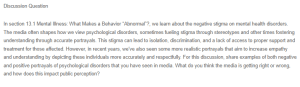
In section 13.1 Mental Illness: What Makes a Behavior “Abnormal”?, we learn about the negative stigma on mental health disorders. The media often shapes how we view psychological disorders, sometimes fueling stigma through stereotypes and other times fostering understanding through accurate portrayals. This stigma can lead to isolation, discrimination, and a lack of access to proper support and treatment for those affected. However, in recent years, we’ve also seen some more realistic portrayals that aim to increase empathy and understanding by depicting these individuals more accurately and respectfully. For this discussion, share examples of both negative and positive portrayals of psychological disorders that you have seen in media. What do you think the media is getting right or wrong, and how does this impact public perception?