
Management of Hypertension
Hello Sukhvir,
Thank you for sharing your post. I want to add a little more on the management of hypertension. According to Mahmood et al. (2019), proper HTN management may need both interventions-pharmacological and non-pharmacological. The non-pharmacological interventions aid in reducing the daily dosage of anti-hypertensive medication and delay the progression to hypertension from the pre-hypertension stage. The non-pharmacological interventions include modifications in lifestyles such as reducing consumption of alcohol, avoiding stress, exercising, and dietary changes. The nutritional requirements of individuals with HTN can be addressed by adopting either the traditional Mediterranean diet or the DASH diet. The dietary guidelines promote consuming dairy products, grains, vegetables, fruits, and foods rich in phosphorous, calcium, magnesium, and potassium (Mahmood et al., 2019).
In educating the patient, the nurse must emphasize losing weight. The patient will need to learn how to count calories and eat fewer servings of food in addition to exercising. The patient should also be aware that in susceptible individuals, NSAID drugs such as ibuprofen can increase blood pressure. Any stimulant, such as those found in illicit drugs, weight loss products, and decongestants, can also increase blood pressure.
Isordil, as you have mentioned, is recommended for the treatment of HTN. The drug works by improving the flow of oxygen and blood to the heart and reduces the work of the heart. Isordil dilates the veins and arteries in the body. Consequently, the heart works less and needs less oxygen and blood to pump blood (Cunha, 2020).
References
Cunha (2020). Side Effects of Isordil (isosorbide dinitrate). https://www.medicinenet.com/side_effects_of_isosorbide_dinitrate/side-effects.htm#does_isordil_isosorbide_dinitrate_cause_side_effects
Mahmood, S., Shah, K. U., Khan, T. M., Nawaz, S., Rashid, H., Baqar, S. W. A., & Kamran, S. (2019). Non-pharmacological management of hypertension: in the light of current research. Irish Journal of Medical Science (1971-), 188(2), 437-452.
ORDER A PLAGIARISM-FREE PAPER HERE
We’ll write everything from scratch
Question 
I NEED TO REPLY ON THE TOPIC
– Length: A minimum of 150 words per post, not including references
Citations: At least one high-level scholarly reference in APA per post from within the last five years
Management of Hypertension
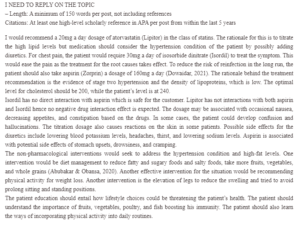
I would recommend a 20 mg-a-day dosage of atorvastatin (Lipitor) in the class of statins. The rationale for this is to titrate the high lipid levels, but medication should consider the hypertension condition of the patient by possibly adding diuretics. For chest pain, the patient would require 30mg a day of isosorbide dinitrate (Isordil) to treat the symptom. This would ease the pain as the treatment for the root causes takes effect. To reduce the risk of reinfection in the long run, the patient should also take aspirin (Zorprin), a dosage of 160mg a day (Dowaidar, 2021). The rationale behind the treatment recommendation is the evidence of stage two hypertension and the density of lipoproteins, which is low. The optimal level for cholesterol should be 200, while the patient’s status is at 240.
Isordil has no direct interaction with aspirin, which is safe for the customer. Lipitor has no interactions with both aspirin and Isordil; hence no negative drug interaction effect is expected. The dosage may be associated with occasional nausea, decreasing appetites, and constipation based on the drugs. In some cases, the patient could develop confusion and hallucinations. The titration dosage also causes reactions on the skin in some patients. Possible side effects of the diuretics include lowering blood potassium levels, headaches, thirst, and sodium levels. Aspirin is associated with potential side effects of stomach upsets, drowsiness, and cramping.
The non-pharmacological interventions would seek to address the hypertension condition and high fat levels. One intervention would be diet management to reduce fatty and sugary foods and salty foods and take more fruits, vegetables, and whole grains (Abubakar & Obansa, 2020). Another effective intervention for the situation would be recommending physical activity for weight loss. Another intervention is the elevation of the legs to reduce the swelling and try to avoid prolonged sitting and standing positions.
The patient education should entail how lifestyle choices could threaten the patient’s health. The patient should understand the importance of fruits, vegetables, poultry, and fish boosting his immunity. The patient should also learn how to incorporate physical activity into daily routines.
References
Abubakar, I., & Obansa, S. A. J. (2020). An Estimate of Average Cost of Hypertension and its catastrophic effect on the people living with hypertension: Patients’ perception from two Hospitals in Abuja, Nigeria. International Journal of Social Sciences and Economic Review, 10-19.
Dowaidar, M. (2021). Discoveries in gene-environment interactions that influence CVD, lipid traits, obesity, diabetes, and hypertension appear to be able to control gene therapy.