
Male Reproductive Disorders
Discuss the potential disease processes and signs and symptoms related to the disease process that Jose may be exhibiting.
An enlarged prostate implies that the gland has become more prominent and happens to almost all men when they reach 40 years and above (Lee et al., 2016). It is often referred to as benign prostatic hyperplasia and is not a risk of prostate cancer. The signs and symptoms of BPH include difficulty in urination, persistent and urgent need to urinate, and microscopic or visible blood in the urine. Prostatitis, a prostate infection, can also cause similar signs and symptoms. In addition, prostatitis is characterized by a build-up of urine, causing urine retention, as is the case with the patient (Khan et al., 2017).
How would you provide multidimensional care to include Jose’s cultural, psychosocial, spiritual, physical, and emotional needs?
The patient is a hard-working father of five and a husband as well. Getting a diagnosis of prostatitis may make him feel less of a man. He may also worry about having sexual relations with his wife. Additionally, the patient may fear that the disease will escalate into prostate cancer. The nurse will have a male translator explain the diagnosis and prognosis to ensure that the patient does not get unnecessary anxiety, and that communication is not lost. The patient will be informed that he can get support for his condition by first seeing the hospital psychologist, and if he requests, he can have the hospital priest talk to him as well. During the next hospital visit, the patient will be asked to come in with his wife, who will get information and educated on how to care for her husband and offer him emotional support. For the physical care, the patient will be started on painkillers and antibiotics (Single dose of ceftriaxone (Rocephin), 250 mg intramuscularly, then Doxycycline, 100 mg orally twice daily for ten days) to control the pain and the infection (Coker & Dierfeldt, 2016).
References
Coker, T. J., & Dierfeldt, D. M. (2016). Acute bacterial prostatitis: diagnosis and management. American Family Physician, 93(2), 114-120.
Khan, F. U., Ihsan, A. U., Khan, H. U., Jana, R., Wazir, J., Khongorzul, P., … & Zhou, X. (2017). Comprehensive overview of prostatitis. Biomedicine & Pharmacotherapy, 94, 1064-1076.
Lee, D. S., Choe, H. S., Kim, H. Y., Kim, S. W., Bae, S. R., Yoon, B. I., & Lee, S. J. (2016). Acute bacterial prostatitis and abscess formation. BMC urology, 16(1), 1-8.
ORDER A PLAGIARISM-FREE PAPER HERE
We’ll write everything from scratch
Question 
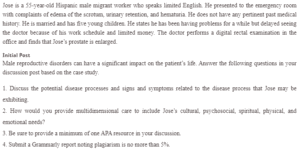
Jose is a 55-year-old Hispanic male migrant worker who speaks limited English. He presented to the emergency room with complaints of edema of the scrotum, urinary retention, and hematuria. He does not have any pertinent past medical history. He is married and has five young children. He states he has been having problems for a while but delayed seeing the doctor because of his work schedule and limited money. The doctor performs a digital rectal examination in the office and finds that Jose’s prostate is enlarged.
Male Reproductive Disorders
Initial Post
Male reproductive disorders can have a significant impact on the patient’s life. Answer the following questions in your discussion post based on the case study.
- Discuss the potential disease processes and signs and symptoms related to the disease process that Jose may be exhibiting.
- How would you provide multidimensional care to include Jose’s cultural, psychosocial, spiritual, physical, and emotional needs?
- Be sure to provide a minimum of one APA resource in your discussion.
- Submit a Grammarly report noting plagiarism is no more than 5%.