
Learning from Experiences and Communicating and Feedback
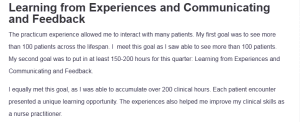
The practicum experience allowed me to interact with many patients. My first goal was to see more than 100 patients across the lifespan. I meet this goal as I saw able to see more than 100 patients. My second goal was to put in at least 150-200 hours for this quarter: Learning from Experiences and Communicating and Feedback.
I equally met this goal, as I was able to accumulate over 200 clinical hours. Each patient encounter presented a unique learning opportunity. The experiences also helped me improve my clinical skills as a nurse practitioner.
The practicum experience may sometimes presents challenging scenarios. The first case I encountered that was challenging was of a middle-aged man with depression and substance use comorbidity. He had had two failed suicidal attempts. Diagnosing the case was challenging to me as the patient concealed crucial aspects of his presentation.
The second case was of a 19-year-old female presenting with palpitations, fidgeting, and excessive sweating. The case was challenging as I had to determine whether she was having a panic attack and consequently had a panic disorder or whether she was just anxious. However, after a thorough examination, it was established that she had a generalized anxiety disorder and panic disorder comorbidity.
The third case was of a 21-year-old female with post-traumatic stress disorder. She had a significant history of early childhood trauma. The case took an emotional toll on me as I was saddened by her unfortunate experiences.
The encounters provided a learning opportunity for me. I learned to recognize the nexus between early childhood experiences and mental health illnesses. As Downey & Crummy (2022) report, early childhood trauma predisposes children to mental health disorders later in life. Likewise, I learned that mental health disorders are complex in their presentation, often warranting thorough examination (Kirkbride et al., 2024).
Several resources were at my disposal during the practicum. Human resources, such as fellow nurses, were a valuable point of information. Likewise, engagement with my preceptor allowed me to learn about the complexity of the clinical environment. Hospital resources, such as clinical guidelines, were also pivotal for my decision-making processes.
An evidence-based practice I used for my patients was the integration of scientific evidence in clinical decision-making processes. As Phillips et al. (2022) report, using evidence to make clinical decisions, such as developing therapeutic plans, is integral to care optimization. In this respect, I ensured all my decisions were backed by scientific evidence. I will be keen to engage with other staff members more in my subsequent practicums.
I managed patient flow and volume by allocating sufficient time for my clinical encounters. Likewise, I ensured I was well prepared and had all the resources I may need during the practicum. One way I can apply my skillset is in patient education. Patient education expands patients’ capacity to make better health decisions (Waqas et al., 2024).
I intend to allocate more time to reading to bolster my skills and knowledge. Extra reading will expand my understanding of the clinical areas I am currently struggling with. I intend to communicate this to my preceptor verbally in our next meeting.
I am doing good. The experiences from the practicum have widened my perspectives on the clinical areas I had difficulty in. I am positive that I am not missing a lot in the learning realm. The formal and informal feedback I received from my preceptor helped me improve my clinical engagement.
References
Downey, C., & Crummy, A. (2021). The impact of childhood trauma on children’s wellbeing and adult behavior. European Journal of Trauma & Dissociation, 6(1), 100237. https://doi.org/10.1016/j.ejtd.2021.100237
Kirkbride, J. B., Anglin, D. M., Colman, I., Dykxhoorn, J., Jones, P. B., Patalay, P., Pitman, A., Soneson, E., Steare, T., Wright, T., & Griffiths, S. L. (2024). The social determinants of mental health and disorder: Evidence, prevention and recommendations. World Psychiatry, 23(1), 58–90. https://doi.org/10.1002/wps.21160
Phillips, R. S., Vaarwerk, B., & Morgan, J. E. (2022). Using evidence-based medicine to support clinical decision-making in RMS. Cancers, 15(1), 66. https://doi.org/10.3390/cancers15010066
Waqas, A., Correia, J. C., Ahmad, M., Akhtar, T. N., Meraj, H., Angelakis, I., & Pataky, Z. (2024). Therapeutic patient education for severe mental disorders: A systematic review. Cambridge Prisms: Global Mental Health, 11. https://doi.org/10.1017/gmh.2024.68
ORDER A PLAGIARISM-FREE PAPER HERE
We’ll write everything from scratch
Question 
In 450–500 words, address the following:
Learning From Experiences
- Revisit the goals and objectives from your Practicum Experience Plan. Explain the degree to which you achieved each during the practicum experience.
- Reflect on the 3 most challenging patients you encountered during the practicum experience. What was most challenging about each?
- What did you learn from this experience?
- What resources were available?
- What evidence-based practice did you use for the patients?
- What would you do differently?
- How are you managing patient flow and volume? How can you apply your growing skillset to be a social change agent within your community?
Learning from Experiences and Communicating and Feedback
Communicating and Feedback
- Reflect on how you might improve your skills and knowledge, and communicate those efforts to your Preceptor.
- Answer the questions: How am I doing? What is missing?
- Reflect on the formal and informal feedback you received from your Preceptor.