
Leadership’s Role and Organizational Effectiveness
The growth and development of any organization largely depend on its leaders’ effectiveness. One of the primary roles of a leader is to develop other leaders along the organization’s hierarchy. By ensuring that other employees are prepared to be leaders, there will be a limited need to supervise employees as they perform day-to-day activities. Notably, an organization’s success depends on the leadership style the organization chooses. A perfect leadership style goes a long way to creating a congenial organizational climate, thus bringing effectiveness to an organization. Therefore, it is incumbent upon the organization’s leaders to come up with a leadership style that aligns with the work environment to bring success and effectiveness to the organization.
Critical Questions
To achieve purposeful organizational effectiveness, leaders must ask themselves some questions that will guide them. One of the critical questions leaders should ask themselves as they prepare to achieve organizational effectiveness is, ‘What are our goals, and what do we plan to achieve?’ The Question will help organizational leaders know what to prioritize as they guide employees. Understanding organizational goals and knowing what to prioritize is particularly vital in helping employees focus on one thing instead of shifting their focus from one goal to another, as this may lead to a lot of unfinished business.
The second question leaders should ask themselves is about who is responsible for making key organizational decisions. Depending on the quality of decisions made, the decision-making role is vital because it contributes to achieving organizational effectiveness (Nadolna & Beyer, 2021). To that end, key organizational decisions should be made by people who have the requisite capacity and authority. For instance, before the marketing department is granted resources to use in marketing campaigns, experts from the finance department must approve that such an expenditure is feasible and sustainable in the long run.
Thirdly, organizational leaders should ask themselves whether the organization has the right resources to achieve organizational effectiveness. This is akin to conducting a SWOT analysis for the company to identify its strengths and weaknesses, and also discover opportunities and threats. For instance, organizational leaders should investigate whether the organization’s employees possess the right skills to effectively accomplish their tasks. Any skills gaps can be filled via training.
Behaviors Associated with Effective Organizational Effectiveness
The leadership style a leader chooses depends on the organization’s industry and the working environment. However, there are leadership behaviors that enhance an organization’s effectiveness regardless of the industry the organization operates. One of the leadership behaviors that will go a long way to support organizational effectiveness is adopting an open communication approach. A leader should foster an easy environment that allows followers to feel free to communicate their perspectives (Arendt et al., 2019). One element of open communication is the ability to listen to followers regardless of their capacity (Arendt et al., 2019). Approachability fosters a sense of belonging among employees as they feel that they are integral to the organization’s success, hence committing to achieving the organization’s objectives.
Another positive leadership behavior that will foster organizational effectiveness is leading by example. A great leader is not the one who instructs followers what to do, but one who becomes a model for followers to follow (Eisenkopf, 2020). For instance, a leader who expects employees to get to work on time should lead by example by being the first one to arrive at work. By being a role model, a leader communicates values, which in turn influence employees’ attitudes and behaviors. Being a role model will align employees to the organization’s objectives and its mission, without necessarily uttering a single word.
Moreover, goal orientation as a leadership behavior will enhance organizational performance. A goal-oriented leader sets realistic goals and comes up with action plans for achieving such goals. This is crucial because it will go a long way to help employees understand their needs as they pursue the organization’s objectives.
Leaders Inspiring Change
Organizational leaders can inspire change in the organization by encouraging and facilitating a learning culture in the organization. By encouraging employees to learn, they will gain new insights that can help them cope with an ever-changing business environment (Hao & Yazdanifard, 2015). Some of the motivators leaders may leverage to encourage learning among followers include rewards and positions (Hao & Yazdanifard, 2015). Notably, it is not only employees who need to learn but also leaders. Leaders can join leadership training programs to sharpen their leadership skills. Also, sending employees for further training will equip them with the necessary skills they need to achieve personal and organizational objectives.
Additionally, leaders should encourage followers to be innovative and cooperative. To that end, communication and teamwork are vital in helping employees come up with innovative ideas. A leader can play a key role in fostering teamwork and rapport necessary for team members to initiate innovative ideas. To that end, a leader should create an environment that allows followers to trust each other, to be autonomous, and to feel free to initiate dialogue among themselves (Hao & Yazdanifard, 2015). Proactive leaders should encourage their followers to collaborate and communicate with each other, for this is how people embrace new ways of thinking.
Also, great leaders can inspire change by shaping a good organizational culture. A culture is shaped based on a leader-employee relationship. By fostering a positive environment where employees trust their colleagues and leaders, all parties can engage each other toward positive change. Such a positive organizational culture offers employees a sense of belonging and loyalty; hence, they will exploit their potential to achieve organizational objectives.
Leadership Actions That Demonstrate Calm and Optimism in Crisis
According to Förster et al. (2022), showing empathy while remaining emotionally distanced is one of the factors that goes a long way in leaders demonstrating calmness and optimism during crises. On the one hand, expressing empathy shows that a leader is concerned about the followers’ interests. On the other hand, maintaining emotional distance or showing hardiness, especially in front of employees, restores confidence by reassuring them that the leader is in control of the situation.
Additionally, leaders should mobilize and provide support during crises to restore calm in the organization. Networks within and outside the organization can provide critical resources that go a long way to reducing the negative impacts the crisis poses (Förster et al., 2022). Leaders are particularly encouraged to foster positive relationships with competitors to the extent that they view them as market participants and not competitors. That way, rivals can provide the necessary support to help the organization weather the storm.
Thirdly, leaders should balance tight and loose leadership in critical situations. While tight leadership involves providing direction and setting priorities, loose leadership allows room for other employees to participate and offer their perspectives that could help resolve a crisis (Förster et al., 2022). Once a leader has set the priorities and communicated direction, they should focus on managerial roles and let employees implement operational interventions that suit the situation. This approach aligns with delegation, which eases the pressure on a manager’s table.
Conclusion
In summary, an organization’s leadership is vital in fostering organizational effectiveness. A leader provides strategic guidance by highlighting organizational goals, decides who can implement decisions, and undertakes a skill analysis to determine the organization’s needs. Key leadership behaviors that support organizational effectiveness include leading by example, goal orientation, and open communication. Leaders also play a key role in inspiring change, and this can be attained by encouraging learning among organizational members, fostering a positive organizational culture, and encouraging innovativeness and cooperativeness. It is also worth noting that crises are inevitable in an organization, but a leader can help by showing empathy, offering direction, and mobilizing support.
References
Arendt, J. F. W., Verdorfer, A. P., & Kugler, K. G. (2019). Mindfulness and leadership: Communication as a behavioral correlate of leader mindfulness and its effect on follower satisfaction. Frontiers in Psychology, 10(667), 1–16. ncbi. https://doi.org/10.3389/fpsyg.2019.00667
Eisenkopf, G. (2020). Words and deeds – Experimental evidence on leading-by-example. The Leadership Quarterly, 31(4), 101383. https://doi.org/10.1016/j.leaqua.2020.101383
Förster, C., Paparella, C., Duchek, S., & Güttel, W. H. (2022). Leading in the Paradoxical World of Crises: How Leaders Navigate Through Crises. Schmalenbach Journal of Business Research, 74(4), 631–657. https://doi.org/10.1007/s41471-022-00147-7
Hao, M. J., & Yazdanifard, R. (2015). How Effective Leadership Can Facilitate Change in Organizations through Improvement and Innovation. In Global Journal of Management and Business Research: A Administration and Management (Vol. 15, Issue 9). Global Journals Inc. (USA). https://globaljournals.org/GJMBR_Volume15/1-How-Effective-Leadership.pdf
Nadolna, K. K., & Beyer, K. (2021). Determinants of the decision-making process in organizations. Procedia Computer Science, 192(1), 2375–2384. Sciencedirect. https://doi.org/10.1016/j.procs.2021.09.006
ORDER A PLAGIARISM-FREE PAPER HERE
We’ll write everything from scratch
Question 
Leadership’s Role and Organizational Effectiveness
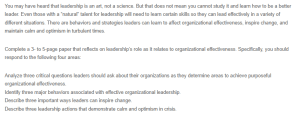
You may have heard that leadership is an art, not a science. But that does not mean you cannot study it and learn how to be a better leader. Even those with a “natural” talent for leadership will need to learn certain skills so they can lead effectively in a variety of different situations. There are behaviors and strategies leaders can learn to affect organizational effectiveness, inspire change, and maintain calm and optimism in turbulent times.
Leadership’s Role and Organizational Effectiveness
Complete a 3- to 5-page paper that reflects on leadership’s role as it relates to organizational effectiveness. Specifically, you should respond to the following four areas:
Analyze three critical questions leaders should ask about their organizations as they determine areas to achieve purposeful organizational effectiveness.
Identify three major behaviors associated with effective organizational leadership.
Describe three important ways leaders can inspire change.
Describe three leadership actions that demonstrate calm and optimism in crisis.