
Journal Entry: Clinical Reflection on Procedural Competence
Self-reflection is a critical component of advanced nursing practice, offering opportunities to recognize clinical strengths, acknowledge areas for improvement, and integrate learning into future patient care. This journal entry reflects on my growth during the practicum experience through the lens of procedural skill development, evidence-based practice application, patient interactions, and professional communication. Using insights from my Clinical Skills and Procedures Self-Assessment Form, patient logs, and preceptor feedback, I analyze three challenging cases and the strategies I employed to enhance clinical effectiveness.
Learning from Experiences
One of the most challenging patient cases I encountered involved a 29-year-old female seeking an intrauterine device (IUD) for contraception. As I had never performed an IUD insertion prior, I experienced initial apprehension about ensuring proper placement while maintaining patient comfort. To overcome this challenge, I followed my preceptor during the performance of the procedure, researched ACOG literature on the topic, and finally, conducted the insertion under direct supervision. Accordingly, I learned the power of preparing, acting with care, and speaking to patients clearly so as to minimize any discomfort and complications (Lanzola et al., 2025).
Another challenging involved treating a 72-year-old man with anterior epistaxis. Managing nasal bleeding was unfamiliar territory for me, particularly regarding nasal tampon placement. Although I knew the basic anatomy, I had no firsthand experience. After observing my preceptor and referencing clinical protocols, I confidently performed nasal packing and monitored the patient’s vital signs post-procedure. This experience emphasized the importance of evidence-based emergency management and rapid clinical decision-making (Kravchik et al., 2023).
The third challenging case involved a 56-year-old patient with a pigmented skin lesion. My preceptor proposed that I do a punch biopsy, which I had little knowledge about. Biopsy was done by consideration of sterile technique, anatomical accuracy, and informed consent. I underwent the procedure after being directed on the way forward, and I checked on the pathology outcomes. It helped up my diagnostic confidence, and it further emphasized the importance of early detection of skin cancers in primary care (Ramsey & Rostami, 2023).
Across these cases, I utilized several resources: preceptor demonstrations, Pfenninger and Fowler’s Procedures textbook, video tutorials, and peer-reviewed clinical guidelines. Each decision was guided by evidence-based protocols, which helped standardize care while ensuring safety and accuracy. I am currently developing skills in digital block anesthesia, fungal microscopy, and wound debridement. If I were to revisit these encounters, I would simulate each procedure beforehand to build muscle memory and reduce performance anxiety.
To manage patient flow and volume, I review schedules daily, prioritize based on acuity, and complete real-time documentation. These habits have improved efficiency and reduced cognitive overload during busy clinic hours.
Communicating and Feedback
To ensure progress, I will maintain open communication with my preceptor via email and one-on-one. I regularly share clinical challenges, ask for feedback, and discuss guidelines and readings relevant to our patient cases. This active participant practice reflects my desire for ongoing learning. Although I now demonstrate improved clinical reasoning and patient education, to be a well-rounded physician, I have identified procedural independence as an area where I need to continue developing myself in concepts of IUDs and anesthetic blocks.
My preceptor provides both formal and informal feedback. She acknowledges my ability to quickly synthesize information, communicate effectively with patients, and adapt to new procedures. However, she also encourages me to take more initiative during procedures and trust my training. Her constructive guidance has been instrumental in shaping my confidence and clinical competency.
Conclusion
The practicum has been life-changing as it has helped me gain practical skills, clinical judgment, and confidence as a professional. By dealing with challenges, evidence-based professional practice, and preceptor feedback, I have become a well-rounded family nurse practitioner. Even in future practice, I will continue to sharpen my technical skills and facilitate the safe delivery of patient-centered care.
References
Kravchik, L., Hohman, M. H., & Pester, J. M. (2023, May 26). Anterior epistaxis nasal pack. StatPearls – NCBI Bookshelf. https://www.ncbi.nlm.nih.gov/books/NBK538304/
Lanzola, E. L., Auber, M., & Ketvertis, K. (2025, February 14). Intrauterine device placement and removal. StatPearls – NCBI Bookshelf. https://www.ncbi.nlm.nih.gov/books/NBK557403/
Ramsey, M. L., & Rostami, S. (2023, September 4). Skin biopsy. PubMed; StatPearls Publishing. https://www.ncbi.nlm.nih.gov/books/NBK470457/
ORDER A PLAGIARISM-FREE PAPER HERE
We’ll write everything from scratch
Question 
Journal Entry: Clinical Reflection on Procedural Competence
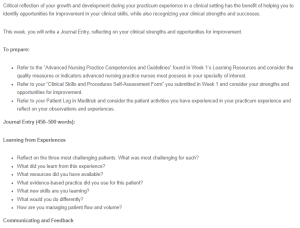
Critical reflection of your growth and development during your practicum experience in a clinical setting has the benefit of helping you to identify opportunities for improvement in your clinical skills, while also recognizing your clinical strengths and successes.
Journal Entry – Clinical Reflection on Procedural Competence
This week, you will write a Journal Entry, reflecting on your clinical strengths and opportunities for improvement.
To prepare:
- Refer to the “Advanced Nursing Practice Competencies and Guidelines” found in Week 1’s Learning Resources and consider the quality measures or indicators advanced nursing practice nurses must possess in your specialty of interest.
- Refer to your “Clinical Skills and Procedures Self-Assessment Form” you submitted in Week 1 and consider your strengths and opportunities for improvement.
- Refer to your Patient Log in Meditrek and consider the patient activities you have experienced in your practicum experience and reflect on your observations and experiences.
Journal Entry (450–500 words):
Learning from Experiences
- Reflect on the three most challenging patients. What was most challenging for each?
- What did you learn from this experience?
- What resources did you have available?
- What evidence-based practice did you use for this patient?
- What new skills are you learning?
- What would you do differently?
- How are you managing patient flow and volume?
Communicating and Feedback
- Reflect on how to improve on your skills and knowledge and how to communicate that back to your Preceptor.
- How are you doing? What is missing?
- What type of feedback are you receiving from your Preceptor?
- Submityour Journal Entry Assignment.
- Reminder: The College of Nursing requires that all papers submitted include a title page, introduction, summary, and references. The Sample Paper provided at the Walden Writing Center provides an example of those required elements (available at https://academicguides.waldenu.edu/writingLinks to an external site.). All papers submitted must use this formatting.
Rubric
Reflection demonstrates a high level of critical thinking in applying and integrating key course concepts and theories from readings, lectures, and/or discussions. Insightful and relevant connections are made through contextual explanations and examples. 50 points
Expresses solid evidence of reflection on own work. Demonstrates substantial personal growth and awareness of deeper meaning through inferences, well developed insights, and significant depth in awareness and challenges. Synthesizes current experience into future implications. 30 points
Well written and clearly organized using standard English, characterized by elements of a strong writing style and basically free from grammar, punctuation, usage, and spelling errors. 15 points
No APA errors 5 points