
Introduction to Research and Evidence-Based Practice
Florence Nightingale was the pioneer of scientific inquiry in nursing practice. She initiated this concept by seeking information on the factors determining mortality and morbidity rates in Soldiers during the Crimean War (Houser et al., 2018). Years after, little research occurred due to a lack of formal nursing education. In the 1950s, research gained prominence after nursing education was introduced in the university setting (Houser et al., 2018). Nursing-based research journals were established in the USA and internationally. This enabled researchers to present their findings to people globally. This culminated in creation of the National Institute of Nursing Research (NINR) in 1993 (Houser et al., 2018). Currently, the NINR supports and facilitates the conduction of research on health and diseases for nursing practice.
Research uses a specific quantitative or qualitative method to identify or develop a new concept. On the other hand, evidence-based practice (EBP) uses scientific evidence, clinical experience, and the preferences of the patient to offer professional nursing care (Houser et al., 2018). A balance of clinical expertise, patient values, and scientific research is critical to EBP. Research supports EBP by helping to develop new concepts or knowledge or validating or disapproving the existing ideas through experiments. The best scientific evidence from research is incorporated into EBP.
The Tuskegee Syphilis Study breached research conduct. Six hundred African-Americans were enrolled in the study; 399 had syphilis, while 201 were healthy (Yearby, 2017). Informed consent of the participants was not sought. Researchers misguided the participants by telling them they were being treated for several ailments (Yearby, 2017). However, the participants were not receiving any proper treatment for their condition. The study started in 1932 and ended in 1972 (Yearby, 2017). The healthcare ethical principle of beneficence can be used to ensure the care of a study participant. Beneficence advocates for not harm (Houser et al., 2018). All actions taken must seek to maximize the benefits accrued by the participant. All types of damage, physical, psychological, economic, or social, should be averted.
References
Houser, J., Provost, R., & Learning, B. (2018). Nursing Research Reading, Using and Creating Evidence Fourth Edition. Jones & Bartlett Learning.
Yearby, R. (2017). Exploitation in Medical Research: The Enduring Legacy of the Tuskegee Syphilis Study. Case Western Reserve Law Review, 67(4), 1171.
ORDER A PLAGIARISM-FREE PAPER HERE
We’ll write everything from scratch
Question 
Introduction to Research and Evidence-Based Practice
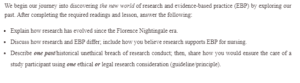
We begin our journey into discovering the new world of research and evidence-based practice (EBP) by exploring our past. After completing the required readings and lesson, answer the following:
- Explain how research has evolved since the Florence Nightingale era.
- Discuss how research and EBP differ; include how you believe research supports EBP for nursing.
- Describe one past/historical unethical breach of research conduct; then, share how you would ensure the care of a study participant using one ethical or legal research consideration (guideline/principle).