
Interview with Yusuf Malik, Member of the Islamic Society of Tampa (Islam)
For this assignment, I interviewed Yusuf Malik of the Islamic Society of Tampa, which is located at 7326 E Sligh Ave, Tampa, FL. Yusuf Malik is a 34 -year-old Bangladeshi American who is a civil engineer. He was born in Florida, but his family was strict and observant Muslim. At his mosque, he is also an active youth organizer. He is an observant Muslim, having been observant from an early age, and he says that his faith is central to his sense of self. When his father found work in the medical field in the United States, the family immigrated and continued to be involved in their local Muslim community. In college, Mr. Malik really began to study and think deeply about his faith. That transition started a more focused and spiritual life, which included teaching classes for children’s education and service to others.
Meaning of Religion to Yusuf
When asked what Islam meant to him, Yusuf Malik returned with careful reflection, “Islam is not just a religion, but a way of life.” He explained that Islam provides a whole life regarding how individuals should do things correctly, spiritually, responsibly, ethically, and socially. To him, practicing Islam is about personal relationships with God (Allah), taking responsibility for one’s actions, and serving others. His soul feels anchored and tethered through prayer, fasting during Ramadan, and giving charity. He also stressed that Islam promotes continuously refining oneself, treating others kindly irrespective of their faith, and carrying out justice on all issues. The concept of Tawheed, the oneness of God, is one of his most powerful beliefs, and it also governs how he sees all people as connected and part of one creator. According to him, Islam demands that its faithful lead lives of compassion, discipline, and purpose. He also added that Islam helps him maintain peace in times of hardship, and strength was given to him by the faith that promotes trust in God (Tawakkul). These lessons inform his daily decisions, including how to speak to people and confront challenges in his personal and professional life. He believes that by living his faith sincerely, he contributes to a more just and understanding society.
Importance of Religion
Islam is important to Yusuf Malik because it sets his life straight and fills it with meaning. In a world filled with distractions, Islam is an anchor that keeps him centered on his values and spiritual purpose. He said the daily rituals, particularly the five daily prayers, establish a rhythm, enabling him to remain present and grounded. He added that during every difficult season of his life, including the death of a friend in a car accident, he found solace in his faith and was able to grieve healthily. The support of his mosque community is another reason he appreciates his religion. He believes Islam is about balance, work and rest, the spiritual and the worldly, individual responsibility, and community service. Religion reminds him not only of his duties to God but also his obligations to fellow human beings. He draws strength from the stories of the Prophet Muhammad, particularly the prophet’s patience, compassion, and commitment to justice. He believes Islam has made him a better version of himself every day and that even when he falls short, it keeps him wanting more.
What Yusuf Wishes Others Knew about Islam
When I asked Yusuf Malik what he wished other people knew about Islam, he responded immediately, “That it’s a religion of peace and mercy, not violence.” He feels deeply troubled by the many misconceptions about Islam in the media and public discourse. The violent actions of a few, he believes, do not reflect the actual teachings of Islam, which include mercy, compassion, and justice. He also wishes people knew how much Islam shares in common with other Abrahamic religions such as Christianity and Judaism. “We all believe in one God, we value family, we believe in helping the poor; it’s not as different as people think,” he said. Another emphasis that he put into his words was that women in Islam had been honored and granted groundbreaking rights for the time the religion was revealed. He provided instances of women scholars, business owners, and community leaders in Islamic history. Finally, Malik added that he wished that people would reach out and seek to learn from a few Muslims in their own community and speak to them without referring back to stereotypes or assumptions.
Conclusion
Speaking with Yusuf Malik was enlightening and profoundly illuminating. Before talking to him, I only had the vaguest idea of what Islam was, and I had no real sense of how intimately interwoven religion and life could be. Hearing Yusuf Malik talk about how prayer and charity are as essential to his faith as they are to who he is, I am reminded of how much Islam operates through discipline and consciousness. In this regard, I was left to think about all the things Islam and Christianity share in common: a duty to help people suffering in poverty, a defense of family, and a commitment to justice. The most significant contrast I feel is with the formality of Islamic practices and rituals when my spiritual outpouring as a Christian is virtually spontaneous. Tawheed was an illumination that guided me in the Islamic paradigm of moral reasoning. I now recognize that Muslims are frequently misrepresented in the media, and I feel the need to take a stand when I witness these misrepresentations. This watershed conversation made me want to know about different faiths. More importantly, it also reinforced the importance of dialogue between faiths for cultivating respect and peace in our troubled communities.
ORDER A PLAGIARISM-FREE PAPER HERE
We’ll write everything from scratch
Question 
Interview with Yusuf Malik, Member of the Islamic Society of Tampa (Islam)
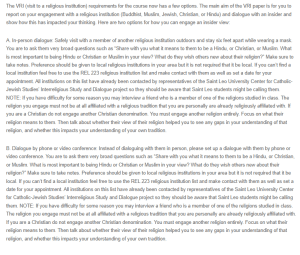
The VRI (visit to a religious institution) requirements for the course now has a few options. The main aim of the VRI paper is for you to report on your engagement with a religious institution (Buddhist, Muslim, Jewish, Christian, or Hindu) and dialogue with an insider and show how this has impacted your thinking. Here are two options for how you can engage an insider view:
Interview with Yusuf Malik, Member of the Islamic Society of Tampa (Islam)
A. In-person dialogue: Safely visit with a member of another religious institution outdoors and stay six feet apart while wearing a mask. You are to ask them very broad questions such as “Share with you what it means to them to be a Hindu, or Christian, or Muslim. What is most important to being Hindu or Christian or Muslim in your view? What do they wish others new about their religion?” Make sure to take notes. Preference should be given to local religious institutions in your area but it is not required that it be local. If you can’t find a local institution feel free to use the REL 223 religious institution list and make contact with them as well as set a date for your appointment. All institutions on this list have already been contacted by representatives of the Saint Leo University Center for Catholic-Jewish Studies’ Interreligious Study and Dialogue project so they should be aware that Saint Leo students might be calling them. NOTE: If you have difficulty for some reason you may interview a friend who is a member of one of the religions studied in class. The religion you engage must not be at all affiliated with a religious tradition that you are personally are already religiously affiliated with. If you are a Christian do not engage another Christian denomination. You must engage another religion entirely. Focus on what their religion means to them. Then talk about whether their view of their religion helped you to see any gaps in your understanding of that religion, and whether this impacts your understanding of your own tradition.
B. Dialogue by phone or video conference: Instead of dialoguing with them in person, please set up a dialogue with them by phone or video conference. You are to ask them very broad questions such as “Share with you what it means to them to be a Hindu, or Christian, or Muslim. What is most important to being Hindu or Christian or Muslim in your view? What do they wish others new about their religion?” Make sure to take notes. Preference should be given to local religious institutions in your area but it is not required that it be local. If you can’t find a local institution feel free to use the REL 223 religious institution list and make contact with them as well as set a date for your appointment. All institutions on this list have already been contacted by representatives of the Saint Leo University Center for Catholic-Jewish Studies’ Interreligious Study and Dialogue project so they should be aware that Saint Leo students might be calling them. NOTE: If you have difficulty for some reason you may interview a friend who is a member of one of the religions studied in class. The religion you engage must not be at all affiliated with a religious tradition that you are personally are already religiously affiliated with. If you are a Christian do not engage another Christian denomination. You must engage another religion entirely. Focus on what their religion means to them. Then talk about whether their view of their religion helped you to see any gaps in your understanding of that religion, and whether this impacts your understanding of your own tradition.