
Interdisciplinary Plan Proposal
Poor communication between the nurses and a lack of professional identity among the nursing team within the facility compromise the organization’s culture of quality care and patient safety. It also undermines its commitment to ensuring positive staff experiences and well-being. This proposed interdisciplinary plan will help make essential changes to improve communication and introduce various strategies to help develop a professional identity among the nurses. It will identify the change theory and leadership strategy as well as the needed collaboration approaches and organizational resources to help achieve the plan’s objectives. Get in touch with us at eminencepapers.com. We offer assignment help with high professionalism.
Objective
The main objective of this proposed interdisciplinary plan is to help establish a working system that will improve the communication system between the hospital’s professional staff, especially between the nurses and the physicians and also among the nursing staff. As communication has an impact on every aspect of the organization, including collaboration, minimization of medical errors, patient experiences, healthcare professionals’ outcomes, and work performance, among others, the plan hopes to improve professional identity among the nursing team by fixing communication issues. Professional identity has been identified as a critical factor for the development of efficient, professional collaborations in medicine and healthcare research (Touati et al., 2019). Therefore, the a need to first solve the communication issues.
Questions and Predictions
-
Is this plan for the short term, or will it offer long-term solutions?
Based on the current situation in terms of communication and collaboration, I believe that the best solution is to adopt a plan that solves the issues step by step. Yes. The plan is to offer long-term solutions. However, it will start by repeatedly solving the issues in the short term, with a focus on the long term.
-
Do you think improving the quality of communication across the facility will improve nurses’ professional identity?
Yes. Communication is important in creating experiences for both nurses and physicians. It helps the team be cohesive. It is also a factor in the development of the right attitudes toward nursing roles and careers in general. Based on evidence from nurse involvement during the COVID-19 pandemic, Sheng et al. (2020) argued that the nurses’ experiences during care delivery, such as experiences of fear, exhaustion, and perception of fairness, influenced the nurses’ professional identity. Therefore, this interdisciplinary plan is developed with the central idea that fixing the communication issues within the organization will help fix collaboration and professional identity issues.
-
How will you know that the plan has been successful or has failed to achieve its main objectives?
Various measures and indicators will be used to determine the success of the plan. For example, the quality and effectiveness of communication will be measured against the set objectives, the rate of opening and reading emails, the level of comprehension for both written and verbally communicated information, staff’s perception of clarity of presented information, the clarity of shared ideas, the efficiency of taking action after communication among others.
Change Theory and a Leadership Strategy
Change Theory
The Kurt Lewin Model of Change is the most appropriate change theory to help an interdisciplinary team succeed in collaborating and implementing the project plan. Kurt Lewin’s change model provides direction in the process of change, which has three distinctive stages: the unfreeze stage, the change stage, and the refreeze stage (Galli, 2019). The unfreezing step involves the leader creating awareness of practices that create inefficiencies and the need for change. The next stage involves taking the organization through the actual change and application of supporting strategies such as communication and staff education about the change. The final stage of refreezing reinforces the new practices. Lewin’s change management model has been found to be effective in optimizing management functions and allowing efficient role delegations in nursing (Teguh Hidayat et al., 2020).
Leadership Strategy
Arguably, change as much as it is needed to improve the safety and quality of care is only possible in an environment that supports frequent and open communication (Shingler-Nace et al., 2019). Therefore, the plan will adopt open communication as a leadership strategy during the implementation of the proposed interdisciplinary plan. The leadership strategy for the plan implementation team will also apply transformational leadership. Transformational leadership has a positive influence on factors of organizational change, such as employee perception of change based on frequency and trust in the management throughout the change process (Busari et al., 2020).
Collaboration Needed by the Interdisciplinary Team
The collaboration strategy needed by the interdisciplinary team to support the proposed plan and resolve the issues of communication and professional identity is creating work duties that require nurses and physicians across the different departments to share resources. This will require them to work together on some common duties. Through this, they can share knowledge, appreciate each other’s input in care delivery, and appreciate the importance of interdisciplinary collaboration. The interconnectedness between various teams and professions during the response and management of the COVID-19 pandemic proved how sharing resources forces the need for effective and timely communication (Kim & Kreps, 2020).
Organizational Resources
The proposed plan does not require many organizational resources to implement. There are already existing channels of communication and information sharing across the organization. However, there is a need to improve human-human communication and connection.
The set budget includes:
Trainers charge (2days/week for 5 weeks) @ $400 a session= $4,000
Miscellaneous costs = $2500
Total = $6,500
Communication and professional identity issues will worsen if the proposed plan fails to achieve its objectives. Lack of good and quality communication between healthcare professionals leads to poor adherence to medications, poor patient satisfaction, and inefficiency in the use of resources (Tiwary et al., 2019). All of these are risks to patient safety, as well as losing clients to competition, which impacts up to 10 percent of the hospital’s lost revenue. Additionally, malpractice can cost more than $27,000, with settlements costing in excess of $1,000,000.
References
Busari, A. H., Khan, S. N., Abdullah, S. M., & Mughal, Y. H. (2020). Transformational leadership style, followership, and factors of employees’ reactions towards organizational change. Journal of Asia Business Studies, 14(2), 181–209. https://doi.org/10.1108/JABS-03-2018-0083/FULL/XML
Galli, B. J. (2019). Comparison of Change Management Models: Similarities, Differences, and Which Is Most Effective? Innovation, Technology and Knowledge Management, 605–624. https://doi.org/10.1007/978-3-030-15409-7_24/COVER
Kim, D. K. D., & Kreps, G. L. (2020). An Analysis of Government Communication in the United States During the COVID-19 Pandemic: Recommendations for Effective Government Health Risk Communication. World Medical & Health Policy, 12(4), 398–412. https://doi.org/10.1002/WMH3.363
Sheng, Q., Zhang, X., Wang, X., & Cai, C. (2020). The influence of experiences of involvement in the COVID-19 rescue task on the professional identity among Chinese nurses: A qualitative study. Journal of Nursing Management, 28(7), 1662–1669. https://doi.org/10.1111/JONM.13122
Shingler-Nace, A., Birch, M., Hernandez, A., Bradley, K., & Slater-Myer, L. (2019). Minimizing hospital-acquired infections and sustaining change. Nursing, 49(10), 64–68. https://doi.org/10.1097/01.NURSE.0000580724.19307.11
Teguh Hidayat, A., Tutik, R., Hariyati, S., Muhaeriwati, T., & Hidayat, A. T. (2020). Applicability of Lewin’s Change Management Model for Optimization Management Function in Nursing Delegation between Head Nurse and Team Leader: A Mini Project in Jakarta Military Hospital. International Journal of Nursing and Health Services (IJNHS), 3(4), 471–478. https://doi.org/10.35654/IJNHS.V3I4.68
Tiwary, A., Rimal, A., Paudyal, B., Sigdel, K. R., & Basnyat, B. (2019). Poor communication by health care professionals may lead to life-threatening complications: examples from two case reports. Wellcome Open Research, 4. https://doi.org/10.12688/WELLCOMEOPENRES.15042.1
ORDER A PLAGIARISM-FREE PAPER HERE
We’ll write everything from scratch
Question 
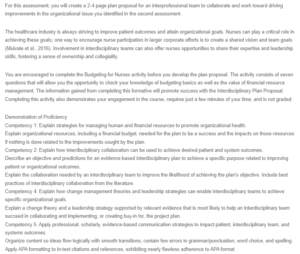
For this assessment, you will create a 2-4 page plan proposal for an interprofessional team to collaborate and work toward driving improvements in the organizational issue you identified in the second assessment.
Interdisciplinary Plan Proposall
The healthcare industry is always striving to improve patient outcomes and attain organizational goals. Nurses can play a critical role in achieving these goals; one way to encourage nurse participation in larger corporate efforts is to create a shared vision and team goals (Mulvale et al., 2016). Involvement in interdisciplinary teams can also offer nurses opportunities to share their expertise and leadership skills, fostering a sense of ownership and collegiality.
You are encouraged to complete the Budgeting for Nurses activity before you develop the plan proposal. The activity consists of seven questions that will allow you the opportunity to check your knowledge of budgeting basics as well as the value of financial resource management. The information gained from completing this formative will promote success with the Interdisciplinary Plan Proposal. Completing this activity also demonstrates your engagement in the course, requires just a few minutes of your time, and is not graded.
Demonstration of Proficiency
Competency 1: Explain strategies for managing human and financial resources to promote organizational health.
Explain organizational resources, including a financial budget, needed for the plan to be a success and the impacts on those resources if nothing is done related to the improvements sought by the plan.
Competency 2: Explain how interdisciplinary collaboration can be used to achieve desired patient and system outcomes.
Describe an objective and predictions for an evidence-based interdisciplinary plan to achieve a specific purpose related to improving patient or organizational outcomes.
Explain the collaboration needed by an interdisciplinary team to improve the likelihood of achieving the plan’s objective. Include best practices of interdisciplinary collaboration from the literature.
Competency 4: Explain how change management theories and leadership strategies can enable interdisciplinary teams to achieve specific organizational goals.
Explain a change theory and a leadership strategy supported by relevant evidence that is most likely to help an interdisciplinary team succeed in collaborating and implementing, or creating buy-in for, the project plan.
Competency 5: Apply professional, scholarly, evidence-based communication strategies to impact patient, interdisciplinary team, and systems outcomes.
Organize content so ideas flow logically with smooth transitions; contain few errors in grammar/punctuation, word choice, and spelling.
Apply APA formatting to in-text citations and references, exhibiting nearly flawless adherence to APA format.
Reference
Mulvale, G., Embrett, M., & Shaghayegh, D. R. (2016). ‘Gearing up’ to improve interprofessional collaboration in primary care: A systematic review and conceptual framework. BMC Family Practice, 17.
Professional Context
This assessment will allow you to describe a plan proposal that includes an analysis of best practices of interprofessional collaboration, change theory, leadership strategies, and organizational resources with a financial budget that can be used to solve the problem identified through the interview you conducted in the prior assessment.
Scenario
Having reviewed the information gleaned from your professional interview and identified the issue, you will determine and present an objective for an interdisciplinary intervention to address the problem.
Note: You will not be expected to implement the plan during this course. However, the plan should be evidence-based and realistic within the context of the issue and your interviewee’s organization.
Instructions
For this assessment, use the context of the organization where you conducted your interview to develop a viable plan for an interdisciplinary team to address the issue you identified. Define a specific patient or organizational outcome or objective based on the information gathered in your interview.
The goal of this assessment is to clearly lay out the improvement objective for your planned interdisciplinary intervention of the issue you identified. Additionally, be sure to build on the leadership, change, and collaboration research you completed in the previous assessment. Look for specific, real-world ways in which those strategies and best practices could be applied to encourage buy-in for the plan or facilitate the implementation of the plan for the best possible outcome.
Using the Interdisciplinary Plan Proposal Template [DOCX] will help you stay organized and concise. As you complete each section of the template, make sure you apply APA format to in-text citations for the evidence and best practices that inform your plan, as well as the reference list at the end.
Additionally, be sure that your plan addresses the following, which corresponds to the grading criteria in the scoring guide. Please study the scoring guide carefully so you understand what is needed for a distinguished score.
Describe an objective and predictions for an evidence-based interdisciplinary plan to achieve a specific goal related to improving patient or organizational outcomes.
Explain a change theory and a leadership strategy supported by relevant evidence that is most likely to help an interdisciplinary team succeed in collaborating and implementing, or creating buy-in for, the project plan.
Explain the collaboration needed by an interdisciplinary team to improve the likelihood of achieving the plan’s objective. Include best practices of interdisciplinary collaboration from the literature.
Explain organizational resources, including a financial budget, needed for the plan to succeed and the impacts on those resources if the improvements described in the plan are not made.
Communicate the interdisciplinary plan with writing that is clear, logically organized, and professional, with correct grammar and spelling, using the current APA style.