
Information Management-Nursing Staffing Shortages in Massachusetts
Staffing levels of nurses are critical in the optimization of patient care of the highest quality, improvement of care outcomes, and cost containment in the long term. In the background of patient complexity, an aging population, and nurse staffing shortages, appropriate levels of staffing have the benefits of reduced rates of mortality, reduced patient stay durations, and reduced number of preventable events such as infections and falls. The State of Massachusetts has had a long battle with nurse staffing shortages.
A survey of over 500 nurses in Massachusetts published at the commencing of the National Week indicated that in the last year (2020), nurses experienced poor patient care quality in hospitals. These were coupled with unsafe patient assignments, limited time with patients, and worsening workplace safety. One of the nurses commented that the corporate takeover of the healthcare system in the state, whether by large NGOs or for-profit companies that pay millions to their executives, has ended up hurting the frontline healthcare workers and nurses’ ability to provide quality care for patients (Massachusetts Nurses Association (2021). The other issues raised by the nurses in the survey are summarized in the graph below:
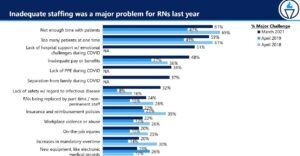
Source: Massachusetts Nurses Association (2021)
In their research article, MIT Sloan (2021) indicates that nursing facilities in Massachusetts continue to face shortages at critical levels, with approximately 4000 direct care nursing staff short. The researchers suggest that the state can meet the need through a competitive living wage, continued support of the opposition of RCA, and training for certified nursing assistants widely affordable and acceptable through online platforms and partnerships with local training providers and vocational training and community colleges. Taking these steps will ensure that caregivers are sufficient in numbers to meet the needs of patients.
After the pandemic hit hard in 2020, the government of Massachusetts leaders continued to make the necessary Medicare and Medicaid payment system investments to fund the increase in wages for healthcare staff. Leaders have also adopted public initiatives and policies that address the staff shortage problem that has gone on for decades.
In 1999, California (CA) passed and implemented 2004 the first state legislation, which is still the only one in the country. The legislation limits the number of patients that a nurse is allowed to care for at any given time. In Massachusetts, a ballot issue arose in 2018 that would improve staffing shortages in hospitals. However, the ballot failed because of the lack of credible evidence at the local level that showed that the legislation would be in the public’s best interest and would not cause any disruptions to care access (Chen,2018; Fotsch, 2019).
Key Quality Improvement Tools
According to the Massachusetts Department of Higher Education (2021), the purpose of developing the Nursing and Allied Health Initiative in 2005 was to address nurse staffing shortage and nurse faculty shortage as well. Seven years later, the Department of Higher Education, along with the campus partners, industry associates, and care providers, initiated the public/private partnership that addressed the workforce needs both on a short and long-term basis and also tackled the program and curriculum systemic capacity challenges. The Nursing and Allied Health Workforce Development Plan contains the proposals and accomplishments as well as the plans of the partnership. The project includes the future directions of the nursing programs offered in the private and public education system, as well as employer partners in the role of transforming the current and future workforce in response to the healthcare system’s changing landscape.
Additionally, healthcare facilities should consider individual departments in a healthcare facility to have a formal staffing plan that ensures every patient receives care from the most appropriately skilled nurse. A staffing plan refers to the shift and unit-specific strategy of scheduling that supports departmental care standardization (Griffiths et al., 2020). In attempting to decrease nurse turnover, healthcare facilities should consider limiting mandatory overtime, delegating to other qualified staff the paperwork, improving workflow by adopting up-to-date technology, and offering competitive compensation in line with a nurse’s experience (Shaffer & Curtin, 2020). Lastly, having a staffing committee will allow a healthcare facility to take a collaborative staffing approach (McDonald, 2019). The committee will provide input on procedures for scheduling and also on staffing policies.
Level of Risk and Frequency
The COVID-19 pandemic intensified the problems with the Massachusetts healthcare system and continues to be a threat to the nurse’s and patients’ safety. According to the Massachusetts Nurses Association (2021), 55% of the surveyed nurses said that the healthcare setting had worsened compared to the 10% who said it had improved. This high percentage was a significant increase in a trend that has been going on in Massachusetts. From the year 2014 (except 2017), more and more nurses have reported that the healthcare system has been worsening rather than improving. In 2020, that number increased even more.
Linked closely to the deteriorating quality of care is the time that nurses report that they were able to spend with the patients. Approximately 60% of the nurses stated that they did not have sufficient time with their patients, while 33% said that their time with patients was adequate. The percentage of those who were dissatisfied increased by 23% from the 2019 survey.
Lastly, without prompting, the nurses in the survey reported that the largest obstacle in providing their patients with quality care was understaffing. This was reported by 33% of the nurses; a ratio of nurses to patients was written by 15%; a lack of staff to assist the nurses, which was written by 9% of the team; and a lack of sufficient time spent with the patients which were also reported by 9% of the nurses. Additionally, 65% of the nurses said that significant issues had risen following the unfilled position left vacant; this was a 15% increase from 2019.
References
Chen, M. (2018). More nurses mean better care—so why did this ballot measure fail? The nation.
Fotsch, R. (2019). The people of Massachusetts decide the fate of Nurse-Patient staffing ratios. Journal of Nursing Regulation, 9(4), 63-64.
Griffiths, P., Saville, C., Ball, J., Jones, J., Pattison, N., Monks, T., & Safer Nursing Care Study Group. (2020). Nursing workload, nurse staffing methodologies, and tools: A systematic scoping review and discussion. International Journal of Nursing Studies, 103, 103487.
Massachusetts Department of Higher Education (2021). Healthcare Workforce Plans. https://www.mass.edu/strategic/work_healthcare.asp
Massachusetts Nursing Association (2021). As National Nurses Week Begins, ‘State of Nursing in Massachusetts’ Survey Shows Existing Quality of Care, Staffing and Safety Problems Worsened by Inadequate COVID-19 Preparedness and Lack of Support for Frontline Healthcare Workers. https://www.prnewswire.com/news-releases/as-national-nurses-week-begins-state-of-nursing-in-massachusetts-survey-shows-existing-quality-of-care-staffing-and-safety-problems-worsened-by-inadequate-covid-19-preparedness-and-lack-of-support-for-frontline-healthcare-work-301285647.html
MIT Sloan Management (2021). To address critical ongoing staffing shortages in MA long-term care, the Commonwealth must amend state law to provide competitive wages and a path to CNA certification for frontline workers who stepped up during the pandemic. https://mitsloan.mit.edu/experts/to-address-critical-ongoing-staffing-shortages-ma-long-term-care-commonwealth-must-amend-state-law-to-provide-competitive-wages-and-a-path-to-cna-certification-frontline-workers-who-stepped-during-pandemic
Shaffer, F. A., & Curtin, L. (2020). Nurse turnover: Understand it, reduce it. My American Nurse, 15(8), 57-59.
ORDER A PLAGIARISM-FREE PAPER HERE
We’ll write everything from scratch
Question 
Gather as much information about your selected problem as possible. Consider both qualitative and quantitative data. For example:
Information Management-Nursing Staffing Shortages in Massachusetts
Leader and peer interviews
Patient/customer surveys
Quality improvement (QI) reports from the facility
Benchmarking studies/baseline data. If baseline data is available:
What are the goals?
Are current practices meeting the organizational goals?
Are the prescribed practices followed?
Apply relevant key quality improvement tools to your problem and list them in your assignment.
Review and aggregate the information you collected on the selected problem.
Determine the level of risk and frequency of the problem. This will provide you with the scope and significance of the problem.