
In What Ways Does Literature View and Represent Mental Health and Mental Illness?
Mental health encompasses an individual’s emotional, psychological, and social well-being, all of which influence thoughts, feelings, and actions, while mental illness includes conditions that disrupt this equilibrium, such as mood, anxiety, and even schizophrenia. In literature, these ideas are captured in the development of character and plot, which offers a reflection of attitudes toward mental health and the prevailing constructs of society. The significance of looking into this aspect is because of the degree to which literature is capable of constructing and deconstructing beliefs surrounding mental illness.
This research transcends Aberle’s content analytical work on young adult novels and contemporary prose that portray mental illness. Other works include Landsverk’s analysis of narrative strategies in “All the Bright Places” and “Thirteen Reasons Why.” Further, Harding’s (2023) critique of reader-response criticism adds the component of emotive engagement with the texts from the audience. Additionally, Maghfiroh’s work on modern prose contributes to the conversation, considering the cultural representations of mental health issues in literature.
This paper argues that literature, as much as it seeks to reflect social attitudes toward mental health and illness, actually seeks to construct those attitudes. The diverse strategies of representation and character construction allow literature to foster understanding and challenge prevailing stereotypes, thereby transforming perception toward mental health issues into a more complex reality. This research aims to enrich the conversation on literature and mental health by addressing these questions.
Contextual Framework
Historical Perspectives on Mental Illness in Society and Literature
Over the years, perceptions of mental illness and its treatment have evolved significantly. In previous times, it was among the most misunderstood concepts. Those suffering from it had to deal with a lot of hardships due to society’s ignorance, which frequently resulted in the person’s cruel ostracism from society. During the Medieval period, people suffering from mental disorders were routinely thought to have some form of demonic possession, thus applying exorcism to them. This came to an end with the rise of rational thought during the Enlightenment period, which at least allowed the existence of some semblance of mental health.
The Significance of Reader Response Criticism
Reader response criticism highlights the importance of analyzing the impact of mental health in literature. This criticism adapts the axiom that “meaning is not in the text but in the reader,” because meaning does go beyond the interpretation that is created, it extends to the emotion that is evoked from the reading. The assumption that readers actively create meaning in texts, especially in sensitive texts concerning mental health, demonstrates the significance of the response theories. In mental health issues in fiction narratives, analysis of emotional reactions to the literature is vital in both appreciation and discernment of purpose.
Readers recall their experiences while emotionally engaged with a range of fictional characters with different mental illnesses/conditions. Such experiences can promote understanding of mental health and reduce stigmatizing viewpoints. The young woman character’s deep depression, culminating in suicidal ideation in Thirteen Reasons Why, is deeply saddening, encouraging readers to reflect on the tragedy and mental health issues and societal factors driving such issues.
Themes in Representations of Mental Illness
Supportive Communities and Their Impact
While contemporary literature typically encompasses issues of mental illness at the level of individual or family therapy, they regard community support systems as a prominent form of treatment. Positively working environments where psychosocial functioning is done properly greatly help improve the burden experienced by these psychosocial patients. Aberle (2021) argues that these patients do better and exhibit better coping skills when they are in relationships that are caring and supportive. This shows how relationships help facilitate healing and reduce the stigma associated with mental illness.
Young adult award-winning literature is filled with examples that portray the importance of community support. For instance, in All the Bright Places by Jennifer Niven, Finch and Violet are profoundly connected lovers, each helping the other to cope with their issues. Finch has bipolar, but his relationship with Violet, who helps him emotionally, stabilizes his condition. Their relationship enriches personal growth and illustrates the extent to which friendship can impact those with mental health challenges. All in all, the tale depicts communities as important for people with psychological problems and appeals to the need for a society where individuals relate with each other.
Other works, such as The Perks of Being a Wallflower by Stephen Chbosky, revolve around a troubled teen named Charlie. Unlike previous accounts, Charlie has friends who understand and accept him. This support enables him to talk about his mental health issues and trauma. The novel demonstrates the importance of a nurturant environment in the healing process, illustrating that in certain contexts, mental illness can be healed by illness-centered communities. Community stories matter deeply and, in positive ways, stir people toward building supportive frameworks in their lives. This illustrates that the community is not only limited to one or two friends but rather a broader framework of societal support.
In A List of Cages, Adam is a character in Robin Roe’s book who has psychological issues stemming from a traumatic experience. His healing comes primarily through the help of friends, teachers, and one exceptionally caring mentor who guides him through his struggles. This illustration of the healing process of trauma is enlightening in showing how the community works and in revealing social responses to social constructions that neglect mental health services and supports. People, through fiction, are made to consider how they interact with one another and where safety is provided.
Complexity of Characters with Mental Illness
Aside from the depiction of characters with mental disorders, there is another feature modern literature is concerned with that is equally as important: the scope of characterization. Aberle (2021) and Maghfiroh (2024) contend that people with diverse mental profiles should be portrayed in their entirety rather than being confined to the monolithic stereotypes that prevail in literature’s portrayal of mental illness. Characters who are multifaceted and who possess complex personalities, not just simple traits, defy the reductive construction of people as symbols of their afflictions.
The attempt to include characters with real mental challenges is a feature of writing that many contemporary authors strive not to miss. For example, Jay Asher in “Thirteen Reasons Why” depicts Hannah Baker as a layered character with a two-dimensional anxiety disorder and clinical depression. Much of her decline is due to various encounters, which she later records in a tape series, each chronological event outlining the essence of her despair. This understanding helps readers appreciate the extent and complexity of mental illness, helping them empathize with Hannah’s emotional battles.
On the other hand, there are still stories that perpetuate simplistic stereotypes and portray characters as either the noble hero or the tragic victim. Such representations are problematic because they ignore the lived experience of mental illness and diminish its complexity. These portrayals, as Maghfiroh (2024) rather aptly argues, strip the essence of mental illness, which should be expressed through a variety of emotions.
The writers intend to resolve the outlined mental health concerns through character development. Plath’s Bell Jar manifests mental illness in the protagonist, Esther Greenwood. What is deeper is her aspirations and many desires. That gives room for the readers to empathize deeply through different perspectives. Hope, ambition, and resilience amalgamated with mental illness depict a stronger narrative rather than define an individual.
In addition, contemporary authors are tackling the intersectionality of mental health—that which relates to the various identities of a person and how they experience mental illness. It enriches the framework of character development while portraying the realities surrounding mental health issues. In The Color Purple, for instance, Alice Walker illustrates the character Celie, who struggles with mental health issues alongside perpetual racism and sexism, which is her primary focus in life. This intersectional approach prompts the audience to consider other sociological factors that render the protagonist mentally unhealthy, thereby questioning the character’s mental health issues.
The narratives about the processes of recovery from mental illness have been viewed as more constructive than what is usually portrayed of the associated challenges. Kaysen’s work depicts life in a psychiatric ward as an incomplete puzzle, emphasizing the “journey toward self-acceptance” that is often part of recovery. As she recounts her episodes of mental illness, Kaysen emphasizes the perspective of ongoing recovery, depicting the enduring inability to simplify the struggles with mental health.
Narrative Techniques and Their Impact
Analyzing Narrative Structures in Young Adult Literature
In young adult literature, the narrative approach employed is particularly important in the depiction of mental illness. Landsverk (2024) examines how diverse methods of narration influence the comprehension of the concept of mental health within a text. Illustratively, the chosen narrator has the power to greatly influence how mental illness is portrayed. A reader can appreciate a character’s mental illness through inner dialogue. This is true for All the Bright Places by Jennifer Niven, who uses first-person narrative. This view permits the reader to know the thoughts of the main character. This strategy fosters engagement among readers, aiding their comprehension of mentally ill characters. A person coping with an illness has persistent mental health challenges, most of which require urgent attention; therefore, the use of a first-person perspective can chronicle the experience authentically.
In addition, third-person perspectives allow for broader scope coverage since multiple angles may be incorporated. To illustrate, Jay Asher’s Thirteen Reasons Why employs dual narration in which Hannah’s tapes are complemented by Clay’s perspective, revealing multiple characters’ stories. Such structure illustrates how the character’s mental health issues are intertwined with one another. It shows the external factors that influence one’s internal mental health difficulties. Regardless, the burden of unreliable narration in this manner increases the ambiguity of interpretation. Although Hannah’s tapes reveal her anguish, the overly dramatized manner of telling her story risks further misunderstanding of mental illness and worse, the blame is placed on her for her anguish. This argument reinforces the overwhelming focus on narrative reliability. In essence, the story at once could subvert and yet reinforce damaging narratives about mental illness, depending on how it is told.
The Influence of Emotion and Character Construction
Addressing the mental health concern with the aid of literature calls for attention to the characters as well as the emotions that their stories evoke. As noted by James and Merickel (2005), being emotionally involved in a story is one of the most powerful ways to engage with mental health issues. The relationship the readers have with the characters often leads them to change their perspectives about mental disorders and the social attitudes in relation to these conditions. In The Bell Jar, for instance, one would argue that Plath’s Esther Greenwood is an astoundingly sympathetic figure surrounded by people with depression, and many of them suffer along with her. Esther’s story is full of sentiments, which, alongside the honest nature of her struggles, compels readers to empathize with her triumphs and challenges concerning mental health.
Maghfiroh (2024) has also pointed out a particular area in the construction of characters, which has been the absence of emotional depth. Through character representation, readers can transcend the definition of a “mentally ill patient” and appreciate each individual for their life situation. This approach nurtures the majority of shallow plotlines and not only fosters their relationships with the characters but also cultivates a sense of appreciation and introspection within themselves. Take, for instance, Adam from Robin Roe’s novel A List of Cages. The protagonist experiences several mental health challenges, but these concerns are not the sole aspects of his character. This kind of insight fosters empathy while shattering the view that mental illness constitutes an all-defining label.
Equally important is the critique on literature’s ability, or inability, to change the societal perception of mental illness. Literature, as much as it can be inclusive, can also be insensitively damaging. For example, there is no issue with a character being a tragic figure, but encasing the entire character’s life in a narrative of mental illness is simplistic. Such simplification strips reality of the challenges faced by many people and instead presents them as vapid and lifeless constructions that serve a story. Clear as these examples are, authors should strive to find a balance between reality and caution when addressing these issues.
Stereotypes and Their Consequences
Examination of Prevailing Stereotypes in Literature
Literature as a popular form of art has paid attention to some of the most stereotypical remnants regarding mental illness and mental health discrimination in popular culture. Such stereotypes also have profound consequences on how society perceives and interacts with them across the globe. Aberle (2021) mentions two main types: the tragic victim and the resilient hero. The tragic victim can be understood in the context of the individual with a mental illness with a condition that would lead to despairing suffering and even death. This portrayal, though sympathetic, does not adequately address the reality existent in some of them. For instance, consider a story where a person with a mental illness is depicted as a victim. All they do is focus on the tragic part of the narrative and are portrayed as being suicidal. These narratives are probably some of the reasons why such people end up devoid of meaning in their lives. People with elaborate internal lives are rendered symbols of devoid sadness, stripped of their identities and whole identities in their essence.
Conversely, the resilient hero archetype propels mental health heroes forward through brutal and unyielding self-advocacy. This image portrayal is in danger of sounding empowering, of setting up unreasonable expectations of one’s ability to grapple with mental illness. The mindset of “powering through” life’s challenges makes one ignore the intricacies and true hardships that come with recovery. This creates false dichotomies that erase the rich, complex nuances of mental health and instead reinforce dangerous narratives.
The damaging literary stereotypes perpetuated are extremely harmful. Within the frameworks constructed through these narratives, living with a mental illness translates to either abject misery or exaggerated theatricality. These interpretations could lead to a harmful and false perception of mental illness, isolating and shaming its victims. Furthermore, the lack of literature chronicling the unremarkable, day-to-day reality of living with a mental health problem creates a gaping void, deepening the divide between public perception and reality, which only reinforces harmful stereotypes.
Literature’s Dual Role as a Reflection and Shaper of Societal Attitudes
Literature informs its audience about mental health issues, and at the same time, it influences their perception. Pérez García (2022) stated, “It cannot be ignored that fiction usually reproduces the attitudes of its time and culture regarding mental illness and mental health issues.” It is important to recognize that literature possesses the dual ability to also construct beliefs and change perceptions by overcoming stereotypes. This dual nature fuels the possibility that literature could either develop understanding and empathy or perpetuate negative misconceptions.
In representing mental disorders, the line dividing realism and empathy is very challenging. There are certain aspects of mental illness that revolve around the sensationalized struggle, which authors must avoid portraying. To illustrate this point, Maghfiroh (2024) describes authenticity in portrayals while exploring issues of mental illness. Authors capture the essence of mental health issues, thus helping society understand and create compassion toward the affected people. On the contrary, the exaggeration of portrayals leads to misconceptions.
In addition, mental health literature that has an active focus on the community can undoubtedly make social impacts. Writers change the perception of mental illness by portraying people afflicted with it as multi-dimensional beings with hopes and aspirations that need to be fulfilled. Concentrating on community, well-being, and the intricacies of mental health issues brings about a gentler worldview. All these works contribute to hoping to create a world where people feel recognized and cared for.
Remembering stereotypes addressed in reverse calls attention to the impact their literature has on mental health issues and mental health literacy in the society. The suffering victim paired with the undermined hero does not aid but rather reinforces the stigma associated with understanding the realities of mental health. Any piece of literature can be analyzed to determine the author’s sociopolitical context, as well as the historical events that influenced his life. As imagination and reality interface, new perspectives about different subjects are brought to life, encouraging society to mature on different levels. Though this work falls under realism, it also addresses the blending of historical accounts, reinterpretation of events, and fantastical elusion, all woven together with profound sensitivity.
Conclusion
To conclude, understanding mental health and illness through the analysis of literature reveals a sophisticated gap between societal attitudes and the lived reality experiences of the people dealing with the challenges. The research looks into how effectively mental health and illness are narrated through the plot, characterization, and thematic development of a particular work. Each metropolitan society and its complex individuals is a facet that literature as an art form seeks to capture in order to reflect deep understanding and nurture enhanced empathy. The literary texts within the scope of this study focus on mental health not only from societal discourse, but also fierce stereotypes that defy the dominant perceptions with skillful imagery and stirring evocative language.
The portrayal of a victim and overly triumphant hero lingers unanswered yet fuels the misogynistic trope, leaving a lingering danger. These seemingly simplistic and dualistic extremes dangerously distort readers’ understanding of mental illness against the existing stigma that surrounds and marginalizes sufferers. Despite the described limitations, authors continue conveying sympathy and complexity within their scope. The character portrayal in a work of literature should be meaningful and symmetrically balanced. In the process of developing a new piece of literature, one must consider the evolving concerns regarding the mental health perceptions of various people in society.
References
Aberle, A. (2021). Mental illness representation in young adult literature. Graduate Research Papers. https://scholarworks.uni.edu/grp/1880
Harding, J. R. (2023). Reader response criticism and stylistics. In The Routledge Handbook of stylistics (pp. 69-86). Routledge.
James, M., & Merickel, A. (2005). Reading literature and writing argument (2nd ed.). Pearson Prentice Hall.
Landsverk, I. (2024). Stories of experience: Representations of mental illness and suicide in young adult literature [Master Thesis, NTNU]. https://ntnuopen.ntnu.no/ntnu-xmlui/handle/11250/3147670
Maghfiroh, D. (2024). Narratives of mental health in modern prose literature. Journal of Literary Prose and Society, 1(1). https://jlps.polteksci.ac.id/index.php/jlps/article/view/1
Pérez García, A. (2022). Mental illness in English literature: Attitudes and representations. [Bachelor’s thesis, Universidad de Oviedo]. http://hdl.handle.net/10651/63474
ORDER A PLAGIARISM-FREE PAPER HERE
We’ll write everything from scratch
Question 
In What Ways Does Literature View and Represent Mental Health and Mental Illness?
INTRODUCTION
- Definition of Mental Health and Mental Illness in Literature
- Importance of Studying Mental Health Representations in Literature
- Overview of the Sources Used in Analysis
- Thesis Statement
CONTEXTUAL FRAMEWORK
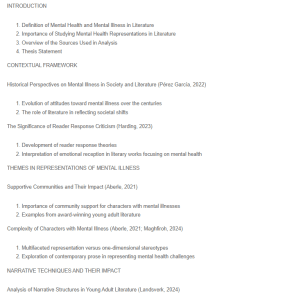
In What Ways Does Literature View and Represent Mental Health and Mental Illness
Historical Perspectives on Mental Illness in Society and Literature (Pérez García, 2022)
- Evolution of attitudes toward mental illness over the centuries
- The role of literature in reflecting societal shifts
The Significance of Reader Response Criticism (Harding, 2023)
- Development of reader response theories
- Interpretation of emotional reception in literary works focusing on mental health
THEMES IN REPRESENTATIONS OF MENTAL ILLNESS
Supportive Communities and Their Impact (Aberle, 2021)
- Importance of community support for characters with mental illnesses
- Examples from award-winning young adult literature
Complexity of Characters with Mental Illness (Aberle, 2021; Maghfiroh, 2024)
- Multifaceted representation versus one-dimensional stereotypes
- Exploration of contemporary prose in representing mental health challenges
NARRATIVE TECHNIQUES AND THEIR IMPACT
Analysis of Narrative Structures in Young Adult Literature (Landsverk, 2024)
- The role of narration in shaping perceptions of mental illness
- Comparison of different literary works on mental health themes
The Influence of Emotion and Character Construction (James & Merickel, 2005; Maghfiroh, 2024)
- Emotional engagement as a tool for understanding mental health
- Critique of literature’s capacity to shape societal attitudes towards mental illness
STEREOTYPES AND THEIR CONSEQUENCES
Examination of Prevailing Stereotypes in Literature (Aberle, 2021)
- The tragic victim versus the resilient hero
- The risks of reinforcing negative perceptions through literary portrayals
Literature’s Dual Role as a Reflection and Shaper of Societal Attitudes (Pérez García, 2022; Maghfiroh, 2024)
-
- The challenge of balancing realism with sensitivity in portrayals
CONCLUSION
- Summary of Findings on Literature’s Representation of Mental Health and Illness
- Call for Continued Exploration and Responsible Depiction in Literary Works
- Implications for Educators and Readers in Promoting Empathy Toward Mental Health Issues
References
Aberle, A. (2021). Mental illness representation in young adult literature. Graduate Research Papers. https://scholarworks.uni.edu/grp/1880
Harding, J. R. (2023). Reader response criticism and stylistics. In The Routledge Handbook of Stylistics (pp. 69–86). Routledge.
James, M., & Merickel, A. (2005). Reading literature and writing arguments (2nd ed.). Pearson Prentice Hall.
Landsverk, I. (2024). Stories of experience: Representations of mental illness and suicide in young adult literature [Master Thesis, NTNU]. https://ntnuopen.ntnu.no/ntnu- xmlui/handle/11250/3147670
Maghfiroh, D. (2024). Narratives of mental health in modern prose literature. Journal of Literary Prose and Society, 1(1). https://jlps.polteksci.ac.id/index.php/jlps/article/view/1
Pérez García, A. (2022). Mental illness in English literature: Attitudes and representations. [Bachelor’s thesis, Universidad de Oviedo]. http://hdl.handle.net/10651/63474