
Improving Patient Care and Quality of Life Through Technological Innovations – Type 1 Diabetes Management
SOAP
D.O. is a ten-year-old male Caucasian who has been brought to the hospital by her mother with complaints of weight loss and bed wetting. D.O.’s mother highlights that D.O. has lost 5 kgs in the past two weeks. She has noticed that D.O. consumes more food and is always hungry; therefore, she does not know how he continues to lose weight despite his eating pattern. D.O.’s mother explains that he has been toilet trained, yet he began bed-wetting one month ago. She restricts the number of fluids, such as water and juice, that D.O. takes in the evening and at night to prevent bed wetting without any success. She ensures that D.O. visits the washroom for urination before bedtime, yet he still wets the bed. D.O.’s mother and teachers have noticed changes in his behaviour. The school report states that D.O. is highly irritable and fights with other children.
D.O. is lactose intolerant and has no known allergy to any medication. He was last hospitalized for an open reduction internal surgery in 2020 when he fell during playtime at school. D.O.’s immunization is up to date. However, he has not been vaccinated against COVID-19. His last eye and dental examination were done six months ago. D.O. is in grade 5 at the neighbouring school. He lives with his father, mother, 15-year-old sister, and paternal grandmother. D.O.’s sister and mother are in good health. His father and paternal grandmother are known people with diabetes. D.O.’s paternal grandfather died in a road traffic accident. His maternal grandfather is a known hypertensive, while his maternal grandmother has dementia. D.O.’s parents ensure he lives a healthy life by eating a well-balanced diet and participating in physical activities such as sports. He has been exposed to surroundings where people take alcohol and smoke, but he is aware of the adverse effects of drugs and does not use recreational drugs. He actively participates in sports and loves cycling with his friends.
The patient’s general and endocrinology review of systems shows weight loss. A review of the genitourinary system reveals increased urination and bed wetting, while the gastrointestinal system reveals increased appetite. The patient is irritable but denies depression, a history of suicidal thoughts, anxiety, bipolar disorder, confusion, problems with memory and concentration, or any other mental health problem. Physical assessment reveals dry skin, pale eyes, cold hands and feet, and sunken eyes, which are signs of dehydration. Tests for vital signs showed a weight of 30kgs, blood pressure of 95/65 mmHg, a height of 137cm, BMI of 16, respiratory rate of 26 breaths per minute, pulse rate of 90 beats per minute, a body temperature of 37C, and oxygen saturation of 99%. Although D.O. has had an unexplained weight loss of 5kgs in the last two weeks, his current BMI shows that he has a healthy weight. The evaluation includes urinalysis and blood glucose tests. D.O.’s urinalysis showed positive urine glucose, while the blood glucose test showed elevated blood glucose levels. The random blood glucose test was 250 mg/dL.
Hyperglycemia in type 1 diabetes mellitus is the most likely diagnosis for D.O. He presents with unexplained weight loss, increased urination, irritability, and increased appetite, which are signs and symptoms seen in diabetes mellitus (Syed, 2022). Type 1 diabetes mellitus mostly begins in childhood. D.O. is a ten-year-old, which is an age bracket that falls under childhood. Risk factors of type 1 diabetes mellitus include genetics, where individuals with a first-degree relative suffering from diabetes have an increased risk of suffering from diabetes (Syed, 2022). D.O.’s father, a first-degree relative, is a known diabetic. Also, D.O.’s paternal grandmother, a second-degree relative, is a known diabetic. Due to family history and genetics, D.O. has an increased risk of type 1 diabetes mellitus. A random blood glucose test result of more than 200 mg/dL in a child with classic symptoms of hyperglycemic crisis or hyperglycemia supports a diagnosis of type 1 diabetes mellitus (Syed, 2022). Classical symptoms of hyperglycemia include polyuria, polyphagia, and polydipsia. D.O.’s high random blood glucose of 250 mg/dL plus the classic symptoms of hyperglycemia, which are polyuria and polyphagia, show that D.O. is suffering from hyperglycemia in type 1 diabetes mellitus.
The patient is managed using pharmacological and non-pharmacological therapy. Pharmacological therapy involves the use of insulin therapy to ensure glycemic control. The insulin dose is calculated based on the patient’s current glucose reading. Although D.O. is a 10-year-old child, he must understand the advantages of insulin therapy to ensure compliance. Children need monitoring; therefore, D.O.’s parents are educated on the importance of ensuring that D.O. has his daily insulin therapy. D.O.’s parents are taught how to administer insulin through injections and storage. D.O.’s insulin injections are done daily at a 45-degree angle. D.O.’s parents are educated on how to identify hypoglycemia. In addition, D.O.’s diet plan must factor in his diagnosis. His mother and other family members should ensure his diet is healthy and balanced with low fat, high fibre, and high carbohydrates. Type 1 diabetes has no exercise restrictions; therefore, D.O. can continue participating in sporting activities he loves.
The Objective of the Paper
The objective of this paper is to study Brew et al. (2022) and American Diabetes Association (ADA) guidelines (ADA Professional Practice Committee (ADA, PPC), 2022) on the use of technology in improving patient outcomes and quality of life in type 1 diabetes mellitus patients.
The Rationale for Topic Selection
The topic is using state-of-the-art devices to manage type 1 diabetes mellitus. The advancement of technology in healthcare has redefined patient care and service delivery for health workers and patients. Technological advancements that target the management of type 1 diabetes mellitus aim to improve patient outcomes. In the wake of COVID-19, technology advancements such as telemedicine were used to increase accessibility to quality and timely healthcare services and decrease the number of hospital visits made by type 1 diabetes mellitus patients (Cahan et al., 2022). Advanced technologies used for the management of diabetes include telemedicine, insulin delivery systems, continuous glucose monitoring, and closed-loop systems.
A Review of Critical Concepts
Continuous Glucose Monitoring
Glucose monitoring is conducted through continuous glucose monitoring (CGM), self-monitoring of blood glucose, or flash glucose monitoring systems (Brew et al., 2022). CGM is effective in glycemic control in children with type 1 diabetes mellitus. CGMs are used to detect hyperglycemia and hypoglycemia. Hyperglycemia signifies that the patient’s current insulin dose is ineffective, while hypoglycemia signifies that the patient’s current insulin dose is too high. Although children of a certain age can comprehend CGM, it is crucial to ensure they are monitored by adults such as their parents or guardians.
Insulin Delivery Systems
Insulin delivery systems used in children and young people with type 1 diabetes include insulin pumps. Insulin pumps are selected for type 1 diabetes mellitus patients who need continuous subcutaneous insulin infusion (Brew et al., 2022). Both guidelines recommended using smartphone applications to collect, store, and track glucose readings. Brew et al. (2022) highlight that smartphones are used as external processors for data collection between insulin delivery and glucose monitoring systems.
Closed Loop Systems
There should be a means of communication between glucose monitoring systems and insulin delivery systems. According to Brew et al. (2022), hybris closed loop systems facilitate communication between CGM and an infusion pump and send the data to an external processor such as a smartphone.
The Multiplicity of Viewpoints
Although the use of technology in diabetes has improved patient outcomes and quality of life, the effect of these technologies on the relationship between young people and their caregivers should be considered (Brew et al., 2022). The readings obtained from CGM usually differ from those obtained through a fingerstick, which makes CGM questionable. Readings on CGM that show hyperglycemia encourage a patient to continuously administer insulin, hoping that the glucose levels will fall. On the other hand, readings that show hypoglycemia encourage a patient to skip insulin administration (ADA-PPC, 2022). Critics argue that a patient should immediately visit a hospital in case of an abnormal reading.
Soundness of Research
The ADA-PPC (2022) and Brew et al. (2022) guidelines were developed through systematic reviews. Brew et al. (2022) used seventeen articles for a systematic literature review. The selected articles met the inclusion criteria by including glucose sensors, remote monitoring systems, and insulin pumps. The inclusion criteria showed that sound research was used. Similarly, the ADA-PPC (2022) guidelines are level 1 and evidence-based, showing that sound research was used.
Evaluation of EBM Guidelines
Brew et al. (2022) used 17 articles that fit the inclusion criteria. The articles used in Brew et al. (2022) were published between 2007 and 2019, while the ADA-PPC (2022) used 228 articles published between 2000 and 2021. Brew et al.’s (2022) guidelines are based on outdated data compared to ADA-PPC (2022). Brew et al. (2022) used 17 articles, while ADA-PPC (2022) guidelines are based on 228 articles, which shows that ADA-PPC (2022) has an enormous scope of researched information.
The Impact of Evidence on Practice
Evidence obtained from the two guidelines will be implemented to ensure the quality of life and improved patient outcomes for type 1 diabetes mellitus patients. The current positive impacts will encourage other patients to adhere to their therapy.
Cultural, Spiritual, and Socioeconomic Issues
ADA-PPC (2022) highlighted the need to ensure cost-effective technology in managing diabetes. Brew et al. (2022) recommended further research on the impact of technology’s size, cost, and usability in managing diabetes. Cultural and spiritual issues were not highlighted in the guidelines.
Conclusion
Technological advancements in managing type 1 diabetes mellitus include insulin delivery systems, continuous glucose monitoring, and closed-loop systems. Advancements that are yet to be fully embraced include the use of telemedicine. Guidelines highlight that the use of technology has led to improved quality of life. Advancements such as telemedicine need further research and training to ensure positive outcomes. The impact of technology should be addressed in all areas, including their cost and usability.
References
American Diabetes Association Professional Practice Committee. (2022). Diabetes technology: Standards of medical care in diabetes—2022. Diabetes Care, 45(1), 97–112. https://doi.org/10.2337/dc22-s007
Brew-Sam, N., Chhabra, M., Parkinson, A., Hannan, K., Brown, E., Pedley, L., & Desborough, J. (2021). Experiences of young people and their caregivers of using technology to manage type 1 diabetes mellitus: systematic literature review and narrative synthesis. JMIR diabetes, 6(1), e20973.
Cahan, E. M., Maturi, J., Bailey, P., Fernandes, S., Addala, A., Kibrom, S., Krissberg, J. R., Smith, S. M., Shah, S., Wang, E., Saynina, O., Wise, P. H., & Chamberlain, L. J. (2022). The Impact of Telehealth Adoption During COVID-19 Pandemic on Patterns of Pediatric Subspecialty Care Utilization. Academic pediatrics, S1876-2859(22)00169–3. Advanced online publication. https://doi.org/10.1016/j.acap.2022.03.010.
Syed F. Z. (2022). Type 1 Diabetes Mellitus. Annals of Internal Medicine, 175(3), ITC33–ITC48. https://doi.org/10.7326/AITC202203150.
ORDER A PLAGIARISM-FREE PAPER HERE
We’ll write everything from scratch
Question 
Improving Patient Care and Quality
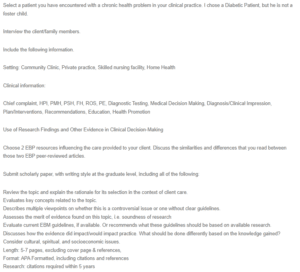
Select a patient you have encountered with a chronic health problem in your clinical practice. I chose a Diabetic Patient, but he is not a foster child.
Interview the client/family members.
Include the following information.
Setting: Community Clinic, Private practice, Skilled nursing facility, Home Health
Clinical information:
Chief complaint, HPI, PMH, PSH, FH, ROS, PE, Diagnostic Testing, Medical Decision Making, Diagnosis/Clinical Impression, Plan/Interventions, Recommendations, Education, Health Promotion
Use of Research Findings and Other Evidence in Clinical Decision-Making
Choose 2 EBP resources influencing the care provided to your client. Discuss the similarities and differences that you read between those two EBP peer-reviewed articles.
Submit scholarly paper, with writing style at the graduate level, including all of the following:
Review the topic and explain the rationale for its selection in the context of client care.
Evaluates key concepts related to the topic.
Describes multiple viewpoints on whether this is a controversial issue or one without clear guidelines.
Assesses the merit of evidence found on this topic, i.e. soundness of research
Evaluate current EBM guidelines, if available. Or recommends what these guidelines should be based on available research.
Discusses how the evidence did impact/would impact practice. What should be done differently based on the knowledge gained?
Consider cultural, spiritual, and socioeconomic issues.
Length: 5-7 pages, excluding cover page & references,
Format: APA Formatted, including citations and references
Research: citations required within 5 years